GOP battles itself over defense funding
In today’s issue: ▪ Reconciliation push faces obstacles ▪ Trump to give presser on Asia trip ▪ Senate passes permitting reform bill ▪ U.N. court finds Myanmar guilty of genocide Republicans in Washington are struggling to find a path forward on the Pentagon’s $350 billion reconciliation ask, as President Trump pushes lawmakers to approve more funding…
▪ U.N. court finds Myanmar guilty of genocide
Republicans in Washington are struggling to find a path forward on the Pentagon’s $350 billion reconciliation ask, as President Trump pushes lawmakers to approve more funding before Democrats take control in January.
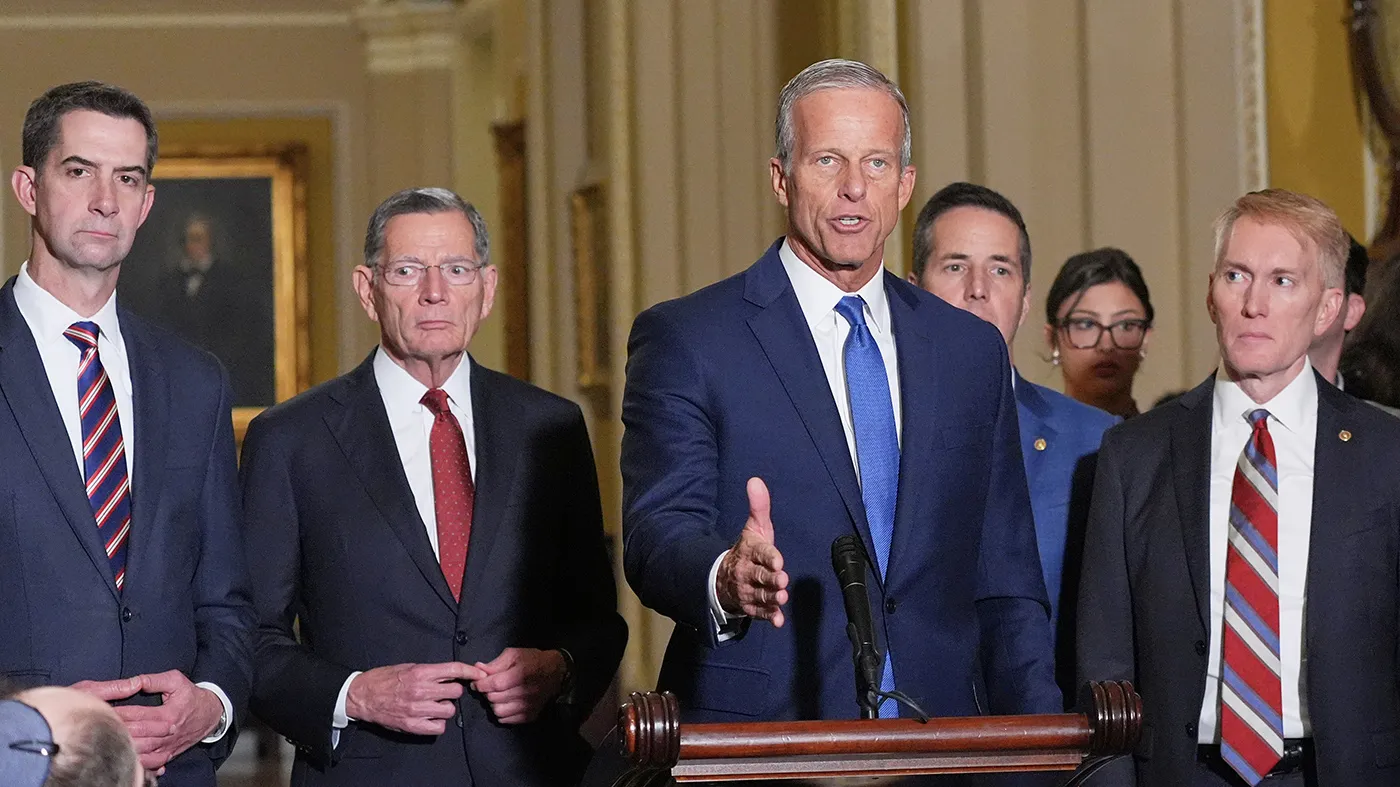
After multiple conference meetings this week to discuss the administration’s request for a party-line push, Senate Majority Leader John Thune (R-S.D.) signaled he would first try a different approach.
“We want to explore all the possibilities for funding the military, one of which would be seeing whether or not there’s an appetite on the Democrat side to do it,” Thune said Wednesday after meeting with his conference.
“I don’t know that they will. But we think that we ought to at least explore that possibility ,” he added.
Senate Republicans have warned that the president’s push for GOP leaders to rely on budget reconciliation — which would bypass the need for Democratic input — could risk a government shutdown, as the Dec. 11 deadline to keep the government funded fast approaches.
It could also derail progress on the nearly $1.1 trillion defense appropriations bill for fiscal 2027 and accompanying National Defense Authorization Act. House Armed Services Chair Mike Rogers (R-Ala.) said Thursday that the must-pass defense bill could be ready for a vote after Thanksgiving.
Some Senate Democrats have signaled that they are looking to use that looming Dec. 11 government funding deadline to force the White House to end the war with Iran, which has lasted more than eight months.
Sens. Tammy Duckworth (D-Ill.) and Kirsten Gillibrand (D-N.Y.) announced on Thursday that they will move to add an amendment to appropriations bills to block funding for offensive operations against Iran.
So far, the Pentagon has shown no signs of backing off its call on Capitol Hill to push through the $350 billion party-line package, which would include funding to expand weapons production and replenish stockpiles used in the Iran war, along with funding for minerals, artificial intelligence and the president’s Golden Dome missile defense initiative.
Pentagon Deputy Secretary Steve Feinberg joined the Senate GOP l unch on Wednesday to discuss the package, The Hill’s Filip Timotija and Helen Huiskes reported. Republicans were still split after the meeting.
Sen. Ron Johnson (R-Wis.) told reporters afterward that reconciliation will “probably not” happen this week, but added, “ We are not taking it off the table at all.”
Sen. Chuck Grassley (R-Iowa) said he supports the $350 billion package, noting that discussions were ongoing, while Sen. Rand Paul (R-Ky.) nodded to the midterm losses while discussing his opposition to the proposal.
“I’m not for a partisan Republican bill to spend more money or borrow more money,” Paul said, The Washington Post reported. “There’s quite a few of them that I guess did not, were not aware of what happened with the election recently. All the exit polling showed that people were upset about the price of gas and the Iran war.”
Sen. John Cornyn (R-Texas), meanwhile, left the meeting describing the internal debate as a “jump ball.”
“Everybody recognizes it’s going to be a herculean effort to get the House and the Senate in terms of the scope and the process,” Cornyn told reporters after leaving the meeting.
Over on the House side, the prospects of getting $350 billion across the finish line are not looking much better. Rogers signaled there could be a path forward on a smaller package.
“By the way, 350 is not going to happen. You may have guessed that, but a reconciliation bill is still possible. It’s going to have to be skinny down to deal with first and foremost the hole in the defense budget that Venezuela and Iran have created,” Rogers said during a Hudson Institute event this week.
The Iran war also appears to be causing growing turmoil in the White House. The New York Times reported Trump has grown frustrated with Vice President Vance for his post-midterm assessment that the Iran war was to blame for GOP losses.
Senate Republicans were largely united in blocking a war powers measure yesterday that would have directed the president to end hostilities in Iran. The White House has noted, however, that, even if it passed as a concurrent resolution, the measure would mostly be symbolic and not be enforceable.
The vote failed 48-51. Republican Sens. Susan Collins (Maine), Lisa Murkowski (Alaska) and Paul, who have all voted for similar Iran war powers resolutions in the past, joined all Democrats except Sen. John Fetterman (Pa.) in backing the measure.
“I’ve supported some. I mean, you do know resolutions differ from each one. This one doesn’t go to the president, so it’s just a statement from Congress,” S en. Thom Tillis (R-N.C.) said, nodding to his past support for other versions of the resolution. “I’ve made that statement. I don’t need to vote on a Democrat resolution to make that statement.”
▪ The Hill : Exiting GOP senators become liability for Trump.
▪ The Hill Insider : House Republicans race for key roles in fight over Trump probes.
Republicans have less than a month of legislating time left in Washington, D.C. before the Democratic-controlled Congress takes over in January. Rep. Ryan Zinke (R-Mont.) is one of the many Republicans on his way out, as he chose not to seek reelection. Part of the report card for Republicans over the past two years includes continuing to rack up multi-trillion-dollar deficits. I asked Zinke if he viewed that as a failure.
“I would describe it as punting. Every time a tough issue comes out, what does Congress do? Punts,” Zinke said . “We’ve been punting for a long time.”
The Democratic record is the same, a roughly equal contributor over time to the current $40 trillion national debt. That’s a longer-term issue that likely isn’t going to be solved anytime soon. For now, both sides need to come together before December to simply make sure the government doesn’t shut down over the holidays.
Burman hosts “The Hill” weeknights, 6 p.m. EST/5 p.m. CST on NewsNation.
The Department of Justice has filed to dismiss its lawsuit seeking to block the certification of Alaska’s Senate race if Mary Peltola (D) won, following projections of her victory. The DOJ argued a third candidate named Dan J. Sullivan could confuse voters and cost Sen. Dan Sullivan (R) the race, but Peltola received more votes than both Sullivans combined, undermining that argument.
The House Ethics Committee voted to adopt a collection of rules changes to expedite sexual misconduct investigations in the chamber and increase transparency. Lawmakers from both parties have called for faster probes into allegations of misconduct following a string of high-profile cases against members this term.
National Cyber Director Sean Cairncross has been let go from his position, and Defense Department Chief Information Officer Kirsten Davies will take over in an acting capacity, a White House official confirmed Thursday . The official said the president supported the decision to let Cairncross go, believing he didn’t have the proper cyber credentials for the role.
President Trump boards Air Force One at Shenzhen Baoan International Airport after attending the Asia-Pacific Economic Cooperation (APEC) summit in Shenzhen in southern China’s Guangdong province, Nov. 19, 2026. (Mark Schiefelbein, Associated Press)
REPORTING BACK : Trump is set to hold a press conference today at noon following his return from a multiday trip to Asia to tout achievements from the two summits he attended.
He called the trip to China, in which he met with both Chinese President Xi Jinping and Russian President Vladimir Putin , “great and highly consequential” in a Truth Social post Thursday announcing the presser at the White House. He said he would also discuss trade deals that were made with Thailand, the Philippines and others during his stop in the Manila for the Association of Southeast Asian Nations conference.
The most high-profile part of the entire trip was the unprecedented trilateral meeting Trump had with Xi and Putin. The leaders agreed to a four-point “peace declaration” to engage in ongoing dialogue on nuclear nonproliferation.
Trump’s kind words for both dictators also stirred an uneasy reaction from critics who have denounced his warm relations with America’s most powerful rivals.
Trump did not hold a press conference in Asia before leaving, which presidents typically do at the end of high-profile visits abroad. Media coverage of the visit was also tightly controlled.
▪ The Hill : Five takeaways on Trump’s summit with Xi, Putin.
▪ The Hill : The Memo: Embattled Trump seeks reset with news conference.
TIME PERMITTING : The Senate has approved a key permitting reform bill to speed up the buildout of the country’s energy and infrastructure projects, but now the test will be if the legislation has the time and support to get through the House .
The upper chamber passed the bill by a vote of 62-33 on Thursday, with backing from most Republicans and some Democrats. The bill seeks to address complaints from various industries that building in the U.S. takes too long, while opponents argue it would be bad for the environment through loosening environmental laws and bolstering fossil fuels and mining.
The bill is expected to have bipartisan support in the House, though Democrats are split on the provisions. And the main hurdle could be the limited time left before the end of the term with an already crowded lame-duck calendar.
▪ The Washington Post : Congress may pass biggest environmental bill in decades.
▪ TIME : Why the bill is dividing environmental, energy advocates.
CLIMATE COUNTDOWN: Today is the deadline for global leaders to reach a climate agreement at the COP31 summit in Turkey, as disagreements over fossil fuels and funding for developing nations threaten to send the negotiations into overtime.
The United Nations climate summit, slated to take place Nov. 9 to 20, brought together negotiators from nearly 200 countries to work on the agreement. But a revised draft released Thursday dropped explicit references to fossil fuels, drawing backlash from climate activists and from countries pushing for stronger commitments to transition away from coal, oil and gas. The draft also removed a proposed $120 billion annual target for funding to help developing countries adapt to climate change.
Countries must reach a consensus to adopt a final agreement, but negotiations have frequently run past their scheduled end dates and could continue into the weekend if the countries fail to resolve their differences in time.
▪ The New York Times : ‘ Shocking’ signs of climate change add urgency to latest talks.
▪ The Hill : Data center fight snarls amendment votes on energy bill.
RECORD LAUNCH : The AI giant Anthropic went public on Thursday with a record-breaking initial public offering (IPO) that surpassed $80 billion.
The firm announced Wednesday that certain stockholders sold 980 million shares of the company’s stock valued at $83 per share. Anthropic then opened at $111.50 per share upon its opening on the stock market, trading under the ticker “ANT.”
The stock finished just above $97 per share at the end of the day. Elon Musk ‘s SpaceX previously held the record for an IPO, raising $75 billion as it went public at $150 per share in June.
▪ The Hill : Federal Reserve vice chair says AI exerting pressure on inflation.
▪ The Hill : Xavier Becerra suggests prosecution for AI attacks.
The president will hold a news conference at noon. He will participate in signing time at 1 p.m. and host a reception at the White House helipad at 3:30 p.m.
The House will convene at 10:30 a.m. for a pro forma session.
Sen Bernie Moreno (R-Ohio) speaks during an event at the renamed Donald J Trump Institute of Peace, Sept. 3, 2026, in Washington. (Jacquelyn Martin, Associated Press)
CAPITOL CRYPTO FORUM : What will the incoming Congress mean for the cryptocurrency industry? That question dominated conversation with lawmakers and industry leaders at The Hill’s “Capitol Crypto Forum” on Thursday.
Members of both parties expressed some cautious optimism that a key bill setting a federal regulatory framework for the crypto industry could have a path forward in the next session of Congress.
Rep. French Hill (R-Ark.), the chair of the House Financial Services Committee, pointed to the 78 House Democrats who supported the Clarity Act as evidence that the industry has support across the aisle.
Sen. Bernie Moreno (R-Ohio) said he had conversations with Sen. Elizabeth Warren (D-Mass.), a longtime crypto critic, in which she said she wants regulations in place.
“I’ll blow all your minds. I’ve had conversations with Elizabeth Warren, where she says, ‘I want the industry regulated. I just don’t want the industry to write the regulations,’” Moreno said.
The Clarity Act stalled in the Senate in September, leaving many wondering if Congress missed its best chance at passing the top item on crypto’s legislative agenda.
At the same time, crypto has found itself caught in the midst of a political crossfire as the industry spent millions to support crypto-friendly candidates in the midterms and was handed some major defeats . There’s also internal divisions within the Democratic Party on its stance, said Peter Van Valkenburgh , the executive director of Coin Center.
“There’s a very strong anti-tech vision being articulated in parts of the Democratic Party, and the voices for a tech-forward Democratic Party, they haven’t found their song yet,” he said.
▪ The Hill : Five takeaways as crypto industry stares down new Congress.
▪ Politico : Crypto faces blue wave reckoning.
Judge Yuji Iwasawa, center right, president of the International Court of Justice, stands in the courtroom before a ruling on whether Myanmar committed genocide against the Rohingya during the 2017 military operations at the International Court of Justice in The Hague, Netherlands, Nov. 19, 2026. (Patrick Post, Associated Press)
LANDMARK RULING : The United Nations’s highest court has found that Myanmar has committed genocide against the Rohingya Muslim population, an ethnic minority in the southeast Asian country.
The decision marks the first time ever that the International Court of Justice (ICJ) has held a state responsible for committing genocide through violations of the 1948 Genocide Convention, which was adopted in the aftermath of the Holocaust.
The ICJ and other international courts have previously recognized that genocide took place in three countries — Cambodia under the Khmer Rouge in the 1970s, Rwanda in 1994 and Bosnia with respect to the Srebrenica killings in 1995. But this is the first time that a state itself has been declared responsible for a genocide.
The court stated that Myanmar’s military, police and border guards killed about 10,000 Rohingya civilians in incidents that included mass shootings, sexual violence and arson. The attacks led more than 810,000 civilians out of the Myanmar state of Rakhine to seek refuge in Bangladesh.
The ICJ ordered Myanmar to immediately cease all ongoing violations, take steps to investigate those suspected of committing acts of genocide, ensure acts of genocide don’t continue and adopt measures to bring restitution to the Rohingya. It gave a two-year timeline for the country to report back on these efforts.
Gambia, a largely Muslim country in Africa, first filed the case against Myanmar seven years ago following the “clearance operations” there in 2017.
ICJ President Yuji Iwasawa said nine judges on the court voted in favor of the ruling and six dissented.
Myanmar has been in the midst of a civil war between the military and pro-democracy resistance forces since 2021. The country has previously denied accusations of genocide.
▪ The New York Times : What to know about the case.
▪ Al Jazeera : World reacts to ICJ finding.
A course correction with lessons for both parties , Rep. James Clyburn (D-S.C.) writes in The Hill.
The GLP-1 blind spot: Why the FDA’s new eye stroke warning matters , Eric Wargotz writes in The Hill.
The late Rep. Don Young (R-Alaska) is shown prior to a 2018 debate in Anchorage, Alaska. (Mark Thiessen, Associated Press file)
And finally … 👏👏👏 Congrats to this week’s Morning Report quiz winners ! Their answers were foolproof for this quiz on the history of Native American representation and Alaska’s unique political identity.
Here’s who went 4/4: Stan Wasser, Chuck Schoenenberger, Lou Tisler, Sari Wisch, Harry Strulovici, Richard Baznik, Peter Sprofera, Michael Salanik, Jess Elger, Rick Schmidtke, Meg Whitehouse, Jenessa Wagner, Ned Sauthoff, Linda L. Field, Leslie Hurst, Gail White, Carmine Petracca, Mark R. Williamson, Steve Comer and Savannah Petracca .
Charles Curtis , who served as vice president for Herbert Hoover, was the first Native American elected to the Senate and the first to serve in the second-highest office. He was a member of the Kaw tribe.
Homeland Security Secretary Markwayne Mullin is a tribal citizen as an enrolled member of the Cherokee Nation.
Alaska has voted for a Democratic presidential nominee only once , when it voted for Lyndon Johnson in his 1964 landslide victory.
Longtime former Rep. Don Young (R) was known as Alaska’s “third senator” given his longevity and stature in the state as its only House member . The other three options were actual senators.
Topics in this story
Gathered from external sources. Rights to this text belong to whoever originally published it.