How new Democratic trifectas could reshape the 2028 presidential election
A string of Democratic victories in state legislatures has put Electoral College reform in the spotlight ahead of 2028. After Democrats clinched trifectas in Michigan, Wisconsin, Pennsylvania, Arizona and Nevada, activists are eager to pass legislation — the National Popular Vote Interstate Compact — that would require participating states to pledge all their electoral votes to…
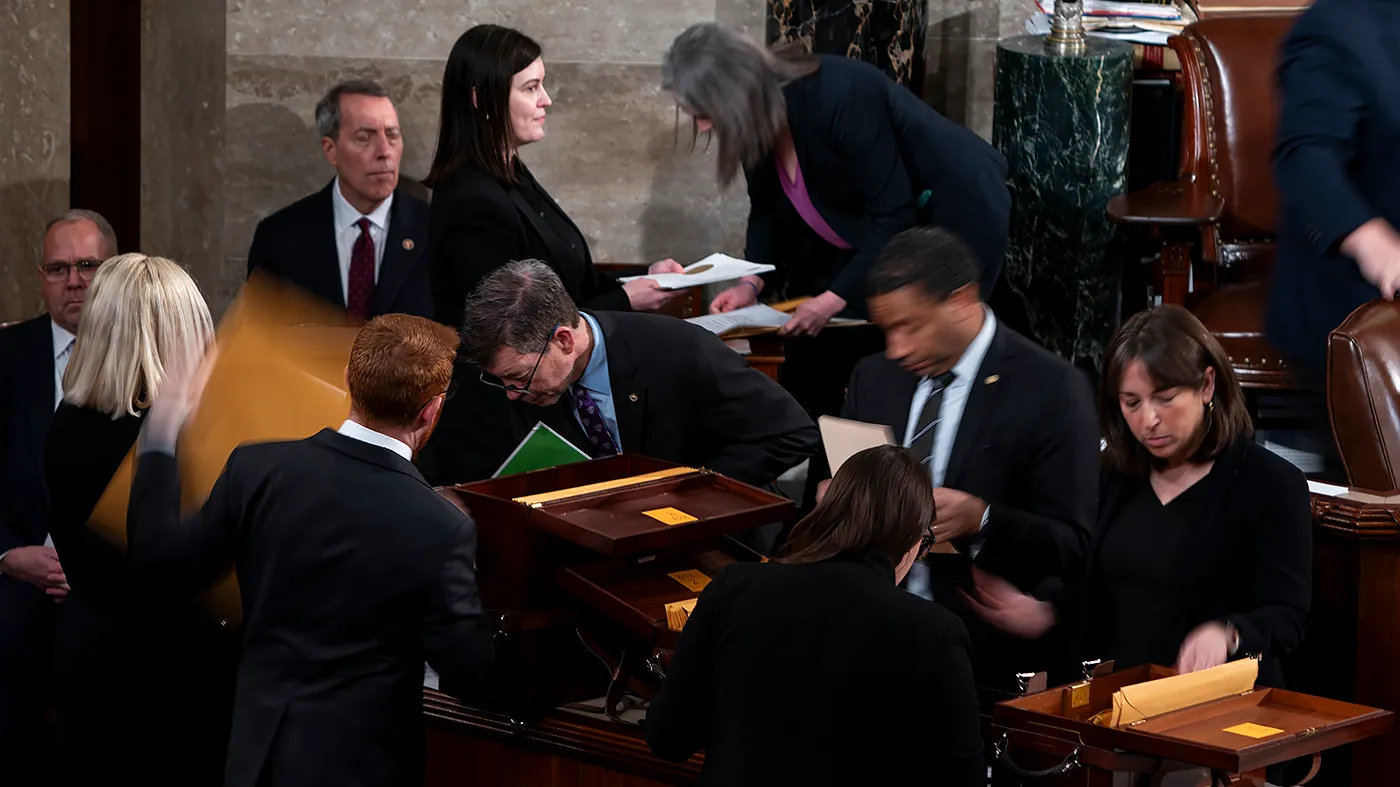
A string of Democratic victories in state legislatures has put Electoral College reform in the spotlight ahead of 2028.
After Democrats clinched trifectas in Michigan, Wisconsin, Pennsylvania, Arizona and Nevada, activists are eager to pass legislation — the National Popular Vote Interstate Compact — that would require participating states to pledge all their electoral votes to the winner of the popular vote.
The compact has support from 18 states and Washington, D.C., making up 222 Electoral College votes, and proponents of the compact need states that represent 48 more electoral votes to greenlight the agreement.
But bypassing the Electoral College will be easier said than done as election law experts caution the compact may require approval from Congress and may invite possible litigation should the states charge ahead.
“The whole point is that these compacting states are trying to change the way we run elections, but it also affects essentially how all the noncompacting states participate,” explained Derek Muller, a University of Notre Dame Law School professor who said he believes the move would require congressional approval.
The Electoral College was created by the Founding Fathers as a compromise between those who wanted Congress involved in electing the president and those who preferred that citizens directly elect the president.
The number of Electoral College votes each state receives is based on the number of the state’s congressional districts in addition to one vote for each of its two senators, meaning the smallest states have at least three Electoral College votes.
This system for electing presidents has come under fire in instances where the president didn’t win the popular vote.
Five presidents have won the Electoral College but lost the national vote. President Trump’s 2016 election was the last time this occurred.
Advocates of the national popular vote argue the system does a better job of reflecting what the plurality of the people in the country want.
“As a conservative trapped behind the blue wall of Minnesota — the only state that voted for Walter Mondale — I didn’t feel like my vote counted in presidential elections in my lifetime,” Patrick Rosenstiel, who’s backing efforts to change the presidential electoral system to the national popular vote, told The Hill, referencing former Vice President Walter Mondale’s unsuccessful White House run against former President Reagan in 1984.
“One person, one vote is a foundational principle of American democracy,” he added.
Should Pennsylvania, Michigan and Wisconsin pass the interstate compact, it would bring the number of electoral votes in support of the move to 266. Advocates would then only need Arizona or Nevada to sign on to tip over the 270 vote threshold for the compact to theoretically go into effect.
So far, only Pennsylvania Gov. Josh Shapiro (D), seen as a likely 2028 contender , and Wisconsin Gov.-elect David Crowley (D) have appeared to express interest in pursuing national popular vote legislation in their states.
Other Democrats have been less clear on where they stand. Arizona Gov. Katie Hobbs (D) declined to say whether there was support for the interstate compact in the state during a recent interview with AZ Family . Nevada’s Gov.-elect Aaron Ford (D) told The Hill that he is focused on affordability and “there will be a time to talk about presidential elections.”
The office of Gov.-elect Jocelyn Benson (D) of Michigan did not respond to The Hill’s request for comment. She has not publicly expressed her stance on the issue.
Even if enough states join the interstate compact, experts point to plenty of legal hurdles and logistical challenges that could hinder its implementation.
First, there are questions around whether the interstate compact would require approval from Congress.
The Constitution states : “No State shall, without the Consent of Congress … enter into any Agreement or Compact with another State.” Muller, however, noted the Supreme Court has interpreted that clause to mean that only certain compacts are subject to the requirement.
“A lot of times over the years the court has looked at compacts, even if Congress hasn’t consented, and said, ‘Well, that’s OK. … It doesn’t really affect the balance of power with the federal government. Doesn’t affect other states, so we’re OK with it.’” Muller said.
Muller suggested the current Supreme Court, which places emphasis on adhering to the constitutional text, “is probably going to be more skeptical of those kinds of claims that may have been popular 50 years ago.”
But there are also questions about what the implementation of the compact would mean for states that didn’t sign on to the pledge. Muller used Alabama as a hypothetical. The state has not entered the interstate compact, objecting to awarding its electoral votes to the candidate who wins the national popular vote.
“Alabama, which is not a part of the compact, might look back and say, ‘Wait a minute, you all changed the rules for how we do our presidential elections,’ and we really had no say in that,” he continued. “And so, to me, that is a pretty significant change in power for states that don’t enter into the compact.”
If implemented for 2028, it would introduce unanswered questions about what would happen if a compacting state’s population decreased, reducing its number of Electoral College votes and scrambling the required 270-vote threshold.
Electoral votes are allocated on the basis of the U.S. census, which is conducted every 10 years. If the population of one or more compacting states drops in the 2030 census, it’s unclear whether it would prompt the elimination of the winner-take-all system for the 2032 presidential election.
Some opponents also argue the national vote compact could make campaigning incredibly expensive, as it would force candidates to compete for every vote across the map. And even then, campaigns may decide to prioritize denser areas over more sparsely populated ones.
“They would still slice and dice up the electorate to try to figure out who to talk to, who not to talk to, what to say to which group of people,” Trent England, founder and executive director of Save Our States, told The Hill, adding that the “national popular vote doesn’t take the politics out of politics.”
Rosenstiel, however, argued those hurdles can be overcome. He suggested Congress may not even need to sign off on the interstate compact if enough states sign on, and he asserted the move would not encroach on federal supremacy.
“The National Popular Vote Interstate Compact doesn’t even involve a federal power,” he said.
Rosenstiel also suggested the national popular vote would encourage parties to put their best candidates forward. Presidential hopefuls would have to make the case to more of the electorate in states that regularly take a back seat on the campaign trail.
“It’d probably make campaigning even more expensive because you would have to travel the entire country and campaign everywhere,” Robert Alexander, director of the Bowling Green State University Democracy and Public Policy Network and a political science professor, said.
“But what’s so wrong with campaigning everywhere to be president of the United States?” he quipped.
Topics in this story
Gathered from external sources. Rights to this text belong to whoever originally published it.