Will Trump’s payout promises boost Republican appeal to white women?
As the midterm elections approach, analysts are questioning whether Donald Trump’s strategy of appealing to white women through promises of protection and financial incentives will overcome voter dissatisfaction with inflation and economic conditions.
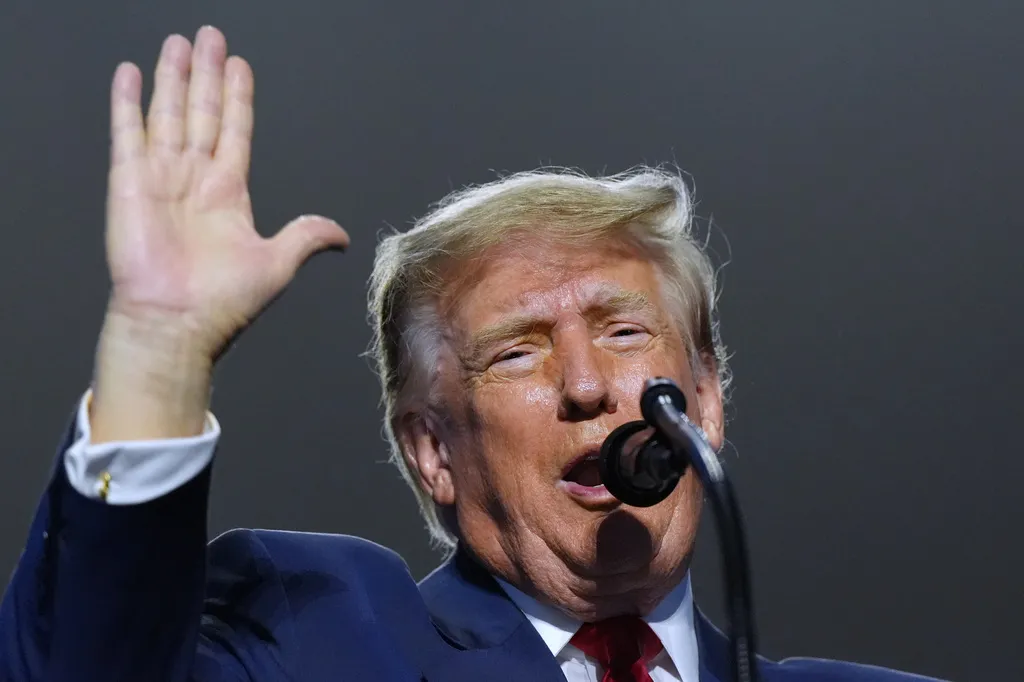
President Trump was recently discovered to have given $45,000 to three people who work closely with him at the White House.
No surprise — all three are young women.
One woman is credited with having the U.S. issue a gold coin featuring Trump’s image — a first for any sitting president. A second woman follows him to record flattering videos for social media. And the third woman is a steady presence at his side to give him news updates. She is a leading hand in producing social media shorts featuring him as a superhero.
It is hard to ignore all the news about Trump and women as the midterms approach. In August, he lost an effort to have the Supreme Court overturn a jury verdict convicting him of sexual abuse. He had to pay $5 million. Also last month, Sen. Jon Ossoff (D-Ga.) stirred attention to one of the president’s female aides, Natalie Harp, with a suggestive comment, even before it was known that Trump had gifted her $45,000.
Ossoff told a rally that Trump is too busy to deal with high inflation and resolving the war in Iran. He said Trump prefers to “build his ballroom and travel with Natalie.”
Later, some letters Harp wrote to Trump were revealed. She wrote : “You are all that matters to me,” and described him as her “guardian and protector in this life.”
Throughout the summer, Trump made a habit of insulting several leading women journalists, including Maggie Haberman of the New York Times, Shannon Bream of Fox News and Kaitlan Collins of CNN.
He recently described Haberman as “an unattractive person both inside and out,” and made fun of her first name by referring to her as “Maggot…”
He lashed out at Collins in personal terms as “very dumb and unhappy.” In a patronizing reproach he told her to smile more.
Most white women — the largest segment of voters — voted for Trump in 2016, 2020 and 2024. That is in line with white men. No Democrat running for the White House has won the white vote since 1964 . But although white men have overwhelmingly supported Trump, the thrice-married Trump has struggled to maintain the majority support he gets from white women.
During the 2024 campaign Trump famously appealed to women by pledging to “protect the women of our country.” Aides warned him that those words might be taken as overbearing and patriarchal, but Trump ignored them.
Instead, he told women of the threat of “criminal migrants,” crossing the southern border to “assault, rape and murder our women and girls.” He asked for the vote of women in the crowd of white, Milwaukee suburbanites by saying “whether the women like it or not, I’m going to protect them.”
Trump’s direct appeal to white women voters as their protector appears to have had its most success with evangelicals.
“Sixty-eight percent of white women identify as Christian, and in 2024, two-thirds of those — and more than eight in 10 white evangelical women — voted for President Trump, while nearly eight in 10 white women with no religious affiliation voted for Vice President Kamala Harris,” wrote Kristin Kobes Du Mez of the Public Religion Research Institute .
Du Mez made the case that conservative evangelical women backed Trump as a man who “surrounded himself with beautiful women, boasted of his wealth, reveled in crass displays of power and promised to use that power to ‘protect Christianity.'”
Trump’s record of success in winning the votes of white women includes persuading them against voting for two women, one a white woman, to be the first female president.
With Trump’s current approval hitting new lows the question for white women voters as the midterms approach is whether Trump’s appeal outweighs the reality of high gas prices, groceries that cost more, and a widening war in the Middle East.
His latest efforts to defy that reality includes attacks on Democrats as “communists,” and culture wars centered on transgender athletes. But vilifying Democrats cannot indefinitely distract families watching their household finances deteriorate under Trump’s presidency.
Last week, Trump tried to address that problem. He sent a message to every family’s kitchen table concerned with inflation by offering $5,000 if they help Republicans hold their majority in the House and Senate . It is a $1 trillion promise with no legislation attached and sure to boost inflation.
Trump has made similar promises that have gone unfulfilled, including a dividend for taxpayers from all the money he promised to produce with tariffs.
After the 2024 election, there was heightened attention to the increasing turnout by young men drawn to Trump by the so-called online “manosphere.” Less attention focused on the idea that many women voted out of concern for their boyfriends, husbands and sons.
“If your son is in the basement, vaping and playing video games,” said podcaster Scott Galloway, other political priorities like the war in Ukraine can suddenly feel remote.
But now the results suggest Trump did not make life better for men or women or their kids. Will vague promises of $5,000 payouts and news of $45,000 checks for the young women close to him, give Trump a midterms boost with white women?
It smells of a man desperate for attention from women. Stay tuned.
Juan Williams is senior political analyst for Fox News Channel and a prize-winning civil rights historian. He is the author of the new book “ New Prize for These Eyes: The Rise of America’s Second Civil Rights Movement . “
Topics in this story
Gathered from external sources. Rights to this text belong to whoever originally published it.