The Memo: Trump’s latest war on the media met with lawsuit, TV boycott
An all-out confrontation between President Trump and the media escalated Monday, as three banned outlets launched a legal fight, Trump compared some reporting to “cancer,” and five major TV networks came together to announce a de facto boycott of White House pool coverage. It’s a remarkable sequence of events that began with Trump’s Friday announcement…
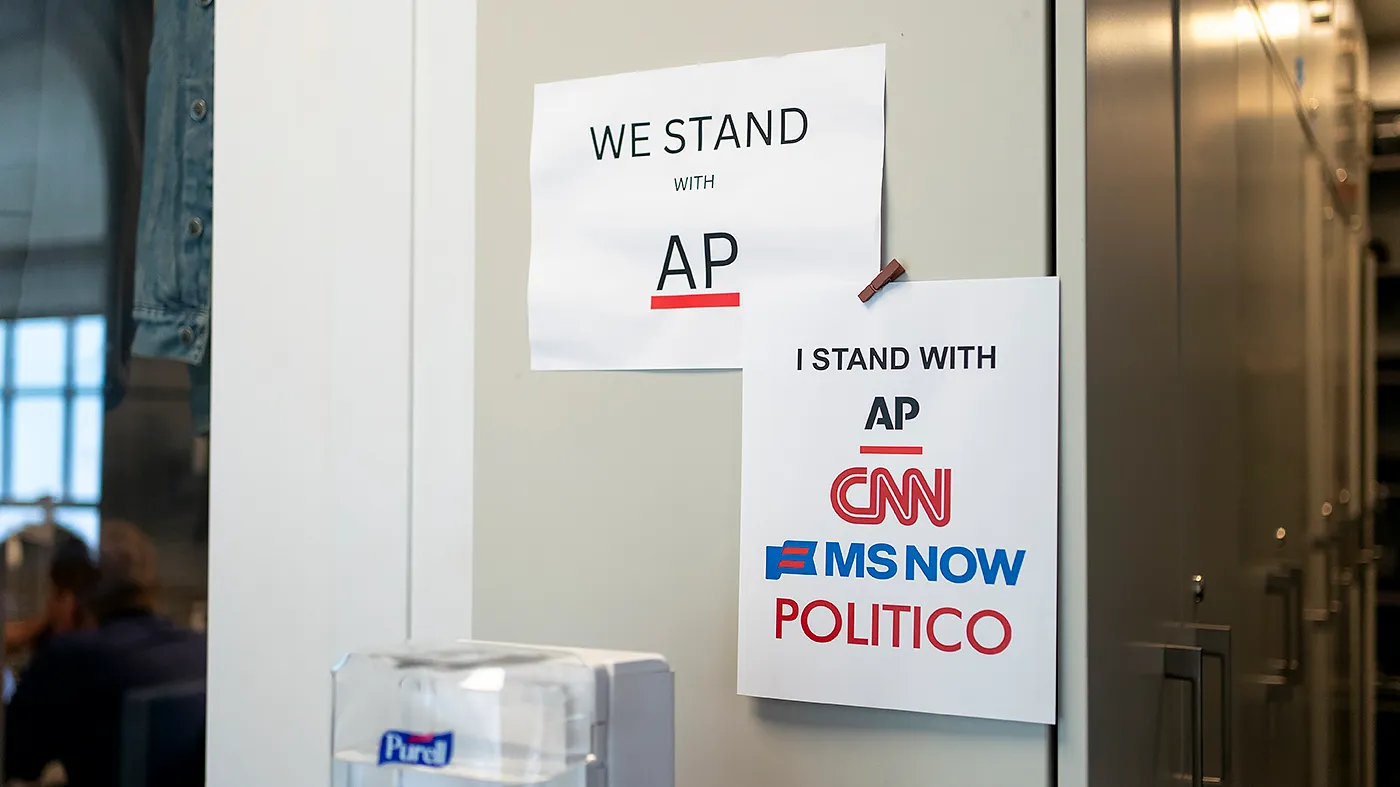
An all-out confrontation between President Trump and the media escalated Monday, as three banned outlets launched a legal fight, Trump compared some reporting to “cancer,” and five major TV networks came together to announce a de facto boycott of White House pool coverage.
It’s a remarkable sequence of events that began with Trump’s Friday announcement that he would ban CNN, MS NOW and Politico from the White House “effective immediately.” Trump made clear that his decision was based upon general grievances with the reporting from those outlets, which he labeled “Fake News” — a term he uses repeatedly about coverage that is not to his liking.
Reporters for all three of the outlets were denied access to the White House complex Saturday, a move that made legal action from their parent companies all but inevitable. The suit was filed Monday morning. It alleged multiple violations of First Amendment rights.
“This ban could not be a more direct assault on the First Amendment nor a more blatant violation of our most fundamental constitutional principles,” the suit argued .
Among the media, and among First Amendment advocates more generally, there is widespread concern that the latest Trump move goes further in seeking to curtail press freedom than any that have come before. This is saying a lot, given that Trump has assailed the media, often in extraordinarily incendiary terms, throughout his decade in political life. He has also sued several outlets.
Right now, the fear on the part of the media is that, if Trump’s action is let stand, almost any outlet could be barred for almost any reason. Conversely, questions would likely arise about the integrity of organizations or individual journalists upon whom the president bestowed a seal of approval.
“I think the president has really gone nuclear here,” Tamara Keith told this column.
Keith, the senior political correspondent for NPR, emphasized she was speaking in her capacity as a former president of the White House Correspondents’ Association (WHCA). Keith was WHCA president for the 2022-23 term. (Disclosure: This writer is also a member of the WHCA.)
“When a president chooses who is in the room and who is asking the questions, then in essence the president is choosing to avoid scrutiny,” Keith said. “And the potential also exists that the public may wonder, ‘Are the people in there, there to serve the president or to serve the public?’”
Steve Scully, who was WHCA president for the 2006-07 term, told this column he was “angry” with Trump’s actions “because this has never happened before and this is truly unprecedented.”
Scully, now the host of SiriusXM’s “The Briefing with Steve Scully,” added, “This should send a shiver down the spine of anyone who supports the law and free speech.”
Scully praised the TV networks that together announced they would not be providing pool footage in protest of the president’s decision. No comparable action has been taken before.
Monday’s decision required solidarity among the “Five Families” that operate a rotating system to furnish the rest of the media, and the world, with TV footage of White House events: ABC News, CBS News, CNN, Fox News and NBC News.
In a joint statement, they wrote: “The public has a vital interest in receiving accurate, independent information about its government. No administration should restrict a news organization because it objects to its reporting.”
Among the people amplifying that statement on social media was Jacqui Heinrich, the current WHCA president and the senior White House correspondent for Fox News.
Heinrich, in her WHCA capacity, had issued a Saturday statement asserting that Trump’s ban “violates the First Amendment” and stating that the association “calls on the administration to immediately restore our colleagues’ access.”
Keith, the former WHCA president, noted the intense competition under normal circumstances between the networks, and, in relation to the de facto boycott added, “This sort of collective action is incredibly rare and reflects the gravity of the moment.”
On Monday afternoon, soon before Trump left for the United Nations in New York, he held a ribbon-cutting ceremony for the new helipad on the South Lawn of the White House. The event was covered on the official White House YouTube channel, but the president’s words were almost entirely inaudible.
Still, Trump is not backing down. Far from it.
His early Monday social media message, in addition to invoking “cancer” in relation to some reporting, also complained about “a threat to our National Security.”
A longer post Monday afternoon complained about the judge to which the news organizations’ suit had been assigned — even though it acknowledged him to be a Trump appointee.
The afternoon post also contended that the Oval Office should be treated with respect and “not defiled by Third Rate Clowns, who purposefully distort, twist, and degrade with everything they write or publish.”
A White House official, asked for further comment during the period between Trump’s two posts, referred this column to the first post and added: “The Fake News has no place demanding a spot in the President’s Oval Office. The lies they smear are a disservice to the American public and tear at the very fabric of our Democracy. They’re completely capable of reporting from directly outside.”
Some criticism of the media, however, comes from exactly the opposite direction.
Some voices — usually on the left, but not always — object to what they see as an overly timid approach from the press corps. They cite examples when Trump has engaged in personal attacks on reporters, especially women, and no other reporter has stepped in to protest.
“The lack of solidarity and respect for their colleagues gave Trump the idea he could single out whoever he wanted — and he could, until today,” said Eric Alterman, a journalist and author who is now the City University of New York distinguished professor of English at Brooklyn College.
Those who failed to show such solidarity, Alterman contended, “bear some responsibility for this. I think many in the mainstream media have exhibited a kind of anticipatory surrender, really, from ABC caving on George Stephanopoulos’s apology, to CBS and ’60 Minutes,’ to the defenestration of the Washington Post. Well, what did you expect?”
Those controversies will likely be dissected in media coverage for years to come.
But for now it’s a new chapter in Trump versus the media.
The president is not for turning. But the reporters believe they have the law — and the Constitution — on their side.
“At the end of the day,” said Scully, “the courts are not going to put up with this.”
The Memo is a reported column by Niall Stanage.
Topics in this story
Gathered from external sources. Rights to this text belong to whoever originally published it.