Can voters learn to stop worrying and love Big AI?
Republican lawmakers and presidential administration policies regarding AI regulation and data centers are clashing with voter concerns and internal party divisions during recent electoral contests.
Sen. Adam Schiff (D-Calif.), who told me he uses chatbots “all the time,” appears confident Republicans are misplaying their hand with the AI industry. Americans have reason to feel that the AI revolution is “something that is happening to them, not for them,” Schiff told me. “AI industry leaders themselves have been clear about the need for federal safeguards. Unenforceable voluntary commitments and self-regulation will not cut it.”
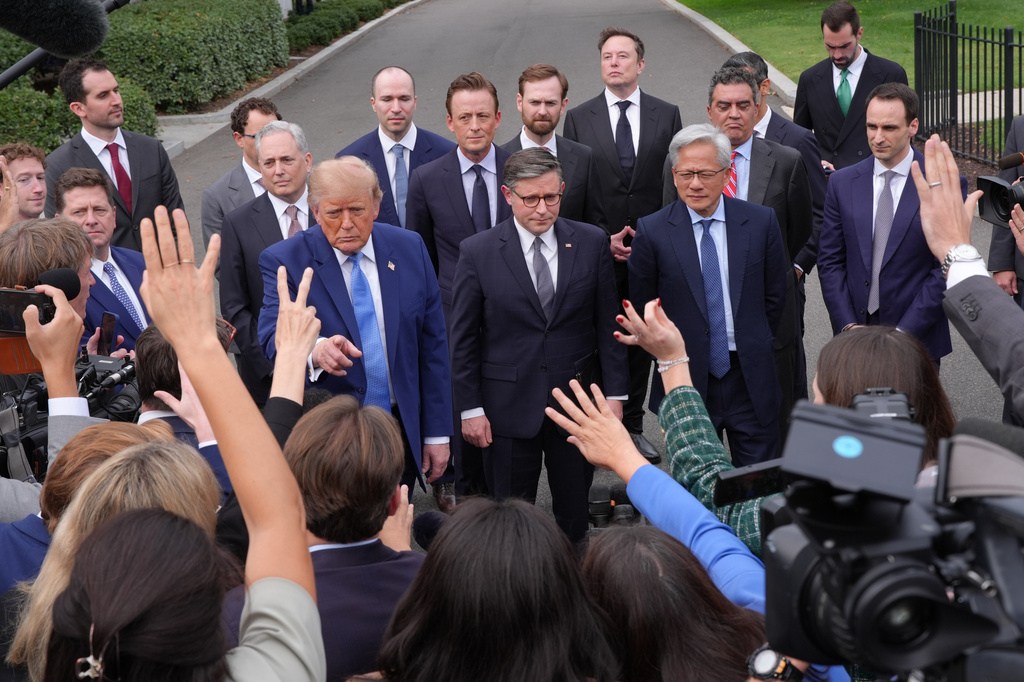
A few Tuesdays earlier, the mood at the White House had been considerably more celebratory. President Trump hosted a who’s who of tech titans in Washington, D.C., for the signing of an AI safety pact. (Sorry, superintelligence or “SI.” ) The meeting yielded what Trump called a “ morally binding ” agreement to develop AI for the common good. The means of securing this happy outcome is to entrust the industry to “self-police” and “self-regulate” rather than face federal regulation.
Will Americans accept an industry’s freedom to remake their lives as the price of national greatness? Trump has made that bet on his party’s behalf — a stark contrast, at least in rhetoric, to what he said back in June. Asked about Sen. Bernie Sanders’s (I-Vt.) proposal for public ownership of AI, he said, “There’s something very interesting about it, where it almost becomes a partnership with the American public,” according to the Associated Press . Trump also told reporters that his voters and Sanders’s “aren’t that far apart” on economics. If that much is true, then — as some Republican candidates are now discovering — the promise of American supremacy should offer limited comfort to Americans who suspect they’ll have little say in the terms of their own future.
Advocates of AI deregulation have found a receptive audience in Washington, with Republican candidates adopting their refrain: let Big AI move fast and break things, lest China get there first. “Under [the] Bernie Sanders plan, a two-year moratorium, that is dangerous to the national security of our country because in two years, China is going to be so far ahead, we’re going to be in so much trouble,” said Sen. Darline Graham (R-S.C.) in a Senate debate days ago after her Democratic opponent dubbed her “Data Center Darline.”
While Democrats are clearly fractured over AI — with many, including Schiff, opposed to such lengthy moratoriums — some Republicans facing tough elections seem to doubt the marching orders from Trump’s White House will help them win. Tom Tiffany, the Republican nominee for governor in Wisconsin who in January called data centers an “exciting new technology” and voted in Congress to speed up their permitting, released a James Fishback-style “aura farming” edit video immediately following the primary election distinguishing himself from his opponent “ Data Center David Crowley .” In Michigan, Republican Senate candidate Mike Rogers backed a yearlong moratorium on data center construction two weeks after affordability champion Abdul El-Sayed became the Democratic nominee, while continuing to attack El-Sayed’s support for public ownership of AI.
There is a clear mismatch between voters’ misgivings on the ground and the way Trump wants to get around the problem: that if he can get Americans excited enough about “Super Intelligence,” his party’s political liabilities will take care of themselves. “These Republicans who are responding to public sentiment and doing something about AI are the ones in competitive races. They’re not getting orders from the top,” Saikat Chakrabarti, the progressive tech multimillionaire and former Rep. Alexandria Ocasio-Cortez (D-N.Y.) chief of staff, told me.
Democrats’ quarrels may yet prove an advantage: a party still arguing about AI gives its candidates, especially progressives who decline Big AI’s super PAC money, latitude to articulate the public’s misgivings. “The Schiff wing is saying we should do some regulation because I know we have to say we have to do some regulation,” Chakrabarti continued. “I think the Bernie wing is taking it the most seriously, but even that answer right now is let’s pause and figure it out. Whoever has the answer to that next crisis is going to win 90 percent of the country in the next election.”
Schiff, for his part, told me he is working on a legislative proposal “[rethinking] what unemployment compensation will look like” and other things, to be introduced in the coming months. There is, at least, some figuring out underway.
Texas Republican Senate candidate Ken Paxton, whom the Democratic campaign of James Talarico has shelled with ads about his ambiguous support for data centers, sounds less than delighted. “I’ve never been in a race where I felt less control over the campaign,” he lamented in private, “like, what issues are going to matter because it’s all coming — you know — from DC. I don’t control the message or what we’re doing.”
Paxton, like Texas Republican Gov. Greg Abbott, now backs tighter restrictions on data center development after previously taking a more supportive stance. Republicans are making a considerable wager that the prospect of winning the AI arms race will reconcile Americans to whatever the industry has planned for them. They’re increasingly finding themselves drawn into the same arguments now consuming Democrats, whatever the president would prefer.
William Liang is a writer living in San Francisco. He volunteers for Connie Chan’s congressional campaign in California’s 11th District.
Topics in this story
Gathered from external sources. Rights to this text belong to whoever originally published it.