Trump toes line on data centers as more Republicans pump the brakes
Republicans’ growing skepticism of data centers is forcing President Trump to balance his steadfast support for the industry with pushback from his party ahead of the midterm elections. While Trump has doubled down on his support of data centers, the president signaled last week he may give GOP candidates room to oppose the facilities as…
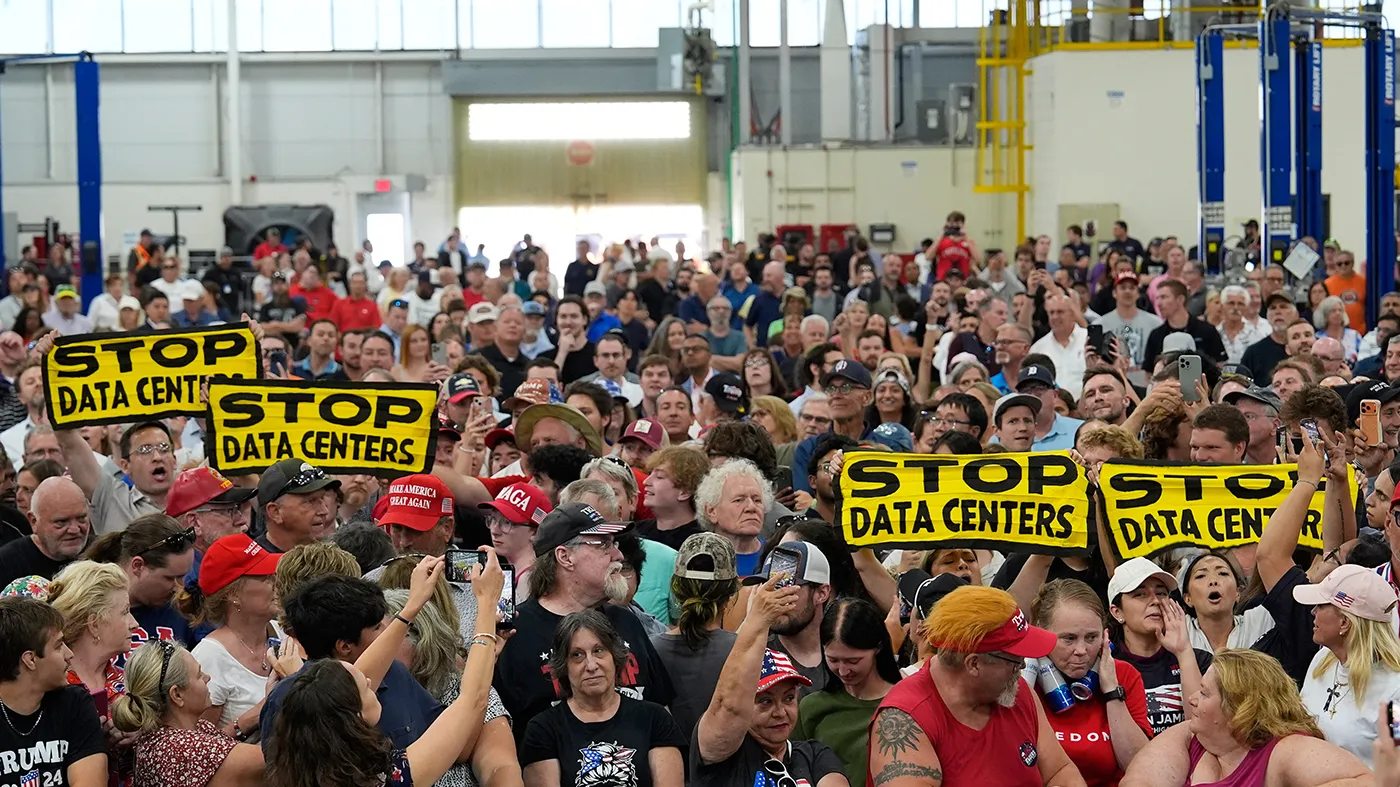
Republicans’ growing skepticism of data centers is forcing President Trump to balance his steadfast support for the industry with pushback from his party ahead of the midterm elections.
While Trump has doubled down on his support of data centers , the president signaled last week he may give GOP candidates room to oppose the facilities as they become a political lightning rod in the midterms.
Trump told reporters last week he wants Republican candidates to “do what they want” on data centers, acknowledging “some people feel differently” on the issue after previously criticizing Democrats for pushing back on planned data center projects.
“If Republicans are against a data center, that’s OK with me,” Trump added. “I’m only saying that if I ran a community … if I was a mayor or if I was a governor in the state, I would want to have the data centers because they bring tremendous income.”
Faced with mounting pressure around the risks of AI and data centers, several high-profile Republicans have abruptly shifted their stance with the midterms just months away.
Those now advocating for stricter restrictions on data centers include not only state leaders such as Texas Gov. Greg Abbott (R) but also Trump-backed Senate candidates such as Texas Attorney General Ken Paxton (R) and former Rep. Mike Rogers (R-Mich.).
“I’d say [Trump’s] been fairly consistent in his messaging. What’s been more malleable is everybody else’s opinion,” one Republican strategist told The Hill.
Mark Weaver, an Ohio-based crisis communications adviser, said he thinks Trump is noticing there is some voter concern about data centers, “and that’s why I think his language has been somewhat muted compared to other things he talks about.”
Still, Weaver thinks Trump will “continue to present a balanced approach of supporting them to ensure that the technology race is not won by China.”
Up until the past few months, the Trump administration framed its light-touch, pro-industry approach to AI as a way to ensure the U.S. remains ahead of China in the so-called AI race.
While competition remains a priority, the administration appeared to tread carefully on its policies as new security risks of AI came into the discussion.
The president’s balancing act was on full display earlier this month when discussing Abbott, a fierce Trump ally, and his shift on data centers
Last November, Abbott called Texas the “epicenter of AI development” as he welcomed Google’s $40 billion investment for the development of data facilities in the Lone Star State.
Now, the governor is arguing data center developers “dug their own grave.” He told ABC’s “This Week” over the weekend that the backlash is what they “deserve” after not collaborating with local governments.
Abbott in June ordered state regulators to audit all data centers seeking to connect to the state’s power grid before project approval. Under the order, project developers are asked for information on whether they are paying their own way or depending on state financial assistance, and on whether they are providing their own power or water to prevent households from bearing the costs.
Amid news of Abbott’s data center initiative, Trump told Punchbowl News that Texas’s approach is a “mistake” while maintaining he is “not taking positions.”
Brendan Steinhauser, a GOP strategist and head of the advocacy group Alliance for Secure AI, said Republicans like Abbott are now seeing “the politics of AI and of data centers specifically kind of turn for the worse.”
“They’ve seen the polling that all of us have seen, but also I think they’re watching what’s happening in the real world,” said Steinhauser, a Texas native.
“They’re seeing a lot of these ‘rogue AI’ loss of control incidents. They’re seeing the Iranians using AI to hack into critical infrastructure, and that’s going to get worse. … They’re seeing the rise of AI companions. The list goes on and on.”
Public concerns around AI quickly increased over the past year, with a recent Pew Research Center poll finding more than half — 52 percent — of surveyed Americans were more concerned than excited about the increased use of AI in daily life, up from 37 percent in 2021.
Data centers are one of the only tangible physical symbols of AI, making them an easy target for overall backlash around AI and its impact on the environment, labor market and utility costs.
Democrats came out hard against the facilitates earlier this year, floating proposals like a national data center moratorium or overhaul of the U.S. tax code to tax AI companies.
Republicans mostly stayed away or echoed Trump, but more are pushing back.
Texas’s Paxton became the latest Republican leader this week to propose restrictions on data centers he would push for if elected to the U.S. Senate this fall. The state prosecutor said his four-point plan will “protect our grid, our communities and our children” while still guaranteeing America beats China in the AI race.
Days earlier, Rogers, who is running in Michigan’s closely watched Senate race, called for a one-year moratorium on data center construction until Michiganders can “get their questions answered” about such projects.
Meanwhile, former Sen. Sherrod Brown (Ohio), the Democratic candidate in Ohio’s Senate race, knocked his opponent, Sen. Jon Husted (R), over the incumbent’s record on data centers in the state. The National Republican Senatorial Committee issued an internal memo last week warning that “data centers are the anchor hanging around Husted’s neck.”
“If he loses and datacenters get the blame, politicians across the country will take notice — and they will not go near the next one,” the memo said.
Steinhauser said he is not surprised by GOP members becoming vocal about the issue, telling The Hill that party members are “willing to have differences of opinion” with Trump on data centers.
“They’re not afraid to say, ‘Well, I don’t agree with him on that,’ or, ‘Yeah, I think this is a mistake.’ I hear it all the time, but they still support him,” Steinhauser said.
Susan Del Percio, a veteran Republican strategist, likened data center outrage to the fracking outrage of the 2010s.
“First communities were welcoming it because it’s so much money, and there really were jobs. … But then people started getting groundwater in their pipes and it started polluting the land,” she said. “A lot of communities who have experienced fracking remember that, so when they see data centers coming in, it makes them nervous.”
So, she said, “it’s a tough needle to thread.”
“Trump never gives in on anything, but I think on this one, there has to be some give somewhere,” she added. “I think you’d rather see Republicans speaking and addressing the concerns on data centers than them talking about how bad tariffs are.”
Multiple Republican strategists agreed there is some level of “risk” for the president to stand behind data centers but also dismissed the notion it would pose as much risk as other issues.
“At the same time, he is the president and he’s responsible for trying to drive policies. … He’s been a pretty strong proponent that having data centers in the country protects the nation and protects the American public in the AI arms race, in particular, against China,” one strategist said under the condition of anonymity to speak freely.
Steinhauser suggested there is a “bit of political risk” for Trump to support the controversial facilities, but it could be more of a risk for potential 2028 Republican presidential nominees such as Vice President Vance and Secretary of State Marco Rubio.
“They have to navigate this as well, based on what they see on the ground. And obviously, they don’t want to distance themselves from Trump, but they also don’t want to be seen as doing the bidding of Big Tech and the data centers, so they have a really tough situation,” he said.
Still, several strategists have pointed out that it’s a local issue, mostly touching the areas where the data centers are being built or there are plans to build one.
“At this point, the president has to just not publicly attack any Republican who speaks out against the issue,” Del Percio said. “It does not have to be an internal Republican fight unless the president makes it one.”
Topics in this story
Gathered from external sources. Rights to this text belong to whoever originally published it.