Federal unions owe workers more transparency. Congress can help.
The answer is not to weaken employee rights, but to strengthen them.
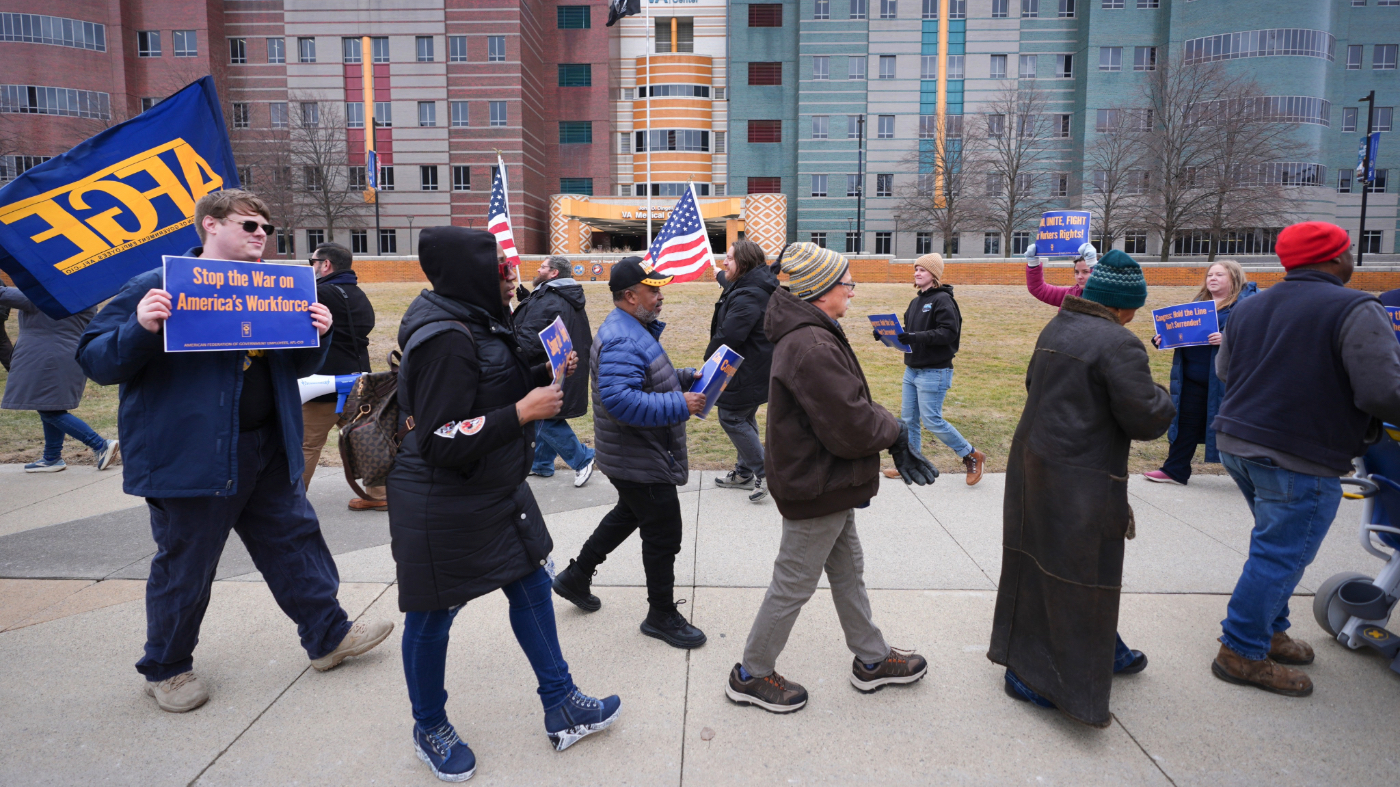
The American Federation of Government Employees is asking Congress to listen to federal employees, protect their workplace rights and restore collective bargaining rights stripped by executive order. The union is right to press that case. But lawmakers should ask at the same time: How many of the employees that AFGE claims to represent actually chose it to represent them?
AFGE is the largest federal-employee union. It is currently pressing lawmakers to override the order stripping bargaining rights from agencies covering roughly 70 percent of the workforce, and to restore bargaining rights for Defense civilians through the pending National Defense Authorization Act. AFGE says it represents more than 820,000 federal and D.C. employees.
AFGE’s own 2025 financial disclosures , filed with the Labor Department’s Office of Labor-Management Standards , tells a more complicated story: It has only about 225,000 dues-paying members, or 27.5 percent of those it is representing.
Other large unions’ filings look different. My analysis of labor management reports and the number of employees cited by unions showed that the Service Employees International Union converts close to 97 percent of represented workers into members. The Teamsters convert about 90 percent. The National Treasury Employees Union, another all-federal union, converts more than 70 percent.
Represented-worker counts are self-reported and unverified, so the gap could be narrower than it looks, but sector alone is unlikely to explain it.
The gap matters because only members elect the officers who negotiate labor contracts or communicate with Congress or the executive branch. Based on my experience, turnout in AFGE elections generally runs 30 to 35 percent of members, and sometimes lower. Multiply the figures, and in some cases fewer than one in 10 employees covered by a contract actually has a say in who speaks for them and how union dues are used. An equally thin slice of engaged members often selects the delegates who ultimately choose the union’s national officers.
Low turnout alone isn’t sinister; apathy is common to every membership organization. But apathy that persists for years under the same leadership stops looking like a mishap. An organization that cannot persuade a majority of the people it claims to represent to join isn’t demonstrating strength. It’s revealing that it hasn’t given most of them a reason to.
‘This is not an argument against unions or against AFGE’s case to Congress. Much of what AFGE is asking Congress to fix deserves support. It is an argument against unaccountable institutional power. The two problems are connected. A labor movement that can point to high, verified participation and transparent elections carries more weight when it argues that stripping bargaining rights is illegitimate. A movement with murky accountability numbers hands its opponents an easy rebuttal.
Had Congress modernized these guardrails years ago, AFGE and its peers might be standing on firmer ground today, instead of fighting the rollback while also fielding questions about who empowered them to fight it. The tools to fix this already exist. The Labor Department has cleared the way for remote electronic voting that meets certain standards, letting members vote directly on important union matters no matter how many or where they are. This requires no new technology — only for unions to use the tools already approved.
Congress should also ask why so few have and strengthen union accountability by requiring unions to disclose in their filings the total number of workers they claim to represent versus the number of actual members. They should also be required to report election turnout data at all levels: eligible voters, ballots sent and ballots returned — similar to shareholder-vote disclosures.
For example, some unions use “delegate” qualification procedures that can insulate national incumbents from direct member voting. As a matter of fair competition, challengers should have the same access to membership contact lists as incumbents, with sufficient time to mount a campaign, with direct member voting as the preferred standard.
Major national officer elections and financial decisions should go directly to the membership, not layers of delegates chosen by that same thin slice of members. Congress should also let the Federal Labor Relations Authority permit recertification/affiliation change votes at individual workplaces, when dues-paying membership remains a distinct minority of the workforce for a sustained period. This supports democracy.
This is a federal workplace, financed in part by taxpayer-paid official time, not a private-sector profit operation. Federal employees should have a direct voice in choosing their representatives and in how their dues, drawn from public service, are used. This would only impact unions with low membership rates.
The answer is not to weaken employee rights, but to strengthen them. A union officer is an elected representative — not the permanent custodian of an institution.
Federal employees deserve protection from arbitrary government action. A labor movement strong enough to demand it must also have the legitimacy to speak for its members. That legitimacy begins with leaders who are meaningfully and transparently chosen by the people they represent. Congress has a say in this for the federal workforce. It’s time to update labor law.
Javier Soto spent 10 years representing federal employees and unions, including five years as a Legal Rights Attorney at AFGE District 14.
Topics in this story
Gathered from external sources. Rights to this text belong to whoever originally published it.