Democrats see new path to expand Senate majority in 2028
Democrats’ sweeping victory Tuesday has scrambled conventional wisdom around the 2028 Senate map. Emboldened party leaders see the world as their oyster and are looking ahead to expanding their majority with a map where suddenly anything seems possible. “Some of the very same states where we won this election will offer new opportunities to…
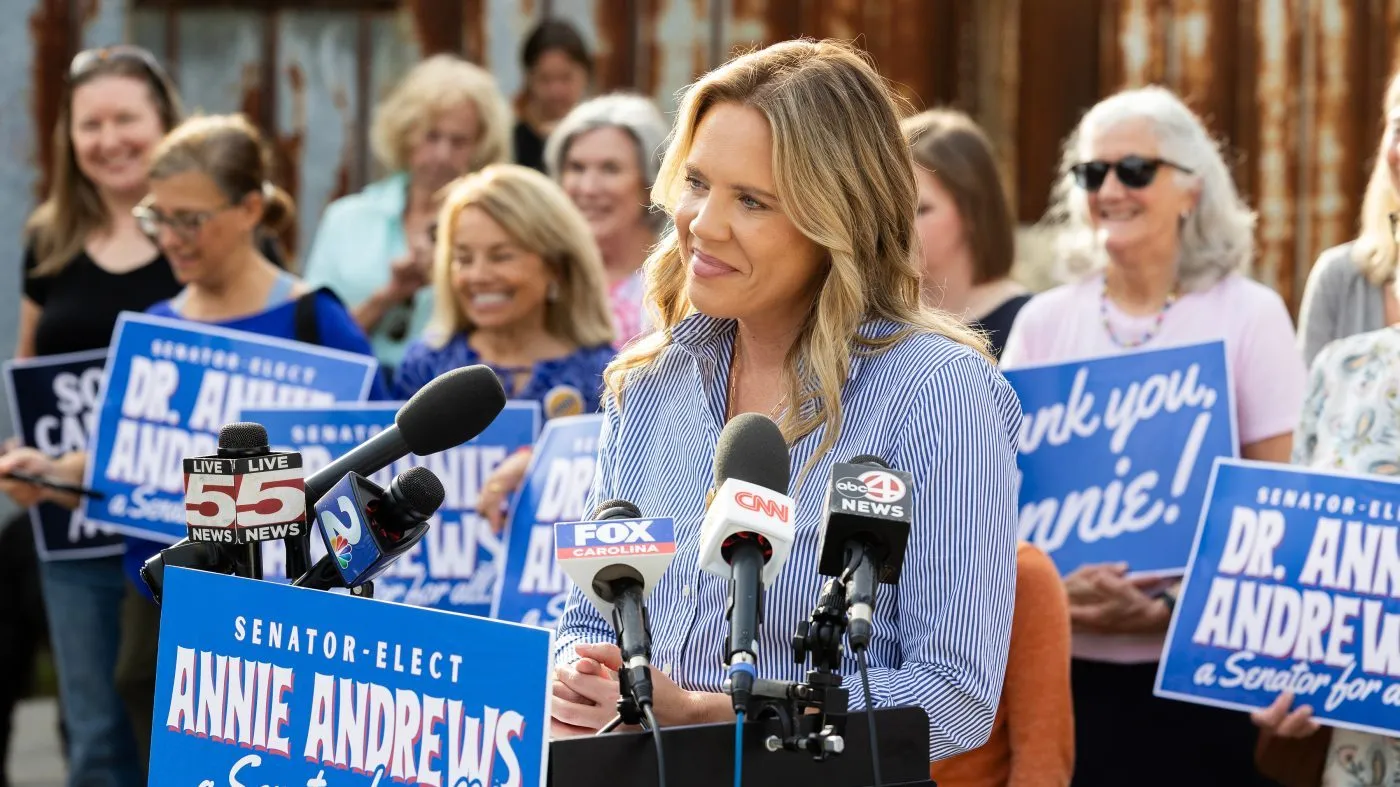
Democrats’ sweeping victory Tuesday has scrambled conventional wisdom around the 2028 Senate map.
Emboldened party leaders see the world as their oyster and are looking ahead to expanding their majority with a map where suddenly anything seems possible.
“Some of the very same states where we won this election will offer new opportunities to expand our majority in 2028 — Iowa, Kansas, the Carolinas and more,” Senate Democratic Leader Chuck Schumer (N.Y.) said during an event Thursday.
“We need to start identifying now in 2027, to solidify our position in the states we won and build our party infrastructure in those areas and continue to expand the map into new states,” Schumer added.
There are only three Democratic senators up for reelection in 2028 that are from battleground states: Georgia, Ohio and Pennsylvania.
Democrats won big in all three of them Tuesday.
The party is also strongly positioned in blue or purple states where an incumbent is up for reelection: California, Oregon, Washington, Colorado, Nevada, Illinois, Hawaii, New York and several New England states.
Meanwhile, Republicans have a steeper battle, and seats once thought as safely red may not be anymore.
They’re defending singular Senate seats in both Carolinas, Iowa and Kansas after Democratic flips. Similarly, they will have to defend seats in Wisconsin and Indiana after Democrats won statewide.
Democrats remain within striking distance in Alaska of unseating Sen. Dan Sullivan (R) as the vote tabulating process continues. Sen. Lisa Murkowski (R) is up for reelection there in two years.
While Republicans held serve in Florida , Democrats made significant inroads in the Sunshine State, and it could be competitive in 2028.
Tommy Garcia, a spokesperson for the Democratic Senatorial Campaign Committee, was less bullish but said in a statement that Democrats had transformed “a difficult map.”
“We had incredible candidates who ran strong campaigns laser-focused on the issues that matter most to voters, and now they will use their majority in the Senate to fight for lower costs and to root out corruption,” Garcia said.
To succeed over the next two years and avoid pitfalls, operatives say national Democratic organizations need to spend like no state is off limits, especially in the South.
Both Carolinas, Florida, Georgia, Texas and Mississippi were extremely competitive this cycle. Democrats won Senate seats in each of them except Florida, while Mississippi’s race was too close to call by press time.
Christale Spain, South Carolina Democratic Party chair, said a Democrat winning the state for the first time in nearly 20 years will make it easier to recruit candidates to challenge Sen. Tim Scott (R) next cycle.
But she said the national party will need to devote resources to maintain its newfound success.
“I think that in order for us to duplicate or even do even better than we did Tuesday night was that we’re going to have to have a lot of national investment,” Spain said.
“We’ve learned as a state party to do more with less, but in order to continue this momentum, we’ve got to have investment from other national organizations other than just the DNC [Democratic National Committee],” Spain said. “They’ve been a great partner, but we’re going to have to see just more substantial, sustained national investment.”
Democrats in Florida are also making the case that national investment would have helped them get even further: They broke the GOP’s statewide supermajority while still falling short of winning the gubernatorial race or the Senate race.
Incumbent Republican Sen. Ashley Moody (Fla.), who defeated Angie Nixon on Tuesday in a special election to finish the remainder of Marco Rubio’s term, will have to be elected again in 2028 to serve a full term.
Nixon said she is keeping the door open to challenging Moody again in two years.
Florida Democratic Party Chair Nikki Fried said she’s been spreading the word that Florida needs more national money and attention for Democrats to have a shot at 2028.
“I think the biggest takeaway from looking at the rest of the map is that all the states that flipped had national presence, national resources, and people just abandoned us, and so we had to fight to get out of this mess by ourselves,” Fried said.
That kind of investment is part of how Democrats succeeded in races in North Carolina and Georgia, once thought to be among the toughest for Democrats.
A year ago, most election experts thought North Carolina’s Senate race would be one of the most competitive in the cycle.
But in the final months, it became clear that Democratic former Gov. Roy Cooper was likely to win, and national groups began shifting money elsewhere.
Cooper is well known in the state and has never lost an election. His campaign focused heavily on its “Make Stuff Cost Less” slogan and kept Cooper out of the headlines.
“No matter what shiny objects were floating around in the national media, this was always about making this a North Carolina-centric campaign,” said Jeff Allen, Cooper’s campaign manager. “And so, to me, that’s one of the takeaways because it also made sure that we never forgot that North Carolina, at its core, is a 50-50 state.”
Allen said there’s plenty of room to run a similar play to unseat Sen. Ted Budd (R-N.C.) in two years. He cited an AARP poll from September that showed Budd’s approval rating at 28 percent.
“Ted Budd is not well liked in this state, and North Carolina Republicans, I think, know that,” Allen said. “I think there is a real opportunity to flip this seat, and we’ve obviously got to continue figuring out what the best path is for ‘28 and down the line, but I think that we have a lot that we can learn from this cycle.”
Georgia was another state that turned out less competitive this year than expected.
Incumbent Sen. Jon Ossoff (D) was considered to be the most vulnerable senator in the chamber at the outset of the campaign, when the 2024 “red wave” still loomed large. But Ossoff won by nearly 20 points .
Yet for all the Democratic hopes, there are Republican targets up for reelection, too.
In Ohio, former Sen. Sherrod Brown (D) is about to retake a Senate seat, but only for two years. Republicans successfully ousted him in 2024, and the right candidate could do so again.
Georgia’s other Senate seat, held by Sen. Raphael Warnock (D), could be one of the GOP’s better hopes for a pickup in 2028. But it won’t be easy.
Warnock could be tough to beat, said Ryan Mahoney, a Republican strategist in Georgia, since he’s a disciplined campaigner with strong constituent services.
In addition, much of Warnock’s “dirty laundry,” including potentially controversial statements from his sermons as a pastor, came out during his 2020 campaign against Kelly Loeffler.
“All of the things that are going to be said about Warnock have been said before and didn’t work,” said Mahoney, who was Loeffler’s communications director at the time. “So I think for Republicans they do need to hope that he isn’t as precise and strategic and intentional as Ossoff, because he goes into reelection in a really good spot with people not thinking he’s as progressive as he actually is deep down.”
Still, Mahoney said if Democrats take their newfound majority too far at the federal or state levels there will be more opportunities for Republicans.
“Democrats do not have a mandate in Georgia, and if they believe that they do, and if they act like they do, they will lose,” Mahoney said.
Topics in this story
Gathered from external sources. Rights to this text belong to whoever originally published it.