Hakeem Jeffries’s road to the Speakership will be nothing like Nancy Pelosi’s in 2018
Rep. Hakeem Jeffries is set to be re-elected as Democratic leader following a period of successful fundraising and caucus unity during the second Trump administration.
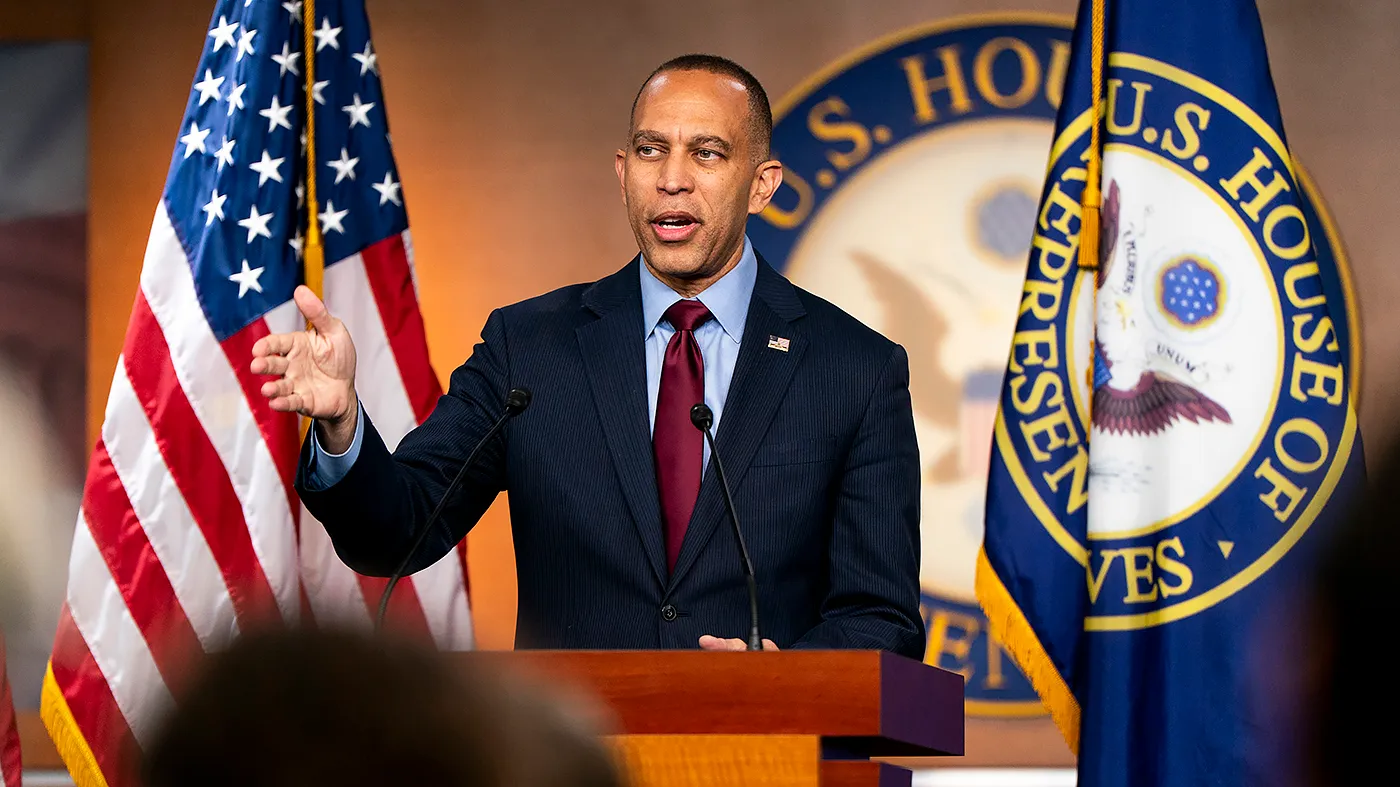
Congressional leadership elections often resemble a book with a propulsive plot and a predictable ending. There’s intrigue, shadowy maneuvering, and backroom leverage. But usually, by the end of the day, the input is more entertaining than the outcome.
So it will be with Wednesday’s Democratic caucus election of Rep. Hakeem Jeffries (D-N.Y.) behind closed doors. Mind you, “closed doors” is a figurative term — I vividly remember my House colleagues texting play-by-plays in real-time to cable network correspondents on the other side of the so-called closed doors.
But even though Jeffries seems to have his votes locked-in, there still may be plenty of intrigue. After all, Democrats don’t always enjoy the smooth, comfortable ride straight to victory; we need stop signs and speed bumps.
Jeffries has led his caucus to an historic House majority. He raised more than $250 million , united his caucus on every consequential vote during the second Trump administration, pushed an effective message against Republicans, and managed his members with inclusivity.
Toppling him now would be the equivalent of the Milwaukee Brewers firing Pat Murphy as manager after they won their first-ever World Series last month. In a sense, the opposition is a game of “inside baseball.” It is meant to extract whatever it can while it has the leverage.
But none of this compares with the last significant leadership election for House Democrats in 2018, when Rep. Nancy Pelosi (D-Calif.) led them to a majority and then almost immediately faced a challenge.
Back then, few had doubts Pelosi would win, but the rebellion seemed stiffer. With roughly 40 new Democratic members, she could afford to lose a mere 17 floor votes. During the campaign, about 20 candidates had publicly pledged to oppose her.
As a matter of outcome, the margin was surmountable. As a matter of math, however, it was razor thin.
Almost immediately, Reps. Seth Moulton (D-Mass.) and Kathleen Rice (D-N.Y.) led a movement for new leadership. Sixteen Democrats signed a letter on Nov. 19 announcing they would vote against Pelosi, falling short of the 209 they had hoped to secure. (Strategic tip: never show early weakness against Nancy Pelosi. She feasts on it.)
Rep. Marcia Fudge (D-Ohio) flirted with running for about a week , then abandoned the idea . One Pelosi ally called it a “botched coup.”
Pelosi, of course, won the closed-door caucus nomination by a vote of 203-32 . But there was still plenty of time for insurgents to maneuver against her before the Jan. 3 formal vote of the full House.
I never liked the phrase “whip” because of what it implies. Most good whipping is simply listening, absorbing, getting to “yes” instead of coercion. But Pelosi — not taking anything for granted — executed a flawless whip operation.
On Dec. 12, Pelosi agreed with seven opponents to back term-limits for the top three leaders and to hold herself to — at most — four more years as leader. The proposal was supposed to go to the caucus by Feb. 15, but it was never brought up as scheduled amid a partial government shutdown.
On Jan. 3, , 2019, Pelosi won the floor vote, 220-192 . Fifteen Democrats voted for someone else or “present,” an unusually high number for this type of vote. Nevertheless, she became Speaker once again and led the House through the final two years of the first Trump administration, COVID-19, and the first half of Joe Biden’s presidency.
Jeffries is in a much different environment today. Similar to his ascension to House leadership in 2019, he has quietly and methodically lined up his votes without drama. He’s listened to the needs and priorities of his caucus members. By Wednesday’s vote, he plans to have met with every single incoming member. Punchbowl has reported that before the vote , he’s scheduled to go to the board of the Congressional Progressive Caucus, led by Rep. Greg Casar (D-Texas), a Jeffries backer. Rep. Alexandria Ocasio-Cortez (D-N.Y.) endorsed him in June.
While Pelosi had a narrow lane to her Speakership eight years ago, Jeffries’s margin is a superhighway. He won’t take any vote for granted; he may listen to every request, demand and petition — but he’s in the enviable position of being able to say no without losing the gavel.
Still, some House progressives see Wednesday’s vote as an opportunity for maximum leverage. Some want commitments for votes to cut aid to Israel, to end funding for the war in Iran, to overturn the Supreme Court’s 2010 Citizens United ruling, or even (gasp) for good individual House committee assignments.
The thing about leverage is that there’s a moment when you lose it. It’s not just the force, it’s the timing. You extract what you can when you can.
The same rules apply to messaging. Democrats can maneuver and negotiate to the fullest affect behind closed doors. But facing Trump, his new chief of staff, Stephen Miller, and a bunch of MAGA Republicans who are feeling now like caged animals, they need to come through those doors entirely united.
As Pelosi used to say: “Diversity is our strength, unity is our power.”
Jeffries has diversity all locked up. Now he needs to make sure unity will get him the power to lead his caucus and the House of Representatives as a truly historic Speaker in 2027 and beyond.
Steve Israel represented New York in the House of Representatives for eight terms and was chairman of the Democratic Congressional Campaign Committee from 2011 to 2015.
Topics in this story
Gathered from external sources. Rights to this text belong to whoever originally published it.