GOP soul-searching for life after Trump is ramping up
Republicans say their party will need to do a lot of soul searching to find its direction before President Trump leaves office in 2029, something that is coming into sharper focus with the approaching midterm election and the realization that Trump will soon become a lame duck. GOP strategists and political experts say the discussion…
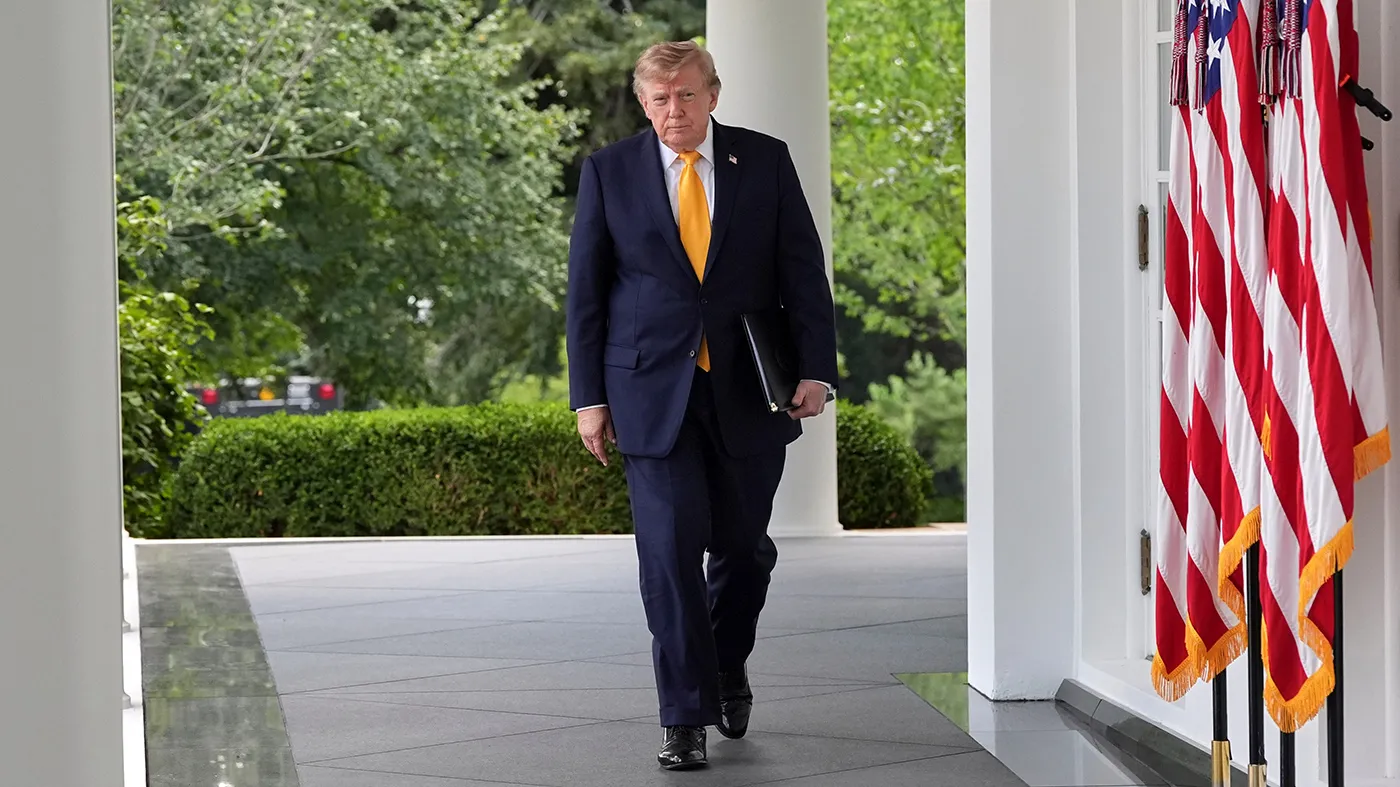
Republicans say their party will need to do a lot of soul searching to find its direction before President Trump leaves office in 2029, something that is coming into sharper focus with the approaching midterm election and the realization that Trump will soon become a lame duck.
GOP strategists and political experts say the discussion about what comes next will begin to ramp up considerably after the November election. It’s a discussion likely to be impacted by how effective the GOP is this fall in defending its House and Senate majorities.
“There will be a serious debate about the policy, about what the direction of the party is,” said Vin Weber, a GOP strategist and former member of House GOP leadership.
That debate will center on whether the Trump revolution on a host of issues, such as trade, will live on with the GOP.
Weber said Republicans have embraced tariffs in recent years because they “respect Donald Trump as the negotiator,” not because they’ve embraced the concept of tariffs generally.
“The traditional position of the Republican Party is anti-tariff. Tariffs are anti-trade, tariffs are taxes. The Republican Party that I grew up in was never the party of tariffs. The Democrats were the party of tariffs,” Weber said.
He said Republicans embraced Trump as a bold fighter who won’t back down, but he said not everyone in the party is thrilled about some of Trump’s policy positions, including tariffs and federal meddling in the private sector.
“In my view, much of the appeal of Trump to the Republican Party was that he was able to rouse the faithful against the movement to the radical left that we experienced under Barack Obama,” he added.
A senior Senate GOP aide, who requested anonymity to discuss the behind-the-scenes discussion about what comes after Trump, said the president will leave a massive void when he leaves the White House.
“Anybody that says there’s going to be a conversation is right. Donald Trump is Donald Trump. There will never be another president like him,” the aide said. “I don’t think the party knows what it wants yet. It’s really hard for a lot of people to think about that. Donald Trump has been the leader of the Republican Party for a decade, and that’s a long time in politics.”
Some Republicans are baffled by Trump’s escalation of a trade war with Canada, a major economic partner, a few weeks before the midterms, where Senate Republicans are trying to win tough races in several states along the Canadian border, including Maine, Michigan and Alaska.
Senate races in two other states along the northern border, Minnesota and Montana, may be more competitive than broadly recognized, GOP strategists warn.
Sen. Susan Collins (R-Maine), one of the Senate’s most vulnerable incumbents, called Trump’s threat to slap 50-percent tariffs on Canadian goods “a mistake.”
Trump’s approval rating has sunk to the lowest point of his presidency — including his first term — according to a recent Reuters/Ipsos poll.
Trump maintains strong support — 95 percent — among self-identified MAGA voters, but Republicans who don’t identify as MAGA are more split on his job performance, with 59 percent of non-MAGA Republicans approving of Trump’s performance and 40 percent disapproving.
The splintering of Trump’s support within the party amid his long-running trade wars with key allies such as Canada and the dragged-out military conflict with Iran has opened the door for a broader debate over where the party should head after this year’s midterms.
Sen. Ted Cruz (R-Texas) says Republicans have not coalesced behind Vice President Vance, and he’s advocating for the party to return to its more economically conservative roots and ditch some of the populism, especially on trade, that Trump has championed.
Other Republicans are echoing Cruz’s argument that Trump’s transformation of the GOP policy agenda into a MAGA-aligned, “America First” worldview is a reflection of the president’s personal popularity and not necessarily a permanent change in the party’s values.
“There’s going to be a full discussion about who we are and what we believe,” Cruz predicted in an interview with MS NOW.
“Going forward, we’re in the midst of a debate about who our party is and what we believe, and I think economically we’ve got to debate, ‘Are we a small-government, free-market conservative party? Are we a big-government, nanny-state party?'” he said.
Cruz, along with Vance and Secretary of State Marco Rubio, is seen as a potential candidate to lead the party after Trump. Florida Gov. Ron DeSantis (R), who was a hot commodity in 2022, could make a comeback after Trump leaves office, GOP strategists say.
Cruz came in second place behind Trump in the 2016 Republican presidential primary.
Steven S. Smith, a political science professor at Arizona State University, predicted that leading Republicans will start jockeying for greater influence and visibility with the GOP primary electorate after the November election.
“There’s going to be a period of experimentation that’s going to start in the new year and really get quite intense for a year because it could very well be that by July of 2027 we already have candidates announcing for the presidency. Even July will be seen as late,” he said.
“I don’t think anyone assumes Vance is the heir apparent,” he said.
Smith argued that Trump’s appeal to GOP voters is based more on his personality than his policy views, something that Cruz has implied, calling Trump’s takeover of the Republican Party and dominance of the American political debate a “black swan event” — a highly improbable event that has major reverberations.
“The problem for Vance is the Trump president is a very personalistic presidency, and his issue positions — like his behavior on the tariffs and the war with Iran – is personalistic. These things are not justified by a coherent ideology or policy framework,” Smith said.
“As a result, it doesn’t neatly translate to any other politician, even the president’s president,” he added. “There are elements of the Trump coalition that will be looking for a return to Reagan-like policy principles.
Some Republicans, such as Cruz, are looking to bring the party to its traditional position, as championed by Ronald Reagan and other Republican presidents, of relying on alliances to project American leadership throughout the world.
“And on foreign policy, we’ve got to debate, ‘Are we an isolationist party that withdraws from the world or do we believe in American leadership?’” Cruz asked.
A McLaughlin & Associates poll of 433 likely voters conducted from Aug. 18 to Aug. 24 showed Vance leading a hypothetical GOP presidential primary with 32 percent support, while Donald Trump Jr. came in second place with 19 percent support. Rubio and DeSantis earned 12 percent and 6 percent, respectively.
An AtlasIntel poll of 2,069 respondents conducted in May found Rubio leading a hypothetical 2028 Republican primary with 45 percent support, while Vance trailed with 29 percent support and DeSantis earned 11 percent support. The survey showing Rubio with a substantial lead over Vance was an outlier among polls of the 2028 GOP primary.
Former Sen. Judd Gregg (R-N.H.), who hails from an early primary state that could play a key role in selecting the party’s next standard-bearer, expects the Republican Party to start wrestling more intensely over its future after Trump in the months ahead.
“I would hope the party would go back to reevaluate what our goals are. Trump is a personality and he’s been able to dominate a populist movement, but the simple fact is that it’s not traditionally Republican or conservative … the expansion of the deficit, the attempt to interfere with the marketplace by directly picking winners and losers, the failures to understand the importance of international relationships with our allies, bullying some of our most important neighbors, such as Canada,” he said.
“The Republican Party is going to have a very, hopefully, significant discussion about [where] we’re going and whether we’re going to be the party that is conservative or what we’re going to be,” he added. “I don’t think we’re going to find another Donald Trump. Certainly, JD Vance is not another Trump.”
Some Republicans have accused the Trump administration of meddling in the economy by putting heavy pressure on some companies to act in certain ways — such as threatening the broadcast licenses of major media companies — or taking major financial stakes in Intel, U.S. Steel and critical minerals companies.
“You got to stop micromanaging and get back to the big-picture issues and I don’t think we are,” Sen. Thom Tillis (R-N.C.) told reporters on Capitol Hill last week, warning that the Trump administration’s attempts to actively manage the economy at the expense of free-market principles have backfired at times.
Tillis has criticized Trump’s trade policies as well as the stakes his administration has taken in major companies during his second term.
“I don’t want us with the golden share now on the board of Nvidia or any of these other companies to start dictating [business decisions] because it’s another step down the slippery slope of micromanagement, which is antithetical to anybody who is a true conservative and believes in free-market capitalism,” he said.
“I’ve never seen such a stark contrast between what I’ve embraced all my life and what we’re doing now,” he said.
Gathered from external sources. Rights to this text belong to whoever originally published it.