Democrats huddle to weigh changes to party rules following surprise defections
House Democrats huddled Wednesday morning to weigh potential changes to internal party rules after a pair of centrist lawmakers crossed the aisle a day earlier to help Republican leaders advance a series of GOP messaging bills that were on track to fail. The defections by Democratic Reps. Jared Golden (Maine) and Marie Gluesenkamp Perez (Wash.)…
House Democrats huddled Wednesday morning to weigh potential changes to internal party rules after a pair of centrist lawmakers crossed the aisle a day earlier to help Republican leaders advance a series of GOP messaging bills that were on track to fail.
The defections by Democratic Reps. Jared Golden (Maine) and Marie Gluesenkamp Perez (Wash.) caught the Democrats off guard and infuriated both party leaders and many members of the caucus.
The episode prompted a special meeting of the Democrats’ Committee on Caucus Rules, which has been charged by leadership with examining possible changes to the party’s internal guidelines in an effort to ensure that Democrats stick together on future rules votes.
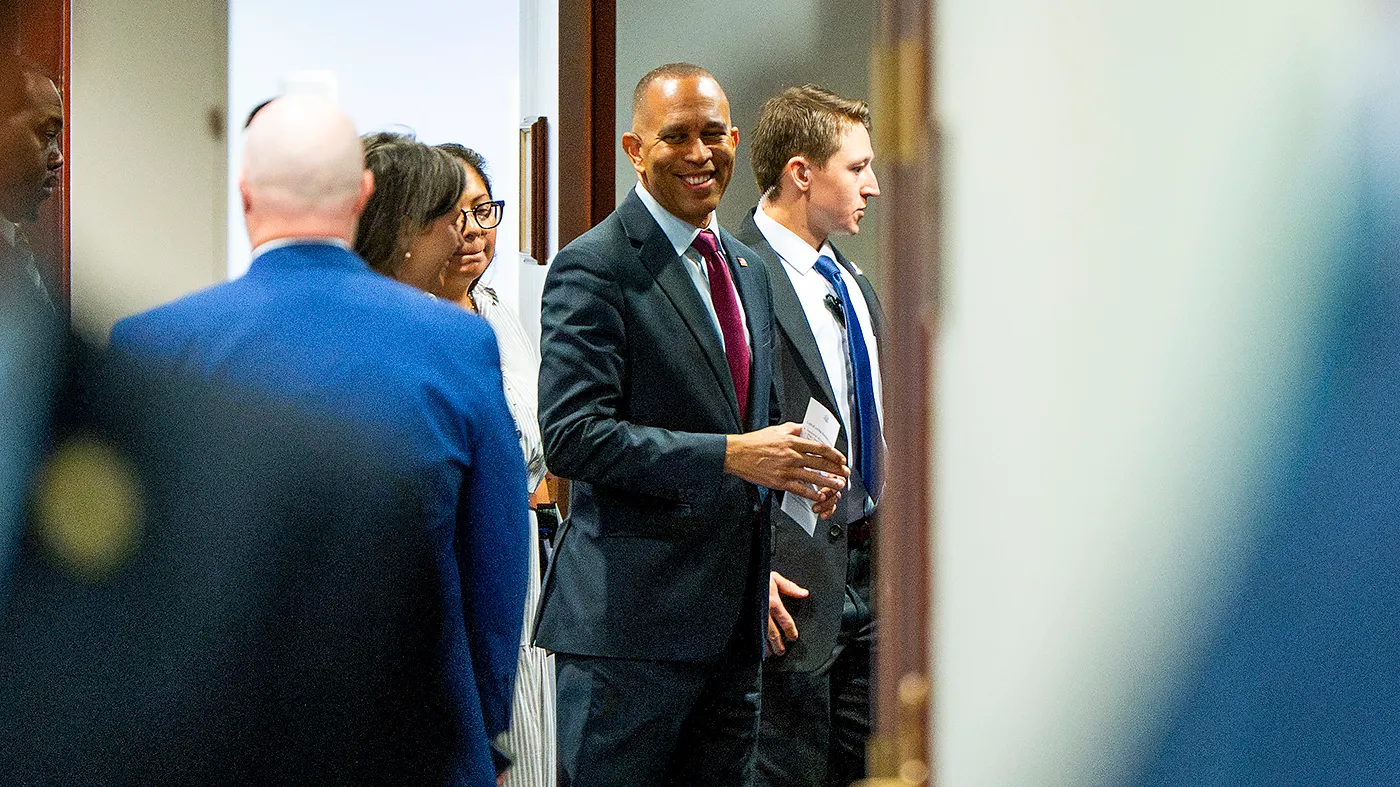
Leaving the meeting, House Minority Leader Hakeem Jeffries (D-N.Y.) said no decisions have been made, but all options remain on the table.
“It’ll be an ongoing discussion through the vehicles that have been set up, including meetings related to the Committee on Caucus Rules, as well as more informal discussions that will continue to proceed during the balance of the time that we’re here,” Jeffries said.
Asked if the changes, if adopted, would take effect this Congress or the next, he was noncommittal.
“We haven’t ruled anything in, and we haven’t ruled anything out,” he said.
The uproar stems from Tuesday’s vote on a GOP rule governing a series of bills that Republicans sought to pass this week as an 11th-hour flourish lending them momentum and talking points heading into November’s mid-term elections. The legislation included proposals to condemn socialism, roll back environmental protections and bar U.S. universities from participating in boycotts of Israel — all hot-button issues Republicans see as beneficial on the campaign trail.
The rule was poised to fail, because a handful of conservative Republicans voted against it to protest the decision by GOP leaders to fast-track a massive government funding bill earlier in the day. But Golden and Gluesenkamp Perez voted in favor of the rule to put it over the top, rescuing GOP leaders and salvaging much of the Republicans’ remaining pre-election agenda.
Traditionally, the minority party votes uniformly against rules even if individual lawmakers go on to support the underlying legislation on a final vote.
Both lawmakers defended their decisions, saying their yes votes were the only way to ensure that one of the underlying bills — legislation designed to help Atlantic lobstermen retain their jobs — made it to the floor for a final vote.
But many Democrats were furious, not least because neither defector warned leadership of their intention to cross the aisle. Jeffries and his top two deputies, Reps. Katherine Clark (D-Mass.) and Pete Aguilar (D-Calif.), issued a joint statement Tuesday evening calling the defections “a significant breach of trust” — one that demands “a significant response.”
Jeffries said he will be meeting with Golden and Gluesenkamp Perez later in the day on Wednesday.
Some Democrats were sympathetic to the centrists’ decision, noting that Gluesenkamp Perez hails from a conservative-leaning district where a vote for the lobstermen bill could pay dividends at the polls.
Most Democrats, however, argued the importance of keeping the caucus together on rule votes, even if individual lawmakers break away later to support the underlying bills based on regional concerns.
“Procedurally, this is about making sure that we maintain unity, whether we’re in the minority, or when we’re in the majority,” said Rep. Steven Horsford (D-Nev.), a member of the Committee on Caucus Rules. “Members — all members — have a right to vote their district. And the underlying bill is the opportunity to do that.”
“It’s long understood what the dynamics are related to procedural votes connected to a rule,” Jeffries said.
Topics in this story
Gathered from external sources. Rights to this text belong to whoever originally published it.