Will the midterm mandate bring real change?
Following the Nov. 3 midterm elections, the incoming Congress faces intense political maneuvering as House Republicans elect Jim Jordan as minority leader and Democrats prepare to advance legislative priorities such as healthcare reform and investigations into the Trump administration.
Gaius Petronius Arbiter, a first century A.D. Roman author, observed that change for the sake of change is an illusion of progress. That insight rattled around my mind while reflecting on the Nov. 3 midterm elections.
After a week of “reckoning” what the Democratic sweep of the tables at all levels of government meant for the parties, their members and the nation at large, the new watchword became “change.” The American people voted for change in the government, the parties, and national policy priorities. But what kind of change, by and for whom, and at what cost and perils going into the 2028 presidential election?
Certainly, no one wants to fall into the Petronius trap of fighting for change for its own sake, only to be called on it by voters at the next election for having merely created the illusion of progress.
In my previous column , I expressed skepticism that things would change much in the new Congress with basically the same leadership and many of the same burned-out incumbents still stuck in the same-old rut of battling and blaming each other instead of tackling the major problems facing most Americans.
I held out a slim hope that the roughly 120 newly elected House members and handful of new senators might shake-up the place enough to force the leadership to change its ways and listen to what the people have really been demanding.
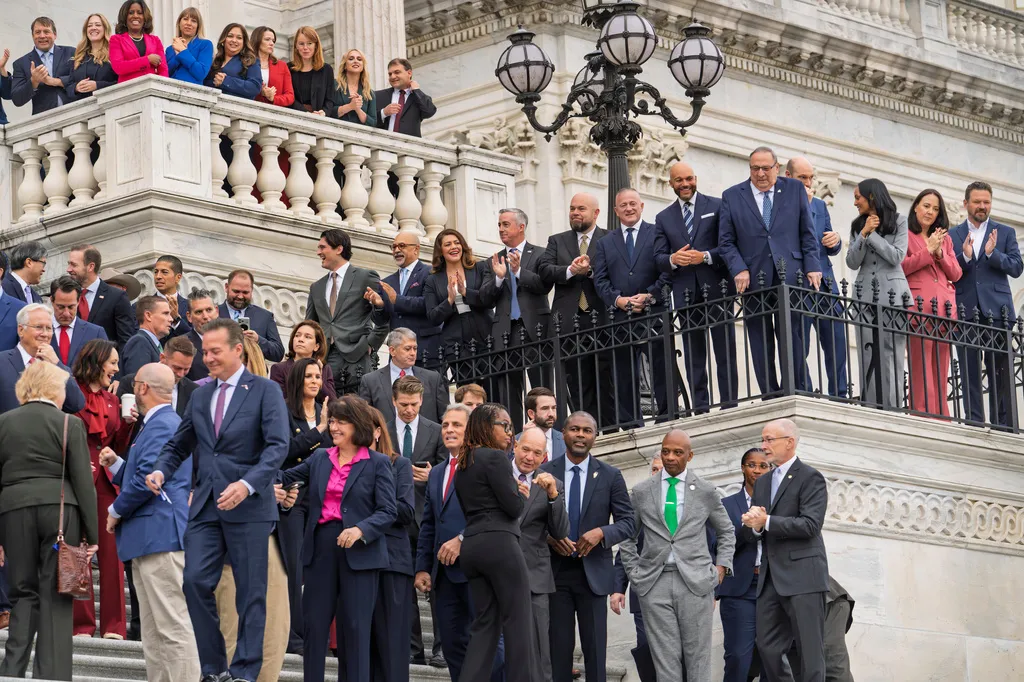
Neither the bipartisan new member orientation last week on the Hill nor the humongous gathering of Democrats at the “What Next?” conference in Denver that followed have produced convincing signs of new directions and priorities — other than that everyone can now pronounce the word “change.” Nor have the party leadership races so far demonstrated different directions. It was still the same old internal finger pointing and blame gaming.
House Republicans did make one change in leadership, voting to elect Rep. Jim Jordan (Ohio), a combative conservative, as their new minority leader over incumbent Republican leader Steve Scalise (La.). Jordan indicated his priority as minority leader will be to protect President Trump against all the investigations Democrats have vowed to unleash.
In House Democratic leadership elections Wednesday, current Minority Leader Hakeem Jeffries (N.Y.) was elected, by a secret ballot vote of 251 to 11 , as the majority caucus’s nominee for Speaker, despite some grumbling in the ranks. Other sitting leaders were elevated a notch on the ladder without opposition.
In the Senate, Republican Leader John Thune (S.D.) was reelected party leader without opposition, though his raucous caucus members went through three meetings in a single day to air their grievances before reelecting their entire leadership team.
The Senate Democratic leadership votes will not take place until Dec. 1. Sen. Chris Van Hollen (D-Md.), 67, is challenging incumbent Minority Leader Chuck Schumer (D-N.Y.), 75, for the majority leader slot. Van Hollen is running on the mantra that it’s time for a new generation of leadership that can deliver real change. Schumer is touting his success in delivering a Senate majority. As Sen. Angus King (I-Maine) put it, “ Why would you fire the manager when you just won the World Series? ”
High on the Democratic list of legislative priorities in the new Congress will be healthcare reforms, immigration law changes, tariffs, and ending the Iran war. Details to follow. President Trump announced even prior to the midterm election that he will become “ Mr. Veto ” if Democrats capture the Congress.
Democrats are also poised to launch a whole series of investigations of the Trump administration. As Rep. Robert Garcia (D-Calif.), the prospective new chairman of the House Oversight and Government Reform Committee advised the president and his Cabinet members, “ Lawyer up .” The administration has reportedly already added 15 lawyers to the Whie House counsel’s office in anticipation of a boatload of subpoenas and contempt citations.
One might expect some hint of the midterm election impact on members’ behavior as they wrap-up the work of the current Congress. High on the list of unfinished business are all 12 appropriations bills which have been backstopped by a continuing resolution at current year spending levels, which expires on Dec. 11.
Several options are available: enacting an omnibus appropriations bill through next September; another short-term continuing resolution into early next year; or a government shutdown if no compromise can be reached between the House, Senate and the White House.
The latter prospect takes us full circle to the embarrassing government closure last year and defies any sign that real change is in the air — not even an illusion of progress.
Don Wolfensberger is a 28-year congressional staff veteran, culminating as chief of staff of the House Rules Committee. He is author of “Congress and the People: Deliberative Democracy on Trial” and “Changing Cultures in Congress: From Fair Play to Power Plays.”
Topics in this story
Gathered from external sources. Rights to this text belong to whoever originally published it.