The Pentagon’s new nuclear doctrine needs congressional guardrails
Critics in Congress and the arms control community are right: Any doctrine premised on “limited” nuclear use invites the illusion of control.
For more than three decades, American nuclear strategy rested on the assumption that U.S. weapons capable of ending civilization several times over would deter adversaries from crossing the nuclear threshold. That assumption is now being tested.
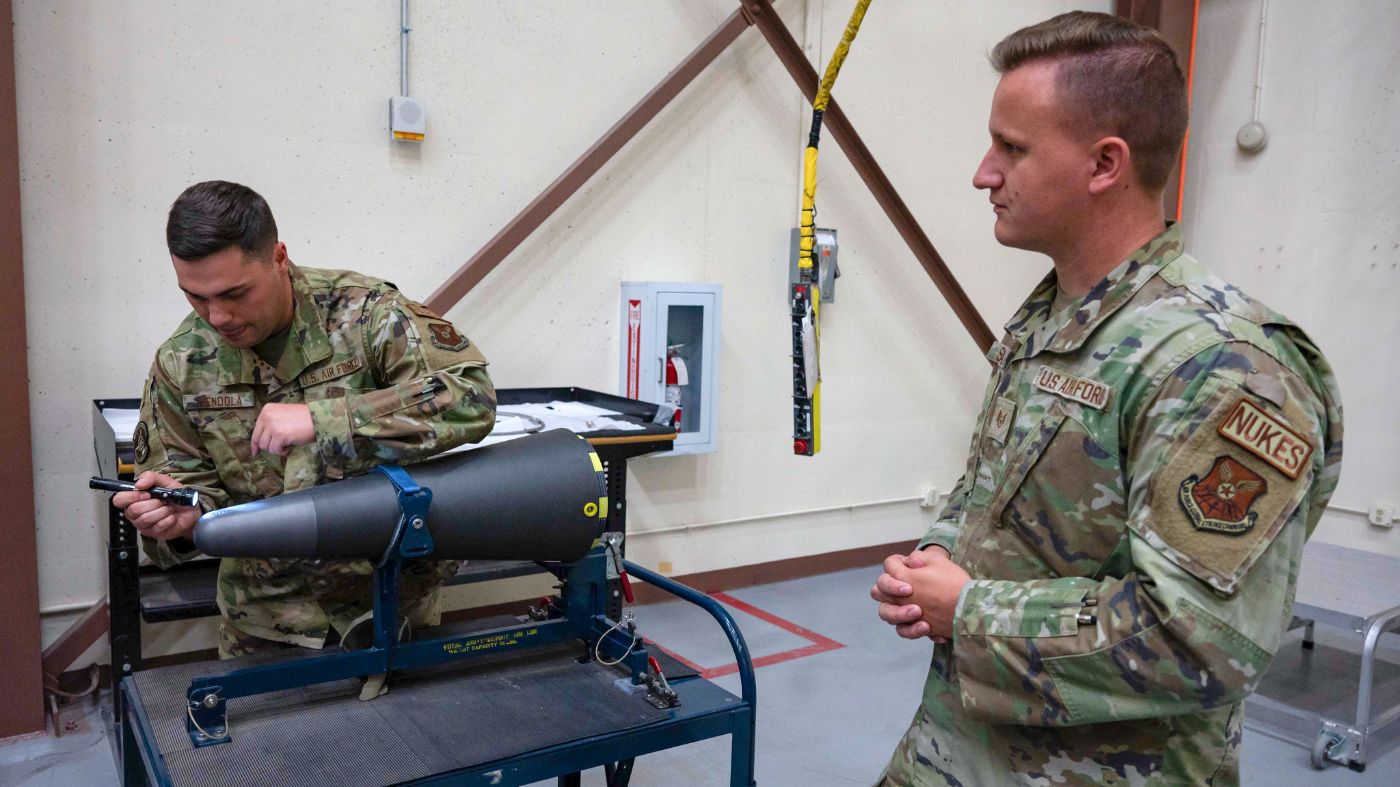
According to NBC News , and broadly confirmed by Undersecretary of Defense for Policy Elbridge Colby, the Department of Defense is drafting a nuclear strategy that places far greater weight on shorter-range, lower-yield tactical weapons in a regional conflict with Russia or China.
This is not, as Moscow’s and Beijing’s propagandists claim, a march toward nuclear war. It is an acknowledgment that America’s deterrent has a credibility gap, and that gap has been widening for years.
Here’s the uncomfortable part: the logic behind the reassessment is sound. America’s current posture forces any president into a binary choice — absorb a limited nuclear strike on an ally or retaliate in a way that risks Armageddon.
Vladimir Putin’s generals have spent two decades developing an “escalate to de-escalate” doctrine, using small battlefield nuclear weapons to shock NATO into freezing a conflict, betting Washington would blink rather than trade New York for Warsaw. Beijing has built a rapidly expanding force of theater-range missiles capable of similar coercive signaling against Taiwan and Japan. If Washington’s only response to a tactical provocation is total strategic war, its deterrent deters very little.
Colby has been walking a careful line. At STRATCOM’s Deterrence Symposium in Omaha this month, he called the effort a “ relook ” at deployment guidance rather than a policy announcement. Days later he went the other way, telling reporters the goal is “to maintain deterrence and stability rather than to exacerbate it.” Either way, the review is real, and the politics are already delicate.
None of this is new territory. In the 1980s, NATO’s Euromissile deployments were justified on identical grounds that a Soviet strike on Europe could not be met solely by threatening an intercontinental exchange. That deployment sparked mass protests yet arguably brought Moscow to the table for the Intermediate-range Nuclear Forces Treaty . Firmness, not restraint, produced that breakthrough.
There is real danger here. Critics in Congress and the arms control community are right: Any doctrine premised on “limited” nuclear use invites the illusion of control. War games suggest a tactical exchange that, once begun, is exceedingly difficult to contain. The fog of war does not respect neat escalation ladders.
The timing compounds the risk. The New Strategic Arms Reduction Treaty (New START) lapsed in February . For the first time in more than half a century, no treaty ceiling restrains Washington’s or Moscow’s deployed warheads, strategic or tactical. A doctrine expanding the perceived usability of nuclear weapons, unaccompanied by any arms control framework, risks triggering the buildup Russian and Chinese state media are already highlighting as proof of American “ nuclear blackmail ”.
That criticism should be read for what it is: an attempt to deter Washington from closing its own credibility gap. Dmitriy Trenin, president of the Russian International Affairs Council has warned expanded U.S. tactical deployments would sharply raise tensions — a remarkable complaint from the nation that pioneered modern tactical nuclear coercion in Europe.
Beijing’s Global Times has denounced the review as coercive pressure, even as China’s stockpile has grown from roughly 200 warheads a decade ago to about 620 today, by independent estimates , with the Pentagon projecting up to 1,500 by 2035 — still well short of Washington’s roughly 3,700 and Moscow’s roughly 4,400. That trajectory looks less like a bid for parity with the U.S. or Russia than a deterrence posture calibrated against them.
Toward its neighbors, though, an arsenal that size is unambiguously offensive-capable, and Beijing is already fielding theater-range systems aimed at Taiwan’s American guarantors. Washington isn’t creating a new category of nuclear risk. It’s catching up to one its rivals built while American doctrine stood still.
The path forward requires discipline. Any expansion of tactical options must be married to ironclad command-and-control safeguards, so flexibility doesn’t curdle into the ambiguity critics fear. Washington must treat this posture shift as leverage, not an end in itself. It’s worth more if it eventually forces Moscow and Beijing toward a negotiated framework than if it becomes the new steady state of an unconstrained arms race.
And allied consultation cannot be an afterthought. Poland, the Baltic states, South Korea and Japan will each weigh reassurance against the anxiety of becoming a bigger target. NATO’s Nuclear Planning Group and equivalent Indo-Pacific consultations need to be brought in early — and for real.
There is also a domestic dimension. For those worried about rising right-wing populism worldwide, a safer security environment under a rejuvenated American nuclear umbrella is more likely to bolster liberal democratic institutions than undermine them.
Colby is not manufacturing a crisis. He’s responding to one Moscow and Beijing have been building for years while Washington’s tactical deterrent atrophied. The Pentagon is right to close that gap. But credibility bought through expanded nuclear options is only durable if it’s disciplined and transparent to allies and aimed at restoring the negotiated stability that ended the last Cold War.
Washington should not trade one credibility gap for a far more dangerous one.
Ariel Cohen, Ph.D. is a senior fellow (non-resident) at the Atlantic Council’s Eurasia Center and Global Energy Center, and director of the Energy, Growth and Security Program at the International Tax and Investment Center. He is the founding principal of International Market Analysis.
Topics in this story
Gathered from external sources. Rights to this text belong to whoever originally published it.