For Jeffries, the glide path to Speaker has some bumps
With a huge Democratic majority lining up behind him, House Minority Leader Hakeem Jeffries (D-N.Y.) is a shoo-in to win the Speakership in the next Congress. But getting there won’t be a cakewalk, either. Outside liberal groups, wary that Jeffries is too moderate, have scrambled to block his promotion with a desperate search for an…
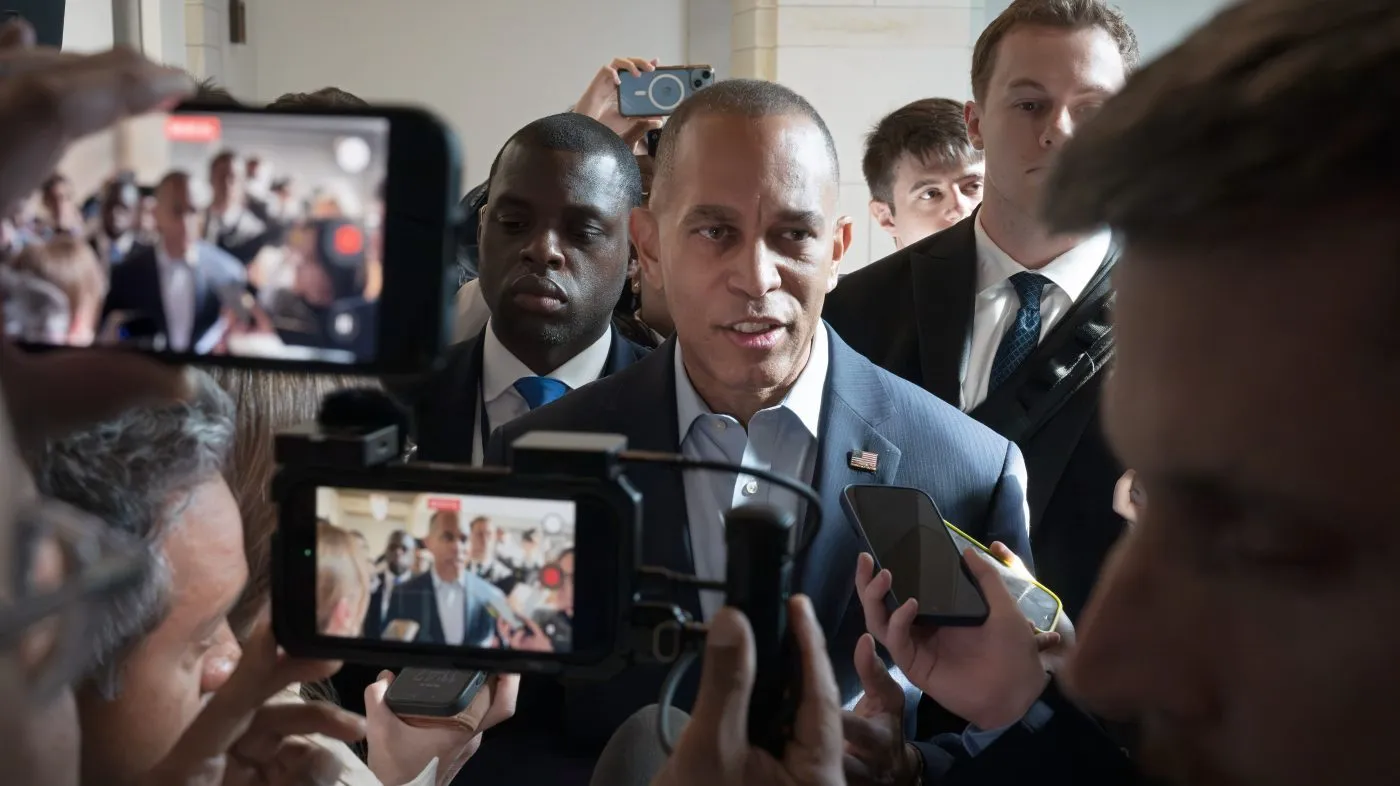
With a huge Democratic majority lining up behind him, House Minority Leader Hakeem Jeffries (D-N.Y.) is a shoo-in to win the Speakership in the next Congress. But getting there won’t be a cakewalk, either.
Outside liberal groups, wary that Jeffries is too moderate, have scrambled to block his promotion with a desperate search for an eleventh-hour challenger.
A huge crop of incoming first-term lawmakers is vowing to shake up Washington, including some who have questioned Jeffries’s leadership chops and still aren’t committed to backing him.
And many Democrats, veterans and newcomers alike, are clamoring for changes to the Democrats’ internal rules that include new term limits for committee heads — a controversial move that could drastically shift power dynamics within the caucus that is already sparking an animated battle among the Democrats’ various factions.
Those disputes won’t prevent Jeffries from being nominated for the Speakership on Wednesday, when Democrats will huddle privately in the Capitol to decide. And they won’t stop Jeffries from winning the gavel when the full House gathers on Jan. 3 for the formal Speaker’s vote. But the combination will challenge Jeffries’s grip on the caucus — and provide an early test of his dexterity in balancing the interests of liberals and centrists through the final years of the Trump administration.
“What we need in this moment right now is not just a caucus leader, but a leader of the Democratic Party,” Rep.-elect Don Leonard (D-Ohio), who ousted Rep. Mike Carey (R-Ohio), told CNN on Sunday. “What I was seeing, from the letter [in which] he requested my support for his Speakership, was not indicative of the kind of things that my constituents need to see in order to put our faith that he is able to lead us.”
Others, like Rep.-elect Melat Kiros (D), who pulled off an upset victory in Colorado’s primary to advance to November’s election, are seeking assurances from Jeffries that the party will pursue priorities such as “Medicare for All,” a moratorium on data centers and legislation restricting U.S. aid to Israel.
Jeffries, for his part, is downplaying the internal tensions, at least in public. And he’s pointing to the Democrats’ successes in battling President Trump over the past two years — including the neutralization of the Republicans’ midterm redistricting effort — as evidence that he’s savvy, seasoned and tough enough to assume the Speakership.
“The record speaks for itself,” he told reporters Thursday in the Capitol. “But that doesn’t mean it’s not important to talk to every single member of the House Democratic Caucus family about what the future looks like and how we can build upon this record.”
The very next day, the party divisions were on full display in Denver, where a who’s who of Democrats gathered to celebrate their midterm sweep and begin plotting a path forward. Almost immediately, the party’s unity message hit a brick wall in the form of Sen. Chris Van Hollen (D-Md.), who used the assembly to defend his challenge against Senate Minority Leader Chuck Schumer (D-N.Y.) to lead Democrats in the majority.
At the same conference, Jeffries took the stage . The goal was to outline Democratic priorities next year, but many of the headlines from the event focused on something else entirely: The heckling he got from protesters who shouted “why should we trust you?” and “f‑‑‑ing liar.” One even said, “The American people demanded impeachment.”
The outbursts have highlighted the simmering distrust of the party brass, even after the massive midterm victory that will give Democrats control of both chambers next year.
Some progressive groups have floated Democratic Reps. Ayanna Pressley (Mass.) and Jamie Raskin (Md.) as potential contenders for Speaker. A change.org petition, organized by the Coalition for Speaker Ayanna Pressley, has garnered more than 140,000 signatures. The petition notes that Pressley has a “genuine commitment to justice and equality” that resonates with millions of Americans. Another change.org petition demanding that House Democrats choose a new candidate for Speaker has received more than 1 million signatures.
But Pressley’s office merely told Axios she is in “active conversations” with Jeffries on how to “leverage this majority” and “meet the moment,” noting she appreciates the support from people nationwide. And Raskin told the outlet he is “not a candidate for Speaker in any way,” saying he supports Jeffries for the position.
For Jeffries, the absence of a challenger paves the way for a drama-free nomination process when the Democrats meet on Wednesday. But a fiercer battle may come later in the lame-duck session, when Democrats will craft the rules governing the caucus in the next Congress.
Unlike Republicans, Democrats have no term limits on committee heads. But Rep. Susie Lee (D-Nev.) has proposed an amendment to change that, capping a lawmaker’s time atop a committee at four terms, regardless of whether Democrats are in the majority or the minority. The proposal is supported by a large number of Democrats, who want to provide newer members with more opportunities to rise in the ranks.
Rep. Pramila Jayapal (D-Wash.), the former head of the Congressional Progressive Caucus (CPC), said last week that she has always been for term limits, though she said she would need to look at the specifics of any proposal.
“When I was CPC chair, I installed term limits on myself so that I wouldn’t be chair forever because I think that it is very important in a party to have a development of leadership and a development of the bench, and there’s too much of people sticking around for too long and forgetting what the urgency is in the field,” Jayapal said. “I told Nancy Pelosi this when I first came in. Republicans have had term limits on chairmanships, and I think that’s a good thing.”
The idea is facing a backlash from others, however, including representatives of the Congressional Black Caucus (CBC), where veteran members hold powerful gavels and want to keep them.
“I am diametrically opposed to it,” said Rep. Gregory Meeks (D-N.Y.), who’s in line to chair the House Foreign Affairs Committee next year. He noted that any member of a committee can vie for the top spot already, as several junior lawmakers did successfully at the start of the current Congress.
“We’ve got a process that’s in place that works for all of us,” Meeks said. “So we don’t have to emulate what the Republicans do.”
The issue is particularly tricky for Jeffries, who’s a member of the CBC and will face plenty of pressure to reject new term limits, even as newer, younger members advocate for that very thing.
Despite the internal fights, Jeffries got a huge boost from the midterm results, which not only lent credence to his messaging strategy, but also provided him with an enormous cushion to absorb defectors and seize the gavel.
“People just got elected from their districts. There are people that are making their voices heard. I think coming in … and being deliberate about where this country is going on healthcare, where this country is going around ICE’s [Immigration and Customs Enforcement] cruelty, what we are doing on investigations — I think it is completely normal for someone to show up and say, ‘What’s the agenda?’” progressive firebrand Rep. Alexandria Ocasio-Cortez (D-N.Y.) said last week.
“I think that is a very normal way of going about things. I don’t think everyday people send and elect new members of Congress to come in and immediately take orders. So I think it’s a totally fair and responsible thing to do. You can’t make villains of people who just showed up two days ago and are asking good faith questions,” she added.
Topics in this story
Gathered from external sources. Rights to this text belong to whoever originally published it.