The last big midterms mystery: Who will these future governors choose to replace them in the Senate?
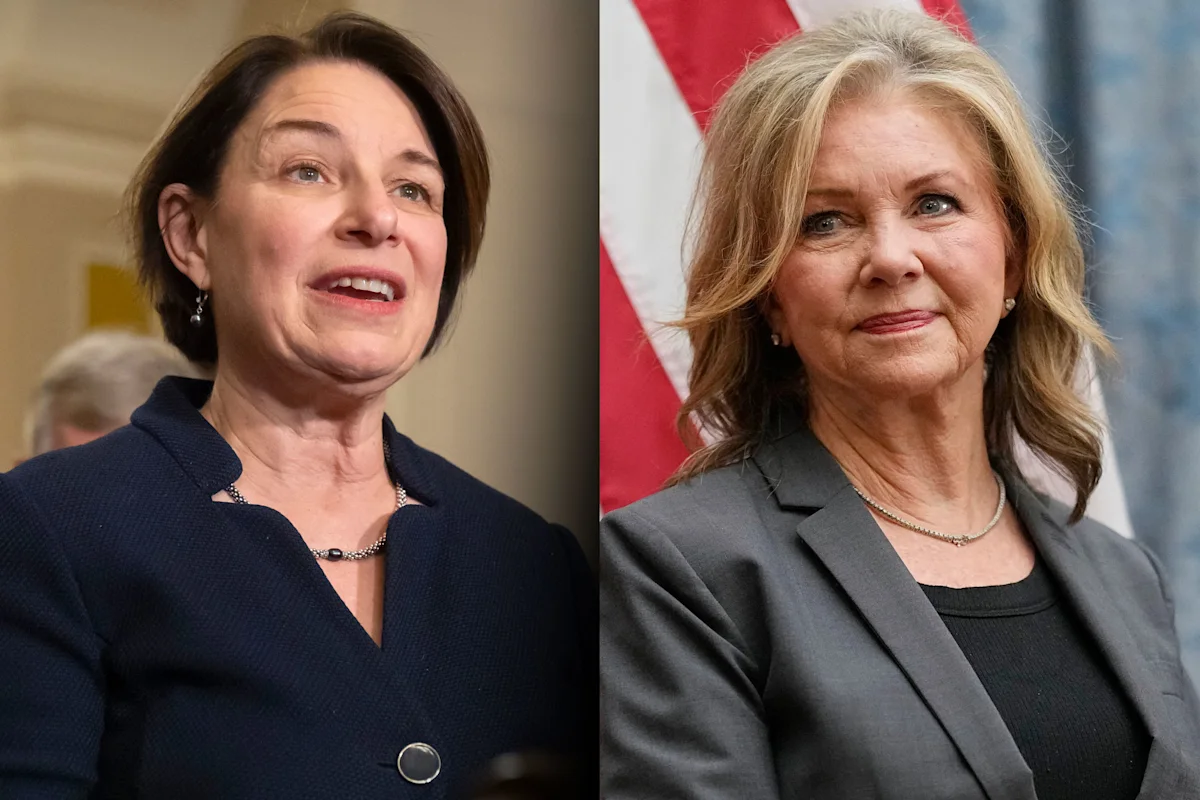
Minnesota's Amy Klobuchar and Tennessee's Marsha Blackburn will have the power to personally select their successors when they're sworn in to their states' t...
The last undecided Senate race finally got a winner on Tuesday night when Alaska Democrat Mary Peltola defeated incumbent Republican Sen. Dan Sullivan to give her party its ninth flipped seat this midterm cycle.
Peltola's win, which came more than two weeks after Election Day, means the final balance of power in the Senate is set. When the new Congress convenes for the first time in January, Democrats will control 56 seats, and Republicans will hold 44 seats.
But there are still two important questions that remain unanswered about the next Senate caucus. As it stands, we only know the identities of 98 of the 100 senators who will serve in the upcoming Congress, and it could be weeks before we find out who those last two pivotal lawmakers will be.
That's because two current senators, Tennessee Republican Marsha Blackburn and Minnesota Democrat Amy Klobuchar, were each elected governor of their home states. They will need to leave the Senate to assume their new positions.
Laws in Tennessee and Minnesota give governors the power to temporarily fill Senate vacancies. That means Blackburn and Klobuchar can each choose their own successor as one of their first acts as governor if they wait to resign from the Senate until shortly before they're sworn in. Both have indicated they plan to do so but have offered very few clues about who they might consider.
It's highly unlikely that either of them would select a replacement from the opposition party, so the partisan split in the Senate probably won't change. But their decisions will still carry a lot of weight. Whoever they choose will occupy two of the most important legislative seats in the U.S. government and could play a significant role in defining the ideological direction of their respective parties.
Blackburn, who has represented Tennessee in the Senate since 2019, announced her bid for governor in August 2025, just nine months after winning reelection to a second Senate term. This year's gubernatorial race was much closer than Republicans in the Volunteer State are accustomed to, but Blackburn was still able to defeat her Democratic challenger, Jerri Green, by more than 50,000 votes. She is the first woman elected to the state's top office.
Blackburn is a staunch conservative and Trump ally. She opened her first gubernatorial campaign video by saying, "Trump is back. America is blessed and Tennessee: better than ever." Her MAGA credentials suggest she's likely to select a successor with a similar profile, but that won't be certain until her choice is formally announced.
Throughout the campaign, Blackburn repeatedly declined to answer questions about who she might choose to replace her but said early on in the process that she intended to make the decision herself, rather than leaving it up to outgoing Republican Gov. Bill Lee.
That hadn't changed in the weeks since she was formally elected. She told Fox News on Nov. 15 that she hadn't made up her mind and didn't yet have a "short list" of potential replacements.
"I'm focused on finishing the work in the Senate and transitioning to governor," she said.
Blackburn's coyness hasn't stopped speculation about who her selection might be. In the days after Democrats' decisive midterm performance earlier this month — which many top Republicans attributed to voters' dissatisfaction with the war in Iran — rumors began to spread that Blackburn might choose embattled Defense Secretary Pete Hegseth to fill her seat. Those rumors were quickly refuted by sources close to Blackburn.
The two names that have been most frequently suggested as Blackburn's replacement are former Knox County Mayor Glenn Jacobs and U.S. Rep. Tim Burchett.
Jacobs turned to politics after a long career in professional wrestling, where he performed as the horror-themed character Kane. He told Fox News in September that it would be a "huge honor" to be Blackburn's chosen successor and he would "consider it very seriously" if asked.
Burchett, who represents Tennessee's deep red Second District in the House of Representatives, has said he "absolutely" wants to be considered for the position. He has also made clear that he intends to run for the Senate in 2028 against Blackburn's pick if she chooses someone other than him.
Blackburn is scheduled to be sworn in as governor on Jan. 16 and would likely appoint her replacement shortly after taking office. Whoever she chooses will hold her seat until the 2028 general election, when a special election will be held to decide who will finish out the remaining two years of her term.
When Minnesota's Democratic Gov. Tim Walz abruptly dropped his bid for a third term in January, reports immediately began to circulate that Klobuchar was considering launching a bid to replace him. She made it official a few weeks later. A former presidential candidate with a strong record of success in statewide races, Klobuchar quickly became the frontrunner in the Minnesota governor's race. She easily defeated Republican Lisa Demuth on Election Day. She will be the first woman to serve as governor of her state as well when she's sworn in on Jan. 4.
Like Blackburn, Klobuchar has said she intends to choose her own successor and has remained mum on who she may be considering. One name that can be crossed off the list is Walz, who said he would "rather eat glass" than take over her Senate seat.
Under Minnesota law, Klobuchar's successor would fill her seat on a temporary basis until November 2027, when a special election will be held to decide who will finish the remaining three years of her term. Because of that short time frame, Klobuchar has described the appointment as an "interim position."
"It would be for about a year," she told a local news station last month.
Nothing in Minnesota law bars appointees from running to keep their seat, but there is some recent history of governors filling vacancies with lawmakers who promise not to campaign for reelection.
Replacements often end up holding on to their seats, however. Minnesota's other senator, Tina Smith, was appointed to her seat in 2018 and has been reelected twice since then. Smith is retiring when her term ends in January.
Klobuchar could insist that her successor pledge to serve only as a temporary placeholder, but she hasn't said whether she might disqualify potential candidates who decline to do so.
Her selection, and the Senate race that will follow in November, could say a lot about the ideological direction of the Democratic Party. Midwest swing states were home to some of the most tightly contested midterm primary battles between progressive and moderate candidates anywhere in the country.
Minnesota's Senate primary was won by the more left-leaning candidate, Peggy Flanagan. The same thing happened in nearby Michigan, where Abdul El-Sayed eked out a primary win over moderate Haley Stevens. Both Flanagan and El-Sayed won their general election races earlier this month.
Topics in this story
Gathered from external sources. Rights to this text belong to whoever originally published it.