Why North Carolina is shifting Democratic
Democrats have the wind at their backs in North Carolina, particularly in the race for Senate, where former Gov. Roy Cooper, a Democrat, is up against Republican political operative Michael Whatley to replace retiring Sen. Thom Tillis (R-N.C.). Based on polling, nonpartisan ratings and campaign shifts, Cooper seems poised to win. A national Republican PAC…
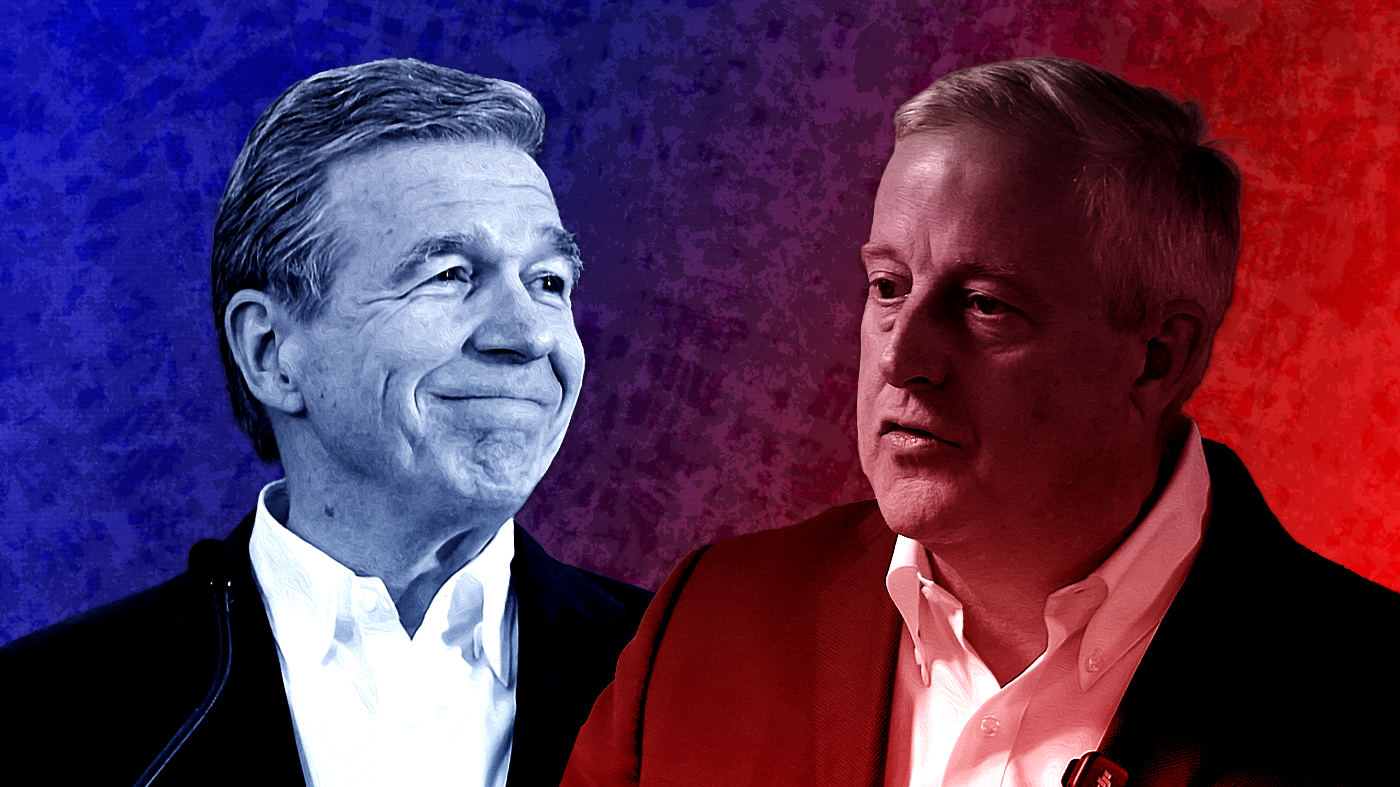
Democrats have the wind at their backs in North Carolina, particularly in the race for Senate, where former Gov. Roy Cooper, a Democrat, is up against Republican political operative Michael Whatley to replace retiring Sen. Thom Tillis (R-N.C.).
Based on polling, nonpartisan ratings and campaign shifts, Cooper seems poised to win. A national Republican PAC last week moved money out of North Carolina and into Kansas, once thought a much harder shot for Democrats. A Democratic group tied to Senate Democratic leadership also took down some ads .
It’s all a rush of indicators that Cooper and Democrats down the ballot are likely to be successful. North Carolina is seen as more and more of a swing state, although the state’s voters have swung for Republican presidents for decades with the exception of President Obama in 2008.
The Cooper campaign is taking nothing for granted.
“A Democrat has not won statewide federal office here in nearly two decades, and North Carolina is a 50-50 state,” campaign manager Jeff Allen said. “We’re building a campaign to earn every vote and make sure North Carolinians know that Roy Cooper will fight for them, while Michael Whatley will continue to enrich himself at their expense.”
The Senate stakes in particular are high, as Democrats are looking for every opportunity to flip Republican-held seats in hopes of regaining their majority. They need to take at least four seats, and that’s if they don’t lose any.
The Democrats’ success, political minds in the state say, is in large part due to Cooper, who has never lost an election and has maintained a folksy, likable and scandal-free brand.
But Tar Heel Democratic optimism goes beyond the Senate: Two House races that should be safer for Republicans, including one that was redistricted to be such, are also looking less like a GOP slam dunk. And there’s even a chance Republicans could lose their majority in the state Legislature, although that is less likely.
Chris Cooper, a professor of public policy at Western Carolina University, said the demographics of the state aren’t necessarily bluer. While there’s been an increase of younger, more liberal voters moving to North Carolina’s urban areas, it’s been balanced out by further entrenchment in the rural areas, which have become politically redder in the President Trump era. But the state still has a Democratic governor and a handful of Democratic state officials, with a Republican majority in the Legislature.
Chris Cooper, who is not related to the Senate candidate, said Democrats are also benefiting from Whatley’s status as being relatively unknown in the state compared with the four-time attorney general and two-term governor.
“We’re having this conversation less than a month until the election, and there’s already been thousands and thousands of votes cast in the state of North Carolina, and people still don’t know who the guy is,” Chris Cooper said.
Whatley was the Republican National Committee chair from 2024 to 2025 and a key figure in Trump’s second reelection contest. Before that, he was the chair of the state Republican Party for years.
But Chris Cooper said it’s difficult to beat the longtime governor’s name ID.
“His secret sauce, in some ways, is mayonnaise, right?” he said. “He’s been able to avoid scandal. He is rhetorically disciplined. You could spend all month looking for rhetorical gaffes from Roy Cooper, and you’re just not going to find any. So he’s a careful politician; he doesn’t make rhetorical mistakes; he is disciplined on the stump, and that has all amounted to a multi-decade career in North Carolina politics as a Democrat.”
The Whatley campaign and national Republicans, including Trump, have sought to dampen that reputation by pointing to Roy Cooper’s record on crime. North Carolina had, in 2024, a slightly higher homicide rate than the national average , and Cooper came under fire for releasing a batch of inmates in 2021, during the peak of the pandemic, to resolve a legal case about COVID-19 spreading within the prisons.
The GOP has run ad after ad, taking Roy Cooper to task for that move and drawing a line, sometimes inaccurately , between the inmate release and violent crimes committed in recent years.
But public safety may not be a salient enough issue for voters, according to Michael Bitzer, a professor of politics and history at Catawba College.
Bitzer mentioned a Catawba and YouGov survey conducted in September that showed voters’ primary concerns are the economy and inflation , regardless of party. Crime, while a concern, ranked below those issues and worries about protecting democracy.
The National Republican Senatorial Committee, which supports Republican candidates, went beyond Cooper’s record on crime in a statement.
“Roy Cooper drove healthcare costs to the highest the nation, put men back in women’s bathrooms, and released violent criminals from prison early,” said Nick Puglia, a spokesperson for NRSC. “Cooper’s far-left agenda is dangerous and too extreme for North Carolina.”
Now, Whatley’s campaign has no ads scheduled after this week. Bitzer said that could indicate that the campaign is rethinking the message. But time is running out to shape voters’ minds, as early voting starts Thursday.
“So I don’t think that that strategy, as long as they’ve been running it, has had the effect that they were hoping for,” Bitzer said. “And I think the real question is, you know, do they pivot to acknowledge the issue of affordability now, or do they try and position some other issue at play?”
Democrats’ optimism is also showing up in downballot races. Statehouse Republicans redrew the district map last year to make it more favorable to the GOP, but the two most competitive districts are still not guaranteed wins.
In the 1st Congressional District covering northeastern North Carolina, Rep. Don Davis (D) has managed to shift the race from “likely Republican” to “lean Republican” in political forecasts .
Another district, the 11th, which blankets western North Carolina, is rated as a “toss-up.” The traditionally Republican region was devastated by Hurricane Helene in 2024, and three counties in the district shifted leftward in the election a few weeks later, even as Trump won the state. Now, incumbent Rep. Chuck Edwards (R) is not running again, after allegations that he engaged in unprofessional conduct toward female staffers resulted in a censure by the House.
His replacement on the ballot, state Rep. Jennifer Balkcom (R), is lesser known than her Democratic opponent, Jamie Ager, a farmer and entrepreneur who has been campaigning for months.
Even safer Republican incumbents seem nervous: Rep. Richard Hudson (N.C.), the chair of House Republicans’ campaign arm, has reportedly reserved more than $200,000 in ad spending in his own district, which voted for Trump by 16 points in 2024.
The state does have a history of ticket-splitting, as shown by Roy Cooper’s wins in years the state went for Trump. Bitzer said he could see the potential for voters to back Cooper and then support downballot Republicans.
“I have learned over studying the state’s politics for 25-plus years never to underestimate the power of North Carolina surprising you in some way, shape or form,” Bitzer said. “So you know, will things tighten up? I think that’s everybody’s expectations. It’s going to take a lot of tightening for the Republicans to make this a close election.”
Topics in this story
Gathered from external sources. Rights to this text belong to whoever originally published it.