Supreme Court slams brakes on Trump’s mail-in voting plan
In today’s issue: ▪ McConnell’s long-awaited return ▪ Kennedy Center closure vote ▪ Donald Trump Jr.’s wedding gift controversy ▪ Key AI test in House The Supreme Court dashed President Trump‘s push for mail-in voting restrictions with a decision handed down late Monday, with November’s election 50 days away. The court ruled over the public dissents…
▪ Donald Trump Jr.’s wedding gift controversy
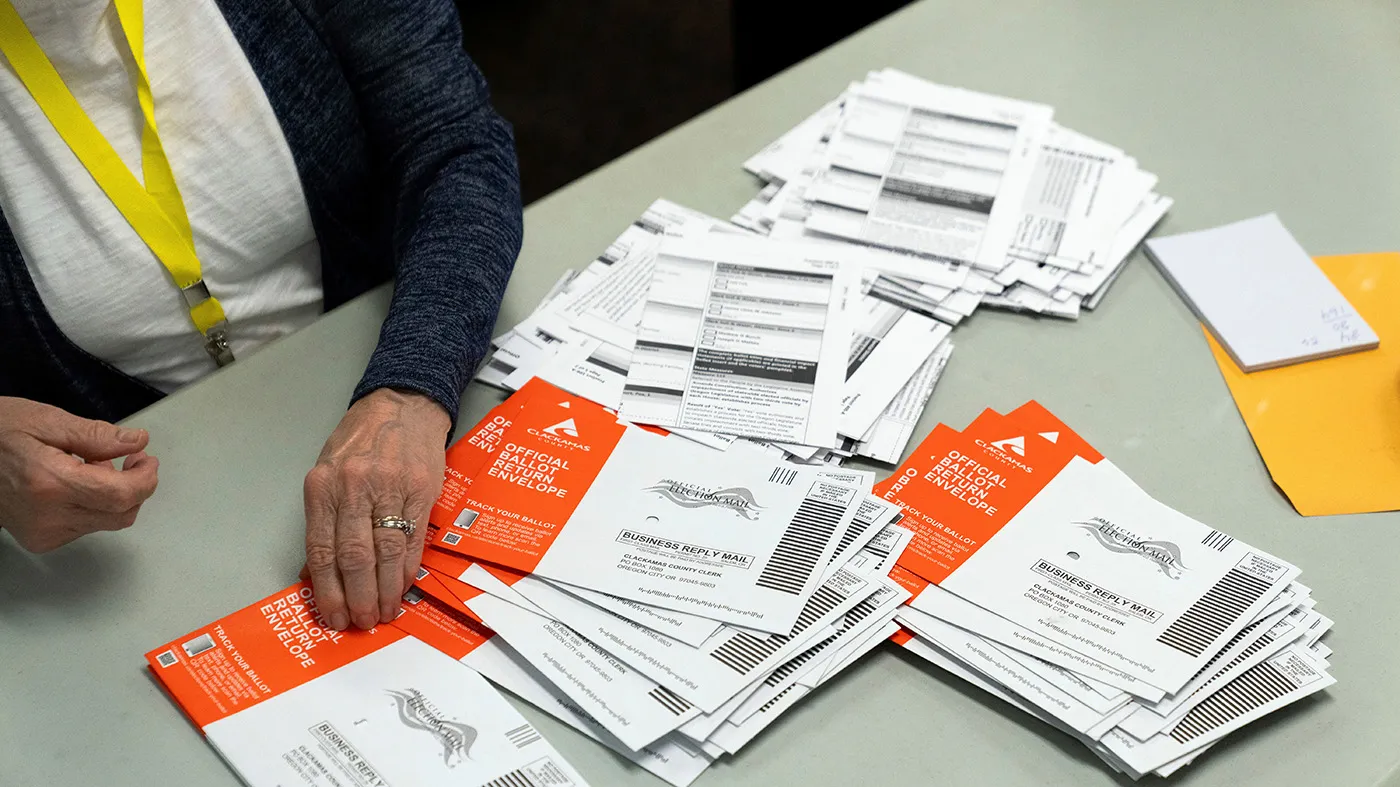
The Supreme Court dashed President Trump ‘s push for mail-in voting restrictions with a decision handed down late Monday, with November’s election 50 days away.
The court ruled over the public dissents of two conservatives, Justices Samuel Alito and Clarence Thomas , that the government was “unlikely to succeed” on the merits of its arguments against a federal judge’s order blocking the U.S. Postal Service’s implementation of Trump’s plan.
One of Trump’s appointees, Justice Brett Kavanaugh , sided with the majority but noted at least a decent argument exists that Trump’s plan is legal.
“But applying the rule in the 2026 elections would be arbitrary and capricious in violation of the Administrative Procedure Act because state and local election officials do not have sufficient time to reasonably implement the rule before the elections,” Kavanaugh wrote.
The logistical challenges of implementing Trump’s executive order were becoming more impractical by the week. A key deadline was reached earlier this month when the 60-day mark before Election Day passed, triggering North Carolina to send out ballots.
Other states are set to begin sending mail-in ballots in the coming days and weeks, and the federal government is required to start sending mail-in ballots to military and overseas voters on Saturday, 45 days before Election Day.
Trump’s executive order sought to require states to submit lists of voters eligible to receive a mail-in ballot by 60 days in advance and direct the Postal Service to only deliver ballots to those on approved lists. It also sought to require the ballots to have a specific approved design.
The ruling marks a rare defeat for the president on the court’s emergency docket. The court previously ruled in Trump’s favor, finding that a group of blue-leaning states likely didn’t have standing to sue because the order hadn’t been finalized.
But the states quickly sued again once the Postal Service sought to implement the order.
The court has been thrust into multiple key election fights recently with Election Day fast approaching. The court stepped in twice to rule against a GOP-favored map in Missouri that likely would’ve resulted in the party picking up an additional House seat.
And The Hill’s Zach Schonfeld notes that the court is still considering another case on whether the Department of Homeland Security can use an overhauled immigration verification system to scrutinize voter rolls.
The ruling on the mail-in voting plan isn’t the end of the legal fight. The court only refused to lift the lower judge’s block on the Postal Service’s plan, and the case can still continue through the legal system.
But opponents of the ban hailed the decision as a decisive win, for this cycle at least.
“Finally, fifty days out, and the American people have certainty when it comes to our country’s electoral process: Voting is safe, vote-by-mail is accessible to any and all who need it,” Gov. Gavin Newsom (D) of California, one of states that challenged the plan, said in a statement.
FIGHT FOR 2028 : Join The Hill’s Amie Parnes and editor-in-chief Ian Swanson today for a special conversation on the battle within the Democratic Party for the 2028 presidential race.
Parnes and Swanson will be joined by Robert Wolf , the founder of 32 Advisers and former chairman and CEO of UBS Americas.
They will discuss the state of the party, who’s up and down among the potential 2028 contenders, Trump’s latest thoughts on AI and Parnes’s reporting on whether the president has a “Biden problem” on the U.S. economy.
The Hill Insiders can tune in today at noon at the link here .
There’s a question right now about if Congress will put legislation together to regulate artificial intelligence in some form. Here’s another one: given AI’s incredible technical complexities, how many in Congress can handle the topic? I spoke with Rep. George Whitesides (D-Calif.), former chief of staff at NASA and former CEO of Virgin Galactic.
“Knowledge about AI is not evenly distributed throughout Congress. And it’s really important that folks who do understand about technology and engineering and how we can make these things work step up right now. That’s what I’m trying to do,” Whitesides said . “Here’s the thing: we have to take this on because it’s our job,” he added.
Whitesides is pushing for a “safety standdown” for at least a month. His proposal means you could still use your AI, but frontier research would be paused. We will start to see the ideas from Congress roll in about what guardrails could look like.
Burman hosts “The Hill” weeknights, 6 p.m. EDT/5 p.m. CDT on NewsNation.
Attorney General Todd Blanche will brief reporters in the Rose Garden on Tuesday, as the White House has yet to replace former press secretary Karoline Leavitt. Vice President Vance was the last administration official to brief reporters, 11 days ago.
Trump nominated retiring Rep. Wesley Hunt (R-Texas) to serve as U.S. ambassador to Saudi Arabia . Hunt lost the GOP Senate primary in Texas this year, finishing third behind state Attorney General Ken Paxton (R) and incumbent Sen. John Cornyn (R).
Voters are heading to the polls in Delaware today for the final primary of the midterm primary season. There are now fewer than 50 days remaining before Election Day in November.
Sen. Mitch McConnell (R-Ky.) speaks at an event, Aug. 2, 2025, in Fancy Farm, Ky. (Mark Humphrey, Associated Press file)
HE’S BACK: Sen. Mitch McConnell (R-Ky.) returned to the Capitol on Monday to cast his first vote since June 11 after spending months recuperating from a fall he took at his Washington, D.C., home.
McConnell’s months-long absence and the limited information provided to the public fueled speculation about his condition and questions about when and whether the former longtime Republican leader would return to Washington before he retires in January.
The Hill’s Alexander Bolton reports that McConnell appeared in good spirits, albeit frail, when he greeted reporters before heading into the Senate chamber to cast his first vote in 13 weeks.
“After two years — two decades, actually — of dodging your questions, I wasn’t sure how many of you would be here today. So I’m glad to see you. Time to get back to work, finish the job of this Congress,” the longtime senator told reporters.
McConnell, who was being pushed in a wheelchair by an aide, told reporters that he returned to Congress to work on the farm bill, acknowledging its importance to Kentucky, and because of his “ongoing interest in NATO and backing up our good friends who are totally in a fight against the Russians,” referring to Ukrainian forces.
McConnell’s return will also provide Republicans the vote they need to pass the farm bill out of the Agriculture Committee and to advance regular spending bills out of the Appropriations Committee.
The senator announced his return in a post on the social platform X Monday evening, acknowledging that his recovery has not been easy but saying he’s“really looking forward to being back on the Senate floor and seeing my colleagues.”
“My recovery has been a long and often frustrating process, and the lingering effects of childhood polio haven’t made it any easier. I’m still not quite back to 100%, but I’ve assured [Senate Majority] Leader [John] Thune [(R-S.D.)] that, as I continue with physical therapy on the advice of my doctors, I will do my best to be present for tough votes when our Conference needs me,” he continued.
▪ The Hill : McConnell’s return shines spotlight on older lawmakers.
▪ WHAS : Photos as McConnell returns for first time since June.
RUSSIA SANCTIONS: The House Rules Committee approved a Russia sanctions bill in a 7-3 vote Monday, sending it to the full House for a vote later this week. The legislation received a new wave of momentum following the death of Sen. Lindsey Graham (R-S.C.), its sponsor and one of the GOP’s most vocal members of Congress in strengthening opposition to Russia.
The bill was renamed for Graham and passed the Senate in an 86-11 vote, gathering widespread bipartisan support .
But getting the bill queued up could be a major challenge for House Speaker Mike Johnson (R-La.). Republican leaders in the lower chamber plan to advance the measure through regular order, meaning it will need to be approved in a procedural vote called a rule before it could potentially receive a final vote.
Johnson will need near-unanimous support among his conference members in that rule vote, with Democrats expected to overwhelmingly, if not unanimously, oppose it — as is standard practice for the minority party on rule votes. If all members are present and voting, Johnson could only afford to lose two of his members.
Democrats could also present significant opposition to the bill in its final vote despite their fellow party members in the Senate widely supporting it.
“This bill would dramatically expand presidential tariff authorities while failing to mandate sanctions on Russia, both of which are unacceptable. These flaws would raise Americans’ prices while undermining support for Ukraine in the long term,” Democratic Reps. Don Beyer (Va.), Gregory Meeks (N.Y.) and Richard Neal (Mass.) said in a statement last week.
The lawmakers said the bill would “do more harm than good” and called on members in both parties to develop a bill that can “deliver on our promise to Ukraine.”
▪ Punchbowl News : Hakeem Jeffries not taking sides on sanctions bill.
PRIME MEETING : The Kennedy Center’s board is meeting today to vote on whether to close the institution’s main building immediately for renovations as the battle over the center’s future escalates.
A copy of a draft resolution included in court filings states that officials are warning the center faces “certain fiscal collapse within weeks” if it isn’t allowed to add Trump’s name to the facility and publicly recognize his fundraising role. The document describes the institution as nearing bankruptcy as it’s struggling to manage payroll and routine maintenance costs.
A second resolution also set to receive a vote Tuesday asserts that the building is “unsafe for continued occupancy,” citing a recent water leak that caused the grand foyer to partially collapse.
The board previously voted to close the institution for two years as one of several changes that the Trump-picked panel has sought to make to the Kennedy Center, along with adding the president’s name to the building. A federal judge blocked the name change and the prolonged closure, though he allowed “necessary maintenance and repair work” to continue.
The Washington Post first reported the planned vote.
▪ Forbes : 10 ways the center is proposing to inscribe Trump’s name.
UNEASY BENCHMARK : Concerns over the bond market were on display again Monday as the 10-year U.S. Treasury bond yield surpassed 5 percent — only the second time that it has done so in nearly the past two decades.
The yield fell back below 5 percent later in the day Monday, but the moment marked the first time that it reached that high since October 2023 and the second time since July 2007, before the global financial crisis that led into the Great Recession.
Bond yields have been on the rise in the U.S. and around the world as a result of inflation from the Iran war and rising government debt, among other factors. The Treasury Department has taken steps to try to get the yields under control including increasing its maximum buyback limit from $2 billion to $6 billion, but they haven’t proved successful so far.
The Treasury is set to buy back up to $4 billion worth of seven- to 10-year securities on Thursday, its operations schedule states .
The development raises the stakes ahead of the Federal Reserve’s meeting this week, in which it could vote to raise interest rates for the first time in three years.
▪ The Hill : Trump’s $5,000 dividend falls flat with GOP senators.
▪ CNBC : Which matters more to stocks — the bond market or AI risks?
FROM RUSSIA WITH LOVE: The top Democrat on the House Oversight and Government Reform Committee is demanding answers following a report that a Russian oligarch provided significant funding for Donald Trump Jr. ‘s wedding.
A ProPublica report Monday stated that the president’s son’s wedding to model Bettina Trump , formerly Bettina Anderson, in May received funding from Umar Kremlev , who has been linked to Russian President Vladimir Putin .
The outlet reported that Kremlev helped rent an island and put up money for a fireworks show as part of hundreds of thousands of dollars in expenses that he covered. Bettina Trump defended the gifts that she and her husband received from Kremlev, saying he “very generously hosted two incredible nights of celebrations” after the wedding.
Rep. Robert Garcia (D-Calif.), the ranking member of the Oversight panel, raised questions as to whether Kremlev received anything in return. A spokesperson for Trump Jr. didn’t dispute Kremlev’s payments in a statement to ProPublica, saying he’s a personal friend.
REGULATION ROLLBACK : The Environmental Protection Agency (EPA) said it is repealing rules that limit greenhouse gas emissions from power plants fueled by coal and natural gas, prompting backlash from environmental groups.
The rule was first proposed last year and would take steps to walk back efforts by the Biden administration to regulate climate pollution. The EPA said the rule would save the industry more than $300 billion in costs and would allow utilities to make decisions that are best for customers rather than close inefficient plants, The Associated Press reported , citing an agency spokesperson.
The EPA proposed a separate rule Monday that could prevent future administrations from regulating greenhouse gas emissions. The move follows an earlier action this year revoking a scientific finding that was long used as the basis for U.S. efforts to regulate emissions. The proposal is expected to be made final next year, the AP reported.
The announcements came as the administration’s top energy officials hosted a Group of 20 meeting on “energy abundance” in Houston.
▪ The Hill : Six takeaways as Trump takes sledgehammer to power climate regulations.
The president will participate in a photo opportunity at 11 a.m. He will participate in an ambassador credentialing ceremony at 2:30 p.m.
The House and Senate will convene at 10 a.m.
Meta data centers operate, Saturday, Sept. 5, 2026, near Social Circle, Ga. (AP Photo/Mike Stewart)
TEMPERATURE CHECK : A key litmus test will be taken today as lawmakers vote on legislation seeking to mitigate AI data centers’ impact on consumers’ electric bills.
The House will vote on the Ratepayer Protection Act, a bill that would require state regulators to hold a hearing on a standard ensuring large data centers pay for the cost of new power or power lines stemming from electricity use.
The vote follows escalating warnings from current and former artificial intelligence researchers about the risks the technology could pose to humanity. While the bill focuses on the impact of data centers rather than reining in the technology itself, it presents an opportunity for lawmakers to respond to growing concerns about the industry’s impact on voters.
Politico notes that potentially vulnerable House Republican lawmakers have increasingly signed on as co-sponsors as backlash to AI has been growing. That includes at least five GOP front-liners.
The bill is being advanced along a fast-track process called suspension of the rules that requires two-thirds support for passage. If passed, the bill would codify a pledge signed by Big Tech leaders earlier this year.
The legislation has support from Trump and members across the aisle in Congress and is expected to pass easily.
Still, some Democrats have said they view the bill as only a “first step.”
It may be one of the only notable pieces of legislation related to AI that can pass during this Congress, with Trump and GOP leaders casting doubt on the need for regulations to slow the race toward AI “superintelligence.”
▪ The Hill : Trump bats down calls for regulation as fears spike.
▪ The Hill : GOP leaders throw cold water on AI regulation.
▪ The Hill Insider : Crypto regulation bill faces key Senate test.
Workers clean up damage at Darnytsia Thermal Power Plant after a Russian attack in Kyiv, Ukraine, Feb. 4, 2026. (Sergei Grits, Associated Press)
JUMPING THE GUN? Trump said Monday that Russia and Ukraine had agreed to avoid striking energy targets as the costs of oil and gas are on the rise, but it seems there’s still work to be done on a final deal.
The president announced in a Truth Social post that Russia and Ukraine agreed to not hit each other’s energy targets as refining capacity has grown limited amid attacks to refineries, resulting in higher prices.
Trump has increasingly sought to blame Ukrainian strikes on Russian energy depots for the jump in the cost of diesel fuel, downplaying the Iran war’s role in the rising costs.
But the Financial Times reported the announced deal caught Ukrainian officials off guard, as they await credible assurances that Russia would also comply.
Ukrainian President Volodymyr Zelensky said in a post on social platform X that his country isn’t convinced Russia is “willing to abide by any agreement.”
“If our partners are ready to ensure that Russia genuinely refrains from striking our electricity system, other energy facilities, critical infrastructure, and food supply routes, then, of course, we are ready to ensure a corresponding halt to our strikes,” he said.
People familiar with the Kremlin’s position told the Times that Putin is reluctant to strike a deal before the winter, when he thinks attacks on Ukraine’s energy infrastructure could press the country’s officials to make concessions in the conflict.
Two Ukrainian officials told the outlet that they believe Trump made the announcement to show the American people that he is trying to bring down prices.
Experts have said the Russia-Ukraine war is playing a part in the rising prices, but the instability in the Middle East is also a major factor.
The cost of a gallon of diesel reached $6 for the first time last week and currently stands at a record high of almost $6.27, according to AAA . The average cost of a gallon of regular gas has also been spiking, surpassing $4.32 on Tuesday.
▪ The Wall Street Journal : Russia churning out new weapons faster than Ukraine, U.S.
▪ CNN : Russia’s drone strike puts NATO on edge.
Ken Paxton’s plight in Texas is mostly of his own making , The Hill’s Chris Stirewalt writes .
It is now or never for the Clarity Act , Sen. Cynthia Lummis (R-Wyo.) writes in The Hill.
Jean Smart accepts the award for outstanding lead actress in a comedy series for “Hacks” during the 78th Emmy Awards on Monday, Sept. 14, 2026, at the Peacock Theater in Los Angeles. (AP Photo/Chris Pizzello)
And finally … Actress Jean Smart made history Monday night at the Emmys as she won best actress in a comedy series for a fifth consecutive time for “Hacks.”
With her win, Smart became the first woman to win the award for every season of a television series. The HBO Max comedy concluded its fifth and final season earlier this year.
Smart has won eight Emmys during her career, tying the record for a performer also held by Cloris Leachman and Julia Louis-Dreyfus .
Smart concluded her acceptance speech by saying, “What a ride.”
Meanwhile, the Apple TV horror comedy “Widow’s Bay” dominated much of the evening , winning for best comedy series, best lead actor, best supporting actor and actress, best writing and best directing. It won 14 awards out of 19 nominations in total.
Topics in this story
Gathered from external sources. Rights to this text belong to whoever originally published it.