Barrasso: Monday will be ‘D-Day for the economy in Iran’
Senate Majority Whip John Barrasso (R-Wyo.) said that Monday will be “D-Day” for the economy in Iran as the Trump administration and U.S. military vow to exert maximum financial and militaristic pressure on Tehran to end the war overseas. “Their economy is in shambles. And they’re still dangerous. So, the president’s right to focus on…
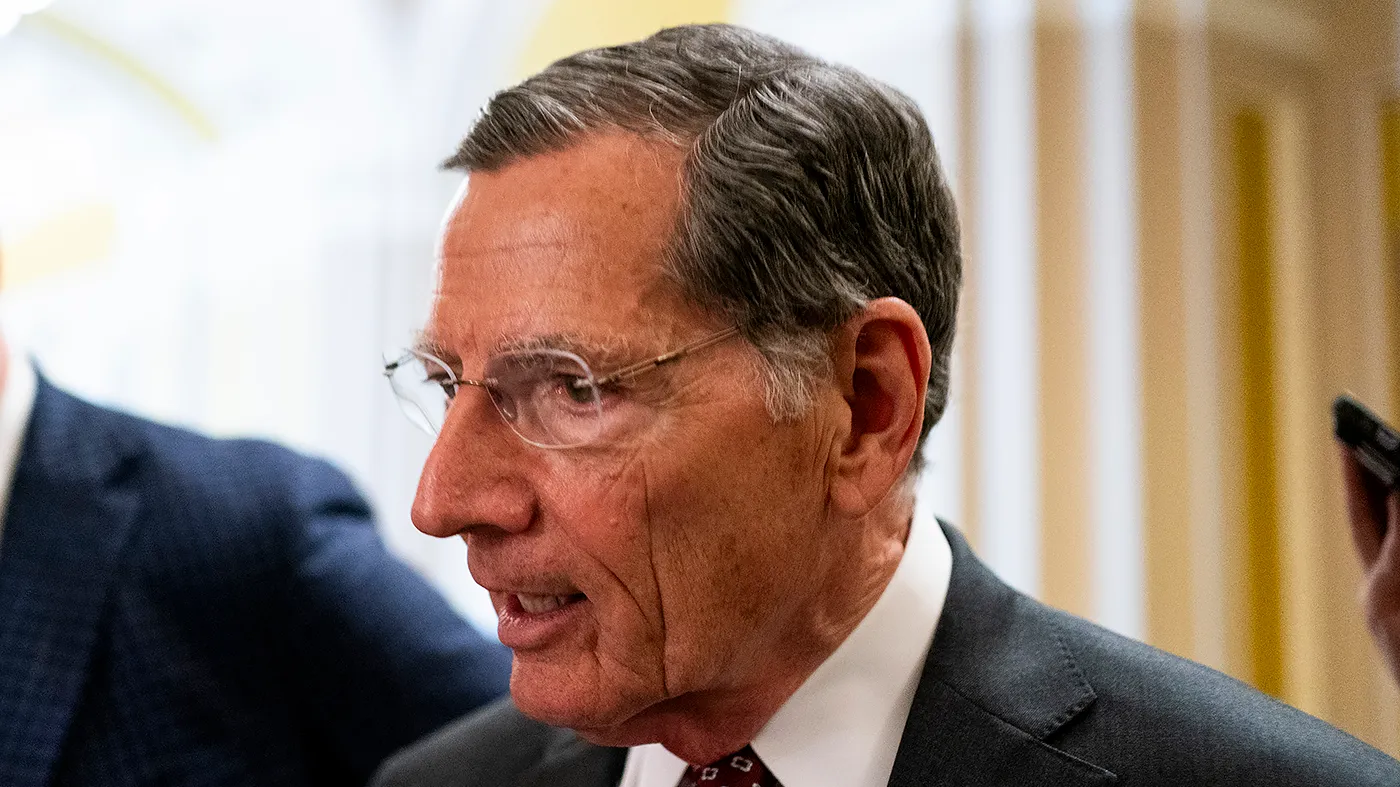
Senate Majority Whip John Barrasso (R-Wyo.) said that Monday will be “D-Day” for the economy in Iran as the Trump administration and U.S. military vow to exert maximum financial and militaristic pressure on Tehran to end the war overseas.
“Their economy is in shambles. And they’re still dangerous. So, the president’s right to focus on it. And now he’s going even further economically. And as you said, tomorrow is D-Day for the economy in Iran,” Barrasso told guest host Jason Chaffetz during a Sunday appearance on Fox News’s “ Sunday Morning Futures .”
The Wyoming senator said he believes the new pressure will cause the Iranian regime to fold — opening the Strait of Hormuz and agreeing to not having a nuclear weapon.
Iran’s decision to effectively close the Strait of Hormuz to commercial traffic ruptured the consistent flow of oil from the Middle East through a waterway responsible for carrying a fifth of the world’s oil transports daily.
The Trump administration’s primary component for an “economic D-Day” includes the aggressive use of secondary sanctions, meaning the U.S. will severely penalize any foreign nation, bank or business that acts as an economic lifeline to Iran.
Meanwhile, the Treasury Department has significantly ramped up enforcement on digital exchanges, freezing an estimated $500 billion in Iranian-linked cryptocurrency assets.
The U.S. Navy is also hunting down unregistered tankers and oil smuggling networks to drive Iranian crude exports to absolute zero while federal enforcement cracks down on alternative banking mechanisms, including currency swap lines, cash transfers and underground exchange houses, as reported by CBS .
Treasury Secretary Scott Bessent is scheduled to reveal the exact, detailed mechanics of the expanded Operation Economic Fury plan during a press conference on Monday.
On Sunday, Bessent said the impact of “economic D-Day” would be forceful.
“We are now entering the endgame. At dawn begins an economic D-Day — the single greatest financial offensive ever marshaled against an adversary. The Islamic Republic has subsisted by dressing extortion as security guarantees,” the Treasury Secretary wrote in a post on X.
“It has drawn strength from a calculus that regards Iranian retaliation as certain and American enforcement as negotiable. Under President Trump, that era is over. And those who fear the danger of defying Tehran ought not to discount the cost of testing Washington,” he added.
Despite efforts to ramp up punishment on Iran, their leaders say it’s a self-defeating mechanism that will only cause U.S. national debt to increase as the war drags on.
“The so-called ‘Economic D-Day’ is a diversion from America’s own crisis: unprecedented debt & surging interest costs,” Abbas Araghchi, the foreign minister of Iran, wrote on social media Thursday.
“Doubling down on failed policies will only bring further defeat—and enmity of Iranians,” he added.
Topics in this story
Gathered from external sources. Rights to this text belong to whoever originally published it.