Work to begin on Trump's 250-foot 'triumphal arch' over the next 2 weeks, administration says. Why is it so big, and what comes next?
Only one of the roughly 1,600 public comments submitted during the review process favored the project without major changes.
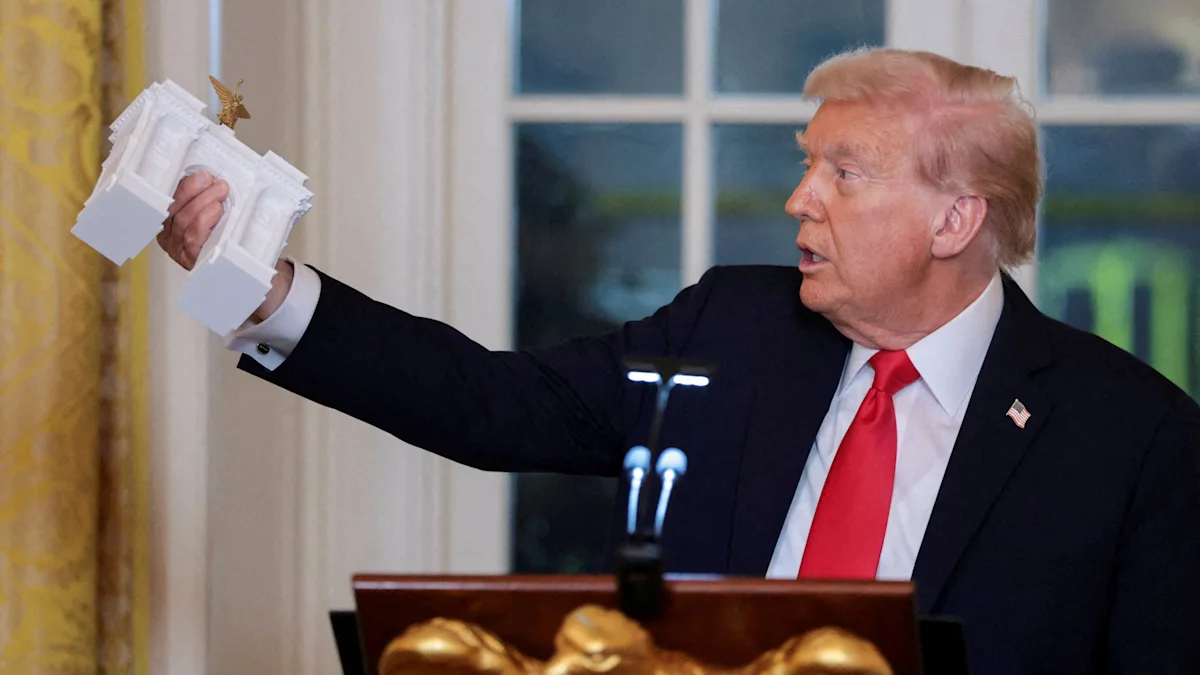
At first, it was supposed to be under 60 feet. Then it grew to 76 feet. Then it shot up to 164 feet and more.
Now the new "triumphal arch" that President Trump wants to build across the Potomac River from the Lincoln Memorial is set to stand 250 feet from bottom to top — making it the tallest in any of the world's capital cities.
On Thursday, the administration announced that it will start excavating the planned site of the arch over the next two weeks.
"This will be one of the Great Pieces of American Architecture … befitting the most powerful Capital in the World," Interior Secretary Doug Burgum wrote on social media .
Trump's arch is one of several projects the Republican president is pursuing as he seeks to leave a lasting imprint on Washington, including "renaming and renovating the Kennedy Center, building a huge new White House ballroom, refurbishing the Lincoln Memorial Reflecting Pool and rebuilding a golf course in East Potomac Park that could significantly reduce the public's access to running and biking paths," according to the Associated Press .
In May, the U.S. Commission of Fine Arts — the federal agency tasked with reviewing the "design and aesthetics" of all construction in Washington, D.C. — gave its final approval to the president's plans for the arch, after previously approving his planned 90,000-square-foot ballroom .
Packed with Trump appointees, the commission went so far in both cases as to fast-track its approval, bypassing the normal review process. At the time, Thomas Luebke, the panel's secretary, told its members that only one of the roughly 1,600 public comments submitted during the review process favored the arch project without major changes.
Many of the rest of the comments said the design "disrespects the [Arlington National] Cemetery and military sacrifice," Luebke continued. "The other ones have to do with misuse of public funds, that it's a gaudy or synthetically incompatible design, that [it] is authoritarian."
So will the president's so-called Arc de Trump — or his "Great Triumphal Arch and Military Observation Deck," as Burgum called on Thursday — actually get built?
For his part, the president has insisted that the answer is yes. "We're doing it," he told reporters in May. "We don't need anything from Congress."
According to the official architectural renderings unveiled in April, the United States Triumphal Arch would stand 250 feet tall — nearly 100 feet taller than Paris's Arc de Triomphe, which it resembles.
Like its French counterpart, Trump's arch would be constructed mainly of stone, with various classical elements — lintels, cornices, friezes, parapets — carved out of the same material.
Unlike the Arc de Triomphe, the U.S. Triumphal Arch would also sparkle with gold — lots of it. Gold medallions would adorn the coffers of the vault. Gold decorations would encircle the attic, including "One Nation Under God" and "Liberty and Justice for All" inscriptions. Three golden statues would top the arch itself: two eagles and a winged, crowned figure reminiscent of the Statue of Liberty.
"The one that people know mostly is the Arc de Triomphe in Paris, France, and we're going to top it by, I think, a lot," Trump said in December. "The only thing they have is history."
The winning design gained the president's attention "because of its ornamentation," according to the New York Times , defeating a "smaller, less decorative" proposal . Trump has also undertaken a " goldening " of the Oval Office since returning to the White House last January.
When a CBS reporter asked Trump last year who the monument was for, he pointed to himself and answered: "Me."
The U.S. Triumphal Arch would be built on Memorial Circle, a grassy roundabout near Arlington National Cemetery directly across the Arlington Memorial Bridge from the Lincoln Memorial.
How do other triumphal arches compare in size?
According to the Times, "ancient civilizations often built grand arches to commemorate their military or civic achievements. The Romans decorated their cities with arches to celebrate imperial conquests like the sacking of Jerusalem. The French originally commissioned the Arc de Triomphe to symbolize Napoleon's military victories."
In recent decades, however, just a handful of countries have built triumphal arches, including Indonesia, North Korea and Iraq. Still, Washington remains "the only major Western capital without a monumental arch," according to a 2025 article by Catesby Leigh, an architecture critic who encouraged Trump to erect one of his own.
If built as planned, the U.S. Triumphal Arch would supplant Mexico City's 220-foot Monument to the Revolution as the largest structure of its kind. Pyongyang's 197-foot Arch of Triumph would slip to third place.
The 250-foot measurement was also chosen to commemorate the 250th anniversary of the Declaration of Independence, which the United States is celebrating this summer. In comparison, the Lincoln Memorial is 99 feet tall; the Washington Monument is 555 feet tall.
Leigh originally proposed a temporary structure no taller than 60 feet that could be built in time for this summer's celebrations. "And if the arch were considered to be of enduring value in its design, then it could be rebuilt in permanent form," Leigh told the Times.
But the proposal then grew to 76 feet to symbolize the year of America's founding — before Trump insisted that it exceed the 164-foot Arc de Triomphe.
At May's Commission of Fine Arts meeting, vice chairman James C. McCrery II — who was also the original architect for Trump's ballroom — objected to the statues on top of the arch.
"I wonder if you need those up there," McCrery asked. Without the statues, the height of the structure would shrink to about 166 feet.
The administration anticipates "construction completed before the end of Mr. Trump's term," according to the Times.
In July, The Atlantic reported that the Department of the Interior is planning to "have crews work 20 hours a day, year-round, to complete the project" before the president leaves office.
How much will it cost (and who will pay for it)?
The administration has not released a budget or even a cost estimate for its arch.
As with his White House ballroom, Trump has suggested that donors could pay for the project. But the latest National Endowment for the Arts "spend plan" shows that taxpayers are also set to chip in $2 million in special funds and up to $13 million to match any private donations.
A White House official told the Times that "the cost of the arch was still being calculated but that it would likely be paid for through a mix of public and private money."
The White House has said it will "follow all legal requirements" to build the U.S. Triumphal Arch. After May's approval by the Commission of Fine Arts, the proposal went to the National Capital Planning Commission (the federal government's central planning agency for the Washington, D.C., region). It was approved in July.
But whether the plans go to Congress is another story.
In February, a group of Vietnam War veterans and an architectural historian sued to block Trump's arch project as well, arguing that "congressional approval is required for construction of symbolic and commemorative works in the Nation's capital" and that a "host of other statutes impose procedural requirements that must be satisfied before erecting a monument on Memorial Circle." They also claim Trump's arch would disrupt the sight line between the Lincoln Memorial and Arlington National Cemetery.
Last week, the National Park Service released a report backing the project — even as it identified "adverse effects on dozens of historic properties, including the Lincoln Memorial, Washington Monument and other landmarks," according to CNBC .
This "will be the GREATEST and MOST BEAUTIFUL Triumphal Arch, anywhere in the World. This will be a wonderful addition to the Washington D.C. area for all Americans to enjoy for many decades to come!" —Trump, on social media
"Over 70 major cities/capitals around the world, from London, Paris and Rome to Madrid, Athens and New Delhi, all showcase beautiful arches. Interestingly, Washington, DC, is the only major Western capital without an arch. Now after 125 years of waiting, the most powerful capital in the world will be home of the most spectacular and beautiful arch of them all!" —Burgum, on social media
It "will be an architectural masterpiece to celebrate our history right here in Washington, D.C. … Great nations build beautiful structures that cultivate national pride and love of country, and this triumphal arc should be a project that all Americans of all political persuasions can support." — Karoline Leavitt , former White House press secretary
"The cemetery is supposed to be doing the speaking. This arch is just a rude interruption. No matter what you may think of it aesthetically, it just is the wrong place for it." — Calder Loth , architectural historian who is suing to block the project
"It's way too big for that site." — Catesby Leigh , the architecture critic who initially encouraged Trump to build an arch
It "would be profoundly out of scale with its surroundings" and "appears to disregard established norms that prioritize harmony with existing structures, preservation of sight lines and respect for the symbolic hierarchy of the capitals and landmarks." —an anonymous public comment read aloud at May's Commission of Fine Arts meeting
"Permitting that Arch to be built without appropriate congressional authorization and review could lead to the unchecked proliferation of monuments, the erosion of public space, and serious constraints on future generations' ability to memorialize their own losses and achievements. … Washington D.C. is not the President's backyard to renovate, relandscape, and build in as he sees fit." —Democratic members of Congress in a March amicus brief filed in support of the lawsuit to block construction
Topics in this story
Gathered from external sources. Rights to this text belong to whoever originally published it.