El-Sayed’s alleged ties to Muslim Brotherhood shake up Michigan Senate race
Senate Republicans are making a last-ditch effort to save former Rep. Mike Rogers (R-Mich.) in the Michigan Senate race by pouring money and effort into highlighting what they say are significant ties between Democratic candidate Abdul El-Sayed and the Muslim Brotherhood. El-Sayed vigorously denies that he has any ties to the Muslim Brotherhood, an Islamist…
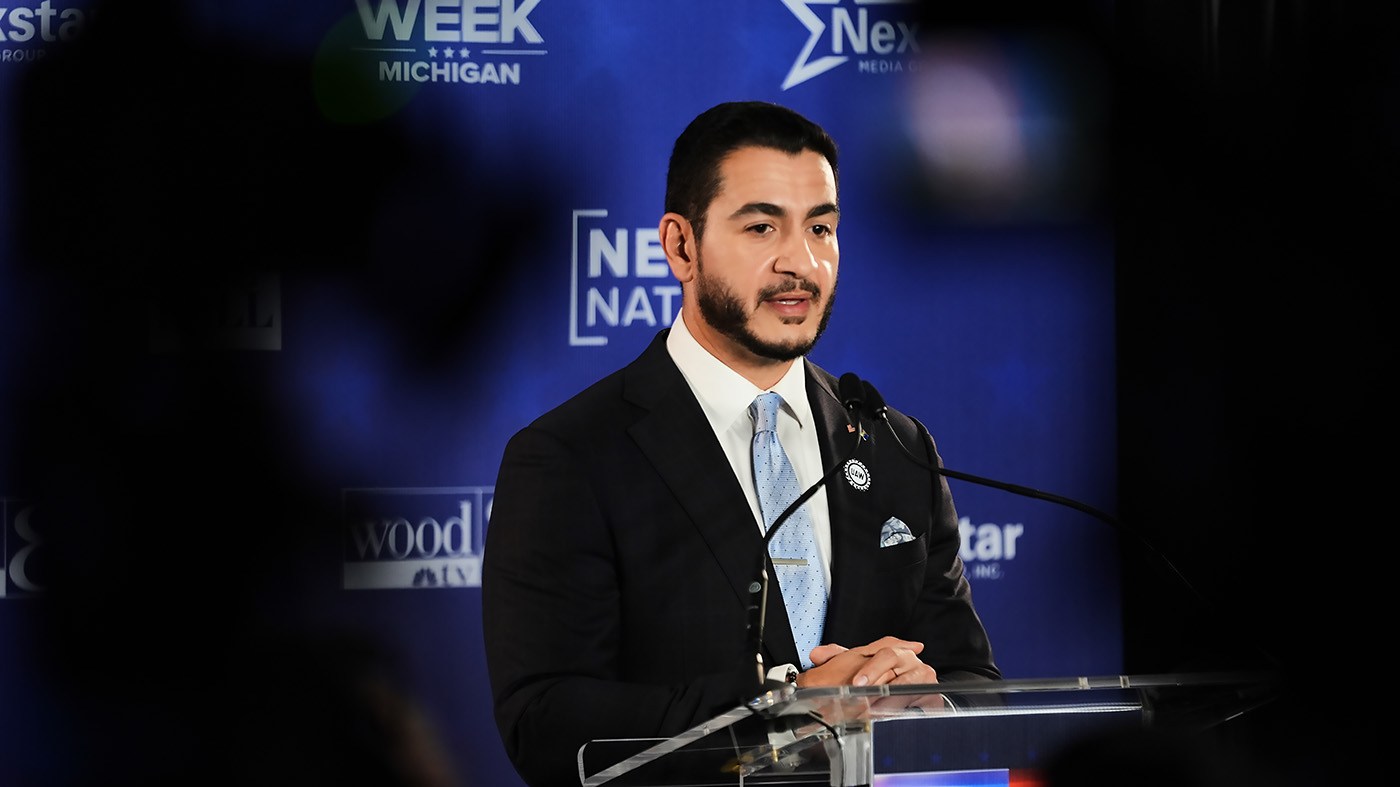
Senate Republicans are making a last-ditch effort to save former Rep. Mike Rogers (R-Mich.) in the Michigan Senate race by pouring money and effort into highlighting what they say are significant ties between Democratic candidate Abdul El-Sayed and the Muslim Brotherhood.
El-Sayed vigorously denies that he has any ties to the Muslim Brotherhood, an Islamist group that is viewed as an influential predecessor to some prominent fundamentalist Islamic groups. Congress has investigated the Muslim Brotherhood as a potential global threat.
But the issue is not so simple, as Republicans have dug up past statements by El-Sayed they say are sympathetic to the Islamist movement that briefly took over Egypt in 2012 and 2013.
In an essay published on HuffPost in January 2011, El-Sayed argued that if the Muslim Brotherhood were to take power in Egypt after the overthrow of Hosni Mubarak, the result wouldn’t be as bad as some critics feared.
He argued the military wouldn’t back the group’s leadership bid unless “strong liberal democratic structures were in place” and dismissed comparisons warning the Muslim Brotherhood taking control of Egypt would be akin to Hamas’s leadership in Gaza.
Republicans are also pointing to a statement El-Sayed signed in 2012 after Islamist leader Mohamed Morsi gained power in Egypt, urging him “to purge the media and police as quickly as possible.”
“We affirm, as Egyptian Americans, that we strongly reject those voices that are courting America and Europe to take a position against the Egyptian regime,” the letter’s signatories declared.
His support for the letter was first reported last month by The Washington Free Beacon.
El-Sayed has now been thrust into the awkward position of having to defend years-old social media posts from his half-sister claiming their family has long had ties to “MB,” referring to the Muslim Brotherhood. She also said that some relatives had been jailed in Egypt because of activism in the group.
The candidate’s half-sister, Eman Abdelhadi, revealed on social media in 2012 that she had an “amazing talk with my mom about her activism in the Muslim Brotherhood during the early 70s while she was in college.”
Her mother, Fatten Elkomy, is El-Sayed’s biological mother.
El-Sayed’s parents immigrated to the United States from Egypt but divorced when he was only 3 years old. He was then raised by his father, Mohamed El-Sayed, and stepmother, Jacqueline Johnson, outside of Detroit.
Even so, Republicans are going all in on trying to portray El-Sayed as radical, playing off some of his more controversial statements during the Democratic primary, such as calling Israel a “rogue state” and endorsing “Medicare for all.”
Rogers confronted El-Sayed over the allegations at their second debate Wednesday evening.
“Are you for America or are you for these terrorist groups overseas?” he demanded of his opponent.
It was a more effective stab at the topic than at their first encounter on the debate stage, when El-Sayed was able to shut down a line of attack aimed at his birth mother’s political affiliations.
Rogers also sought to divide Democratic voters by appealing to “Jewish Democrats who are afraid for their children,” playing on the Republican effort to frame El-Sayed as allied with Islamic fundamentalists and the pro-Palestinian movement.
El-Sayed sought to rise above the attacks by declaring “I love this country” and “I love the Constitution.”
Political experts say Republicans may be trying to play on some voters’ apprehensions about electing the first Muslim member to the United States Senate.
“It may be the Muslim Brotherhood is radical, which of course it was,” said Ross K. Baker, a professor of political science at Rutgers University, who noted the group hasn’t figured very prominently in news from the Middle East recently.
“The name, Muslim Brotherhood, suggests something sinister, and I think that’s probably why they’re using it,” he noted.
President Trump has declared El-Sayed is “100 percent” affiliated with the Muslim Brotherhood, and other prominent Republicans, such as Sen. Ted Cruz (Texas), are piling on.
Cruz has challenged whether El-Sayed, if he wins the Michigan race, should have access to sensitive national security information in Congress as a potential member of the Senate Armed Services or Intelligence committees.
“There would be an unacceptably high risk that American servicemen and women, their lives would be in danger, and that our covert intelligence assets, their lives would be in danger, because there’s every reason to believe that Abdul El-Sayed would share that information with Muslim Brotherhood terrorists,” Cruz declared Tuesday during an interview with Fox News’s Sean Hannity.
El-Sayed over the weekend disavowed any loyalty to the Muslim Brotherhood when asked about it during a town hall.
He followed that up by telling Newsmax in a brief interview at a public event that he “clearly disavowed” the group and bristled at any implication that he would harbor a dual loyalty with the fundamental Islamists.
“The implication of the question is that somehow I have dual loyalties, right? And there’s nothing about my history or record to imply that,” El-Sayed said.
The Democratic Senatorial Campaign Committee and El-Sayed’s campaign did not respond to The Hill’s requests for comment.
Two Republican super PACs backing Rogers are now spending big on ads tagging El-Sayed as tied to the fundamentalist Islamic political group.
A Senate GOP strategist keeping tabs on the Michigan race said that Great Lakes Conservative Fund and Senate Leadership Fund, which is aligned with Senate Majority Leader John Thune (R-S.D.), appear to be spending millions of dollars on ads attacking El-Sayed over his family ties to the Muslim Brotherhood and his past statements that appear sympathetic to the group.
“I think it’s affecting the race. I think it’s hurting El-Sayed,” the source said. “The ads are on pretty frequently, and I do think it’s made the race turn.”
“There’s one from the Great Lakes Conservative Fund that deals with it pretty directly, and there’s another Senate Leadership Fund [ad] that deals with it,” the strategist reported.
The spot by the Great Lakes Conservative Fund highlights El-Sayed’s efforts to distance himself from the Muslim Brotherhood, including an appearance on NBC News’s “Meet the Press” when he categorically denied any ties.
The Great Lakes Conservative Fund contrasts El-Sayed’s claim to NBC host Kristen Welker that neither he nor his family has any ties to the Muslim Brotherhood with multiple past social media posts from his half-sister that appear to call his answers into question.
The ad also highlights video footage of El-Sayed telling an audience that “Muslims definitely hate you” and another clip where the candidate acknowledges he has dual U.S.-Egyptian citizenship.
John Clark, a professor of political science at Western Michigan University, said El-Sayed’s alleged ties or alleged sympathies with the Muslim Brotherhood are becoming a high-profile issue in the Senate race because of the barrage of Republican spending.
“Certainly, it has a lot of visibility, at least in the media I’m consuming. It’s everywhere. There’s so much money coming in,” he said. “The advertising windows are just filled with ads for the Senate race.”
“The Senate ads and these allegations are really all over the place,” he added.
The National Republican Senatorial Committee (NRSC) is leaning in hard on the alleged ties between El-Sayed and the Muslim Brotherhood.
“Abdul El-Sayed and his family’s ties to designated terrorist groups have raised so many red flags that even the mainstream media can no longer ignore them. El-Sayed has serious questions to answer, and it should alarm every single Michigander that he continually refuses to do so,” said NRSC regional press secretary Samantha Cantrell.
Clark, the political scientist from Western Michigan University, said some voters are likely to be turned off from El-Sayed when they hear about his alleged ties to the Muslim Brotherhood but questioned whether it would ultimately make much of a difference in the race.
“I think [it] has become the perceived way to make an impact,” he said of the Republican strategy. “Certainly for folks who have been paying attention to Abdul El-Sayed at least through this campaign, if not before, this is not going to affect them very much at all.”
“People voted for him knowing this would likely be a topic during the general election campaign,” Clark continued. “I have yet to see anybody that I consider to be credible that can make these direct ties that [Republicans] are claiming.
“The [half-] sister who was from a later marriage of the mother says she had a conversation with her mother about her connections to the Muslim Brotherhood in the 1970s; I’m not sure it really carries much water with folks,” he said.
“Here’s where the impact is: The idea of a Muslim anything scares the hell out of a lot of people and so that’s what the Republicans are going for,” he noted. “In that sense, it might make in a big difference.”
Topics in this story
Gathered from external sources. Rights to this text belong to whoever originally published it.