GOP senators not happy about Trump’s warming relationship with Putin
President Trump’s warming relationship with Russian President Vladimir Putin, which may lead to a trilateral summit of the United States, Russia and China to resolve the fate of Ukraine, is getting strong pushback from Republicans in Congress. Several Republicans have panned the idea that Trump would huddle with Putin and Chinese leader Xi Jinping, two…
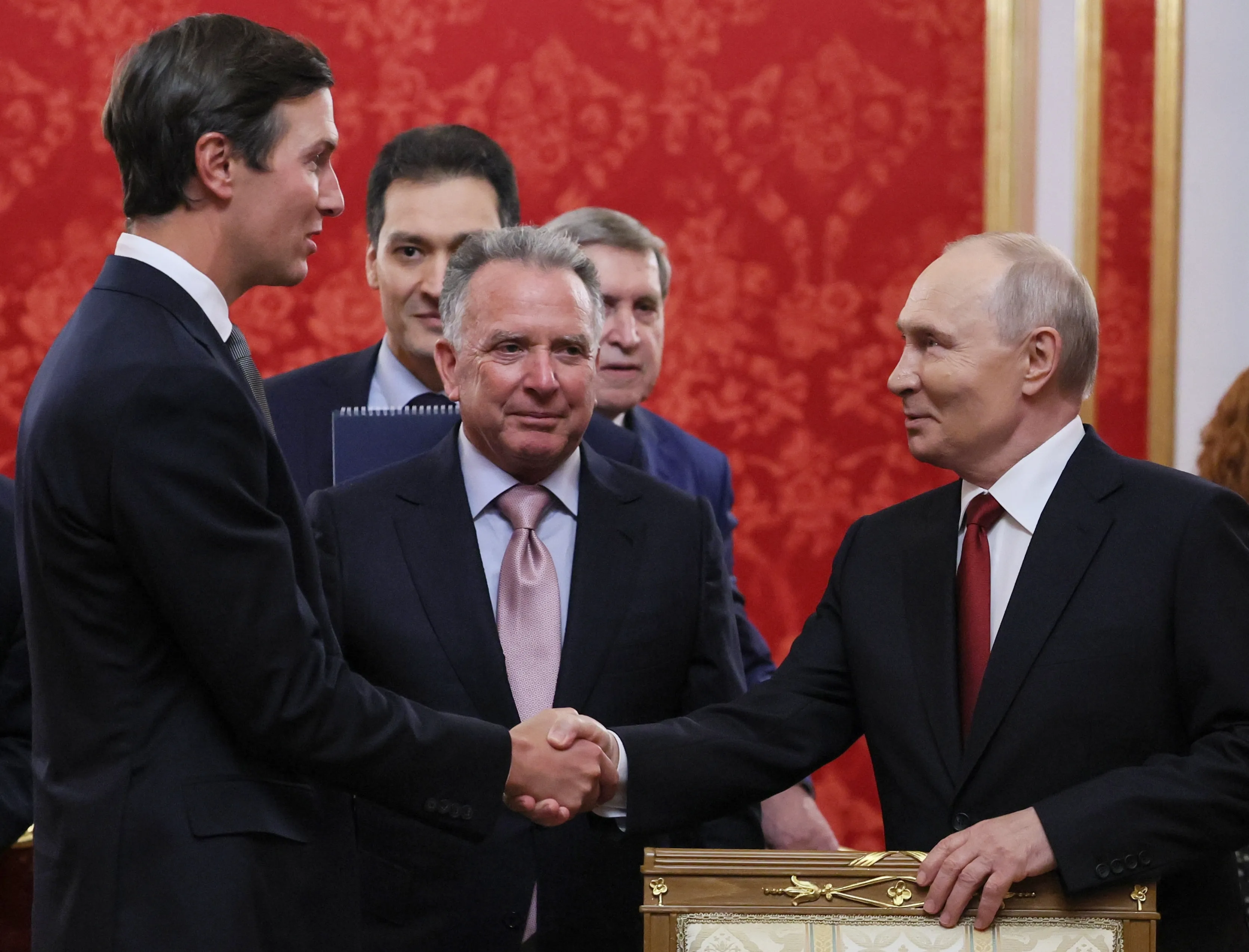
President Trump’s warming relationship with Russian President Vladimir Putin, which may lead to a trilateral summit of the United States, Russia and China to resolve the fate of Ukraine, is getting strong pushback from Republicans in Congress.
Several Republicans have panned the idea that Trump would huddle with Putin and Chinese leader Xi Jinping, two foreign leaders largely viewed in Congress as adversaries to American interests, to cut a peace deal that Ukraine would be forced to accept.
Trump told reporters this week at the White House he would be open to a trilateral summit with Putin and Xi but said the focus should be on nuclear weapons and nuclearization and possibly trade as well.
But the prospect Trump could also cut a deal on Ukraine with Russia and China is leaving some Republican senators alarmed after Trump surprised GOP lawmakers on Friday by issuing an executive order waiving tough new sanctions against Russia that Congress approved last month.
Sen. Bill Cassidy (R-La.) called a potential summit with Putin and Xi to decide Ukraine’s fate “foolhardy” and “morally wrong.”
“To not include Ukraine is nonsense,” he told Sirius XM’s “The Julie Mason Show.”
“Ukrainians have got to be part of any peace deal. It’s not only essential because otherwise we won’t have peace, but it’s also the right thing to do,” he added. “Russia is trying to kill Americans around the world, covertly and overtly.”
Sen. Thom Tillis (R-N.C.) declared in a CNN interview that “Putin is playing President Trump like a fiddle” and warned “history is not going to look good on an America that failed to rise up and defend the Western world if Putin actually gets his way.”
The North Carolina Republican warned that Xi and Putin “want to overwhelm the world” and dismissed the idea of a trilateral summit between the United States, Russia and China on striking a peace deal in Ukraine as “absurd.”
Daniel Fried, a former ambassador to Poland and former assistant secretary of State for European affairs for several administrations, said the proposal for a trilateral summit recalls the Yalta Conference toward the end of World War II, when President Franklin D. Roosevelt, British Prime Minister Winston Churchill and Soviet leader Joseph Stalin struck the deal to carve up postwar Europe into spheres of influence.
“A great power deal about [Ukraine] without them is called a new Yalta, and now you have the Russians proposing it. The Russians love it. The potential victims of such a deal hate it, and Republicans used to,” Fried said, noting Republicans for two generations decried the great-power dynamics of the Yalta Conference more than 80 years ago.
Fried noted some Republicans retain their traditional skepticism of the realpolitik approach taken by Trump, Putin and Xi.
“That muscle memory in the Republican Party is not entirely forgotten,” he said, calling the proposed summit “a terrible idea.”
“We would choose diplomatic ground stacked against us,” he warned. “We would be in a weaker position, and the idea that Trump is wary enough and nimble enough to avoid traps and blandishments is simply not credible.”
Fried, a distinguished fellow at the Atlantic Council who has served in the Clinton, Bush and Obama administrations, warned “if Ukraine was discussed, you could have Trump ending up in a bad or irreparably bad situation.”
Former Republican Sen. Judd Gregg (N.H.), who previously served as ranking member of the Senate Appropriations Subcommittee on State and Foreign Operations, called Trump’s decision to waive Russia sanctions that were included in legislation named after the late Sen. Lindsey Graham (R-S.C.), a strong Trump ally, “beyond inexcusable.”
“These sanctions were put in with his support, I presume, and they reflect a very strong opinion of the Congress and of the American people that Russia has invaded a democracy and killed tens of thousands of people and they are very clearly at fault,” he said.
“We should not be endorsing a dictatorship that has used power in this way to kill innocent people and to invade countries which they have no right to be in,” he added. “These sanctions … passed because there was legitimate and appropriate — and there continues to be legitimate and appropriate — outrage with the actions of Putin.”
Some Trump allies argue the president is simply keeping an open line of communication with powerful foreign rivals.
“Trump wants to always have some sort of relationship with his adversaries even if he’s doing a small deal so that when he really needs to push back and get something done, he can. He knows that Putin is a killer. He knows that Xi wants world domination,” said Ford O’Connell, a GOP strategist and former Trump campaign surrogate.
He added Trump is clear-eyed about whom he is dealing with in Putin and Xi.
But even some of Trump’s most loyal allies in the Senate think he’s giving Putin too much credibility.
Sen. Kevin Cramer (R-N.D.) told The Hill last month that Trump’s invitation to Putin to attend the Group of 20 summit in Miami in December was “giving Vladimir Putin more credit than he deserves.”
Trump’s decision to waive sanctions came a few days after Ukrainian officials blamed Washington for restricting its access to Starshield, the vital satellite-based internet network that enables Ukrainian forces to operate drones and other military aircraft to intercept Russian attacks.
The Wall Street Journal reported Tuesday that Elon Musk, the founder and CEO of SpaceX, which owns Starlink and it’s military-focused sister company, Starshield, ordered the slowdown of Ukrainian access, citing people familiar with the matter.
The Journal reported Musk and Trump discussed the decision to limit Ukraine’s access to the network shortly after the slowdown of critical internet access became public.
Four Republican senators, Sens. John Cornyn (Texas), Susan Collins (Maine), Lisa Murkowski (Alaska) and Tillis, signed a bipartisan letter on Thursday to Platte Moring, the Defense Department’s inspector general, demanding an immediate investigation into whether senior Pentagon officials ordered or had advance knowledge of the Starshield slowdown.
The controversy over Starshield erupted in Washington a few days after Trump stunned GOP allies on Capitol Hill by announcing a deal with Putin to immediately import an estimated 2.2 million tons of Russian diesel into the United States to combat high fuel prices, which have hit farmers, truckers and business owners hard.
Senate Republican Policy Committee Chair Shelley Moore Capito (R-W.Va.) said she was “surprised” by that announcement and said it raised questions about the Trump administration following the law and wishes of Congress.
She noted Trump lifted sanctions on Russian diesel only weeks after signing the Lindsey O. Graham Sanctioning Russia and Iran Act, which passed the Senate in August by an overwhelming vote of 86-11.
“I worry more that this is an act of Congress that we worked with the White House on and … we had timed this to when the president and the White House felt it was a good time to move forward with this, where it could be effective,” she said of the new sanctions law.
“I was extremely surprised when he did it,” she said of Trump’s deal to import hundreds of tons of Russian diesel without advance notification to Congress. “I worry about those dynamics … the legislative and executive.”
Trump made the deal weeks before the midterm elections, which have been dominated by voters’ concerns over high prices, including the price of diesel fuel. Trump has linked the higher diesel costs to Ukraine’s attacks on Russian fuel infrastructure, though the prices appear to be more of a result of the restricted Strait of Hormuz and the war with Iran.
The Wall Street Journal, which is part of the conservative-leaning Murdoch family’s media empire, criticized Trump for sticking “a shiv in the back of the legacy of the late Sen. Lindsey Graham,” who was an ardent advocate for tougher sanctions on Russia before dying of a heart issue in July.
Topics in this story
Gathered from external sources. Rights to this text belong to whoever originally published it.