Collins, Jackson clash in first Maine Senate debate: 4 takeaways
Republican Sen. Susan Collins and Democrat Troy Jackson faced off Tuesday in the first debate of their neck-and-neck Senate race in Maine. A rare Republican to win statewide in blue-leaning Maine, five-term Collins used the debate stage to spotlight times she’s bucked her party, from her pro-choice position to her vote against President Trump’s signature…
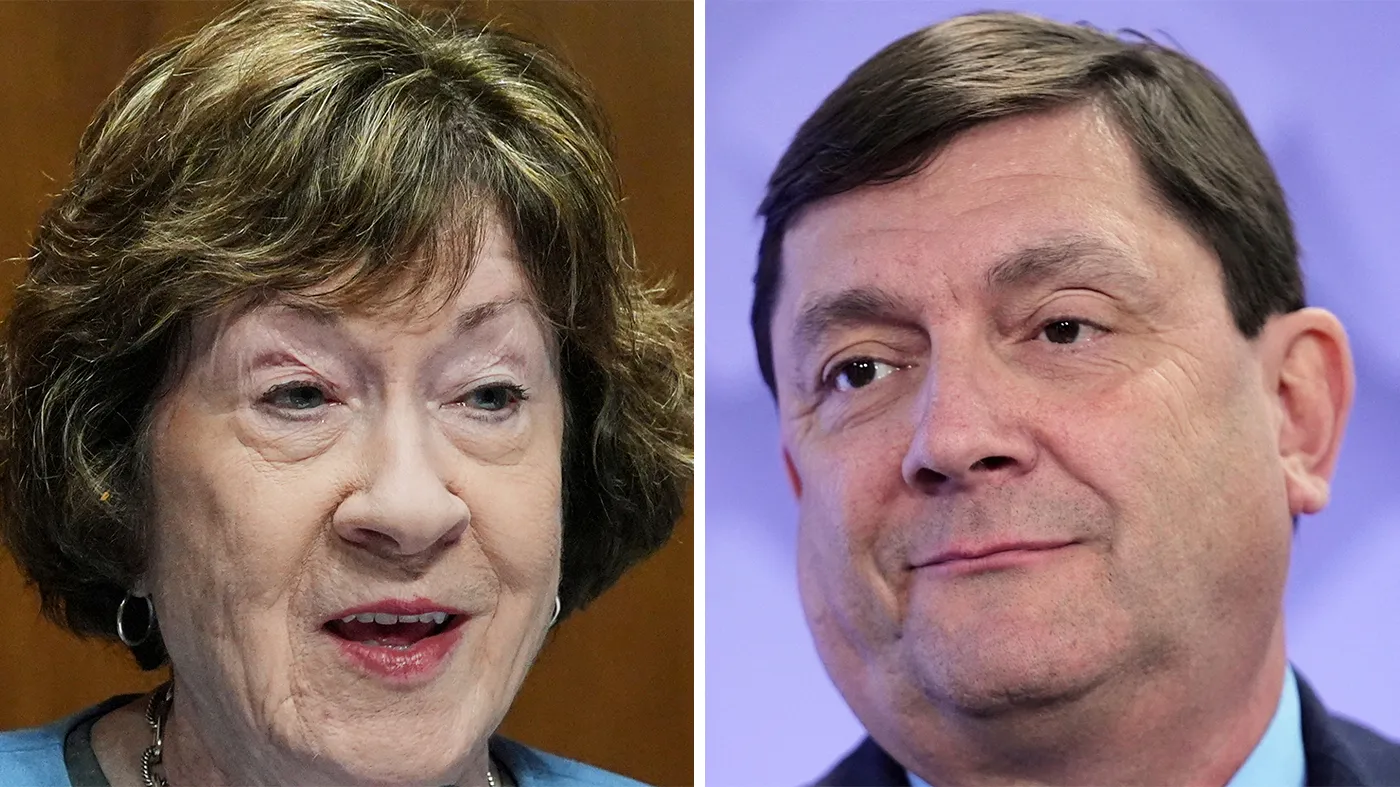
Republican Sen. Susan Collins and Democrat Troy Jackson faced off Tuesday in the first debate of their neck-and-neck Senate race in Maine.
A rare Republican to win statewide in blue-leaning Maine, five-term Collins used the debate stage to spotlight times she’s bucked her party, from her pro-choice position to her vote against President Trump’s signature “Big Beautiful Bill” — while Jackson, a former president of the state Senate, tied Collins to Trump’s agenda and hammered her controversial vote to confirm Supreme Court Justice Brett Kavanaugh.
The candidates also sparred over immigration, healthcare and abortion rights in the hourlong WGME program as polls indicate a tight race that could reshape Maine politics.
Jackson became the party’s pick to take on Collins this fall after Graham Platner, a progressive who won the party’s initial primary, withdrew amid sexual misconduct allegations. Despite a shortened campaign runway, Jackson has been leading Collins by roughly a point in Decision Desk HQ’s polling averages of the race, and top forecasters rate the race a critical toss-up in the fight for Senate control.
The rivals are expected to face off in three more debates over the next two weeks, with the next set for Thursday.
Here are three takeaways from their first showdown:
Jackson presses Collins on Kavanaugh vote
Collins was reelected in 2014 by nearly 40 points, but notched another term by a comparatively narrow 9 points in 2020 after Democrats in the state were outraged by her 2018 vote to confirm Kavanaugh to the nation’s highest court.
On Tuesday, Jackson sought to connect Collins’s vote to Kavanaugh’s role in the Supreme Court’s 2022 decision to overturn abortion rights in Roe v. Wade.
“Maine women, I know many of them came to your office and begged you not to confirm Brett Kavanaugh, but you did it anyways. And then he overturned Roe, and you still say that you don’t regret that vote. So I guess what I’m curious about is what will it take for you to admit that you were wrong, you know, especially whenever Kavanaugh went out and did what he did?” Jackson asked his debate stage rival.
Collins said she looks at justice nominees for “whether they’re fit to serve on the court” rather than trying to predict how he or she would vote on any issue.
“I clearly don’t agree with how Brett Kavanaugh voted on Roe v. Wade,” Collins said, noting that she also voted for Democrat-nominated Justices Sonya Sotomayor, Elena Kagan and Katanji Brown Jackson.
Collins has said that Kavanaugh told her before his confirmation that he considered Roe v. Wade “settled law,” but when pressed about their exchange on the debate stage, she denied feeling that he lied to her.
“I do not feel that he lied, but I think that he should not have said it was settled law because, to me, that meant that it would not be overturned. But to be fair, you cannot ask a nominee how he might vote on some hypothetical future case.”
Meanwhile, Collins knocked Jackson for taking a more conservative stance on abortion earlier in his career, saying “there’s only one of us on this stage who has always been pro-choice.” She also chided Jackson over Maine’s high cost of living, pointing to state policies during his 20-year tenure in the Legislature.
Collins distances from Trump: ‘I’m not exactly his favorite’
As she fights for a sixth term in blue Maine, Collins kept her party’s leaders and legislative moves at arm’s length, despite claims from Jackson and other Democrats that she’s sided with Trump 96 percent of the time.
Collins called that number “greatly misleading” and argued that the same study found “I voted against my party more than any other senator on either side of the aisle.”
When Jackson jabbed early at her vote to advance Trump’s “Big Beautiful Bill” out of committee, she argued that the vote was necessary to advance other legislative agenda items and stressed that she ultimately sided against the final passage.
Jackson, though, took issue with that framing, calling Collins an “arsonist who helped set the fire, and then she wants credit for bringing a cup of water to put it out.”
The incumbent also stressed her pro-choice position, a rare move for a Republican Senate hopeful, and said the war in Iran was “not well thought out.” And she deflected on whether she’d stand by Trump if he were to visit Maine as he crisscrosses red states to boost some of the party’s most vulnerable candidates.
“I don’t think that President Trump is going to come to Maine,” she said. “I’ve heard nothing from his office, and I’m not exactly his favorite senator.”
Rivals diverge on ICE after fatal Maine shooting
Collins and Jackson diverged on their approach to Immigrations and Customs Enforcement (ICE) after Johan Duran Guerrero was shot and killed by a federal immigration in Biddeford, Maine, earlier this year.
The incident has put Collins on the defensive as Democrats seek to tie her to Trump and his unpopular immigration crackdown. After the July shooting, protestors surged on the Republican’s office in Biddeford with calls to “vote her out.”
“It’s time that ICE is disbanded, and we go back to putting that money in the Customs and Border Patrol. They have training. They’re law enforcement. People respect them. We don’t respect ICE,” Jackson said on Tuesday’s debate stage.
But while Collins called the shooting “horrific,” she argued that ICE “needs further reform” rather than a total cut.
“You cannot abolish ICE. It does need reform, but you really want to abolish an agency that is responsible for deporting violent criminals?” she asked, noting her support for body-worn cameras and other changes to agency practices.
Candidates tackle tariffs, economic strain on Maine
Jackson and Collins quickly went viral for an exchange over road salt as they tackled the president’s tariffs and talked economic strains on the Pine Tree State.
Collins reiterated her opposition to Trump’s tariffs on Canada, stressing that America’s longtime ally to the north is a vital trading partner for the northeastern state in particular.
“But I’ve also been working behind the scenes. Troy [Jackson] mocked it, but I was successful in getting concrete, pulp, and road salt removed from the tariff list. And if you ask towns in northern Maine and eastern Maine, they get all of their road salt from Canada,” the senator said.
“I didn’t mock the fact that she got road salt back. I mock the fact that: what about everything else? I mean, we can’t eat road salt,” Jackson hit back.
The Democrat added that, in light of the Iran war and other factors driving up prices, “there’s going to be so many less people to be able to afford to drive that I’m not even sure the road salt’s going to be worth anything either.”
At different points in the night, the pair cast blame on each other for Maine’s economic struggles.
Jackson pointed to Collins’s votes in Washington, while Collins pointed to state policies during Jackson’s 20-year tenure in the Legislature.
Topics in this story
Gathered from external sources. Rights to this text belong to whoever originally published it.