Harmeet Dhillon resigns from DOJ in first major postmidterm exit
Harmeet Dhillon, the assistant attorney general for the Civil Rights Division at the Department of Justice (DOJ), resigned Thursday. Dhillon is one of the first major Trump administration appointees to resign from the department and the first major figure to exit the administration after the Republicans’ midterm battering. “Serving my country as AAG for Civil…
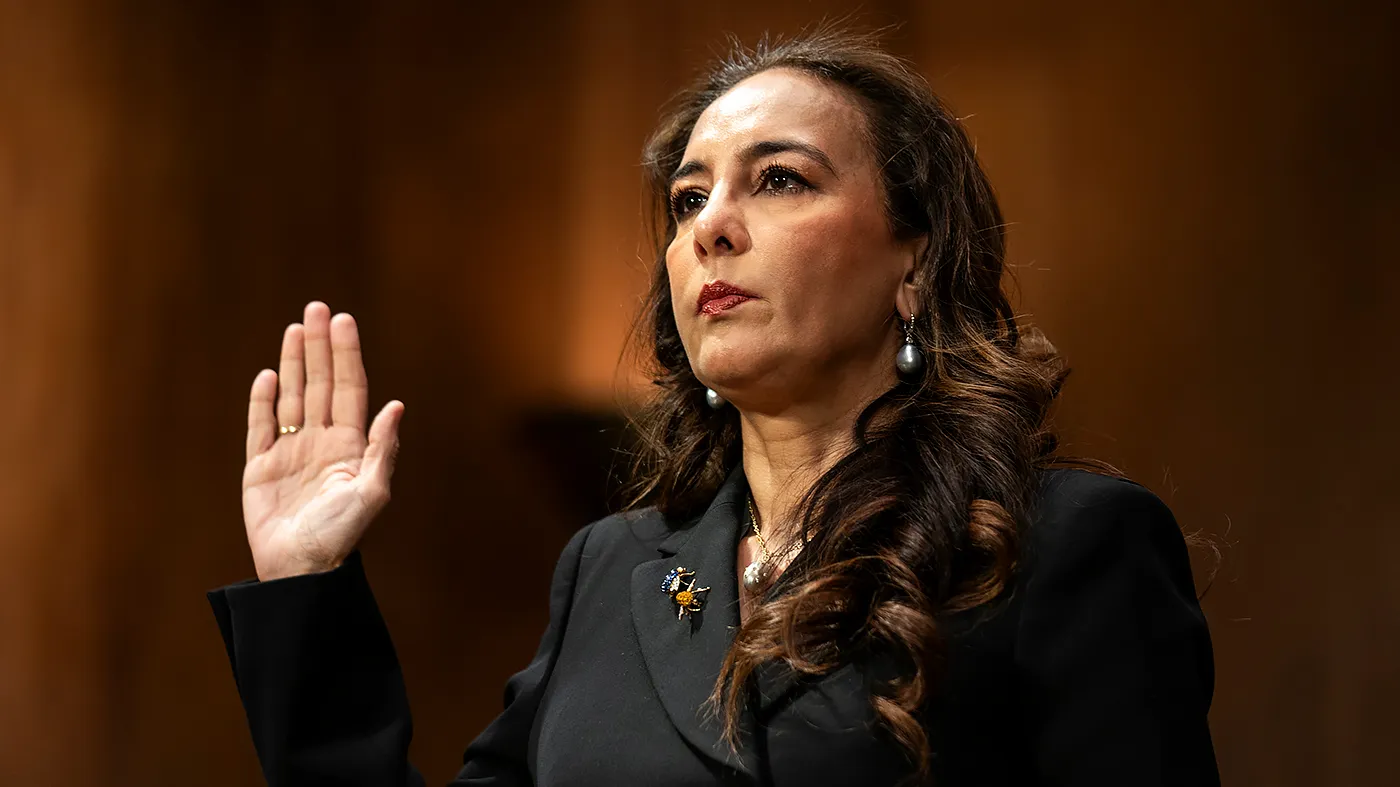
Harmeet Dhillon, the assistant attorney general for the Civil Rights Division at the Department of Justice (DOJ), resigned Thursday.
Dhillon is one of the first major Trump administration appointees to resign from the department and the first major figure to exit the administration after the Republicans’ midterm battering.
“Serving my country as AAG for Civil Rights has been the honor of a lifetime. We ushered in the downfall of illegal DEI, we fought to protect women and girls’ sports, and so much more. I want to thank President Trump for giving me this opportunity. I look forward to what’s next!” Dhillon wrote on X, using the abbreviation for diversity, equity and inclusion.
In an interview with Fox News, Dhillon said she had planned to resign for some weeks.
“I wasn’t asked to resign,” Dhillon told the outlet.
“I resigned three weeks ago, and [White House Chief of Staff] Susie [Wiles] asked me to please wait until after the midterms.”
Dhillon’s role is one traditionally focused on confronting discrimination, protecting access to the ballot and monitoring police departments found to have a pattern or practice of excessive force in their tactics.
Critics have argued she turned the role on its head.
“Harmeet Dhillon has been the most destructive, lawless, and hateful head of the Civil Rights Division in DOJ history,” Stacey Young, head of Justice Connection, a DOJ alumni group, said in a statement.
“Americans’ civil rights don’t enforce themselves. For almost 70 years, the Civil Rights Division brought to fruition the civil rights laws that Americans demanded. Dhillon decimated it.”
A former Republican National Committeewoman for California, Dhillon was also a legal advisor for Trump’s efforts to challenge the 2020 election in court.
She also previously launched the conservative legal group the Center for American Liberty, filing legal challenges against COVID pandemic restrictions while voicing opposition to mail in ballot access.
In the months leading up to the midterms, Dhillon had penned letters to election officials warning them they could face prosecution for how they administered elections, including if any noncitizens were able to cast a ballot.
It was her division that also spearheaded the effort to get states to turn over their voter rolls, igniting a disastrous string of court losses in which the department failed in every case to gain access.
Under her watch, the department also suspended numerous consent decrees signed under the Biden administration.
According to a count by Democracy Forward, under the Trump administration, the Civil Rights Division walked away from 70 different cases and investigations into violations started under previous administrations.
The division has also launched probes into various universities, arguing they discriminated against white and Asian students.
Dhillon told Fox News on Thursday that she had “accomplished everything” she wanted to do, and waived away questions over whether she might be pardoned by President Trump.
“I have no idea. I haven’t ever discussed that with him, asked for it. And I have done nothing, in my opinion, that would require that, but, you know, that’s up to the president.”
Young noted that more than three quarters of the Civil Rights Division left under Dhillon’s tenure, arguing that “civil servants who dedicated their careers to protecting vulnerable communities were instead told to target them.”
“Dhillon wielded the enormous power of the Justice Department to threaten universities, state and local officials, and election workers in spurious cases that rarely won in court,” she said in her statement.
“She ended pattern or practice investigations into police departments and consent decrees with cities like Minneapolis and Louisville, leaving communities less safe and their residents’ rights less protected. And she refused to open investigations into ICE-related shootings, even as deaths and injuries continued to rise.”
Last December, former staffers at Dhillon’s division also penned an open letter criticizing her leadership on the 68th anniversary of the creation of the Civil Rights Division.
“We must sound the alarm about the near destruction of DOJ’s once-revered crown jewel,” they wrote at the time.
“The Administration wants you to believe that career staff who fled the Division ‘were actively in resistance mode’ and ‘decided that they’d rather not do what their job requires them to do. That could not be further from the truth. We left because this Administration turned the Division’s core mission upside down, largely abandoning its duty to protect civil rights.”
Dhillon took other surprising moves while at the Justice Department, including representing former Attorney General Pam Bondi when she appeared before the House Oversight Committee under subpoena to discuss the Epstein files.
House Oversight ranking member Robert Garcia (D-Calif.) called the move a conflict of interest.
But Dhillon defended herself, saying she was there “to represent the interests of the Department of Justice” and said it was up to Bondi if she wanted to secure a personal attorney.
Attorney General Todd Blanche praised Dhillon on X, saying she led the division “with conviction.”
“She has defended the civil liberties of every American and enforced the law without fear or favor,” he wrote.
“The Department is grateful for her dedicated public service, and we wish her every success in her future endeavors.”
Topics in this story
Gathered from external sources. Rights to this text belong to whoever originally published it.