Swinney suggests Scots will not travel further for health care under reforms
Plans are in motion to cut Scotland's mainland health boards from 14 to two, but questions remain about how they would work in practice.
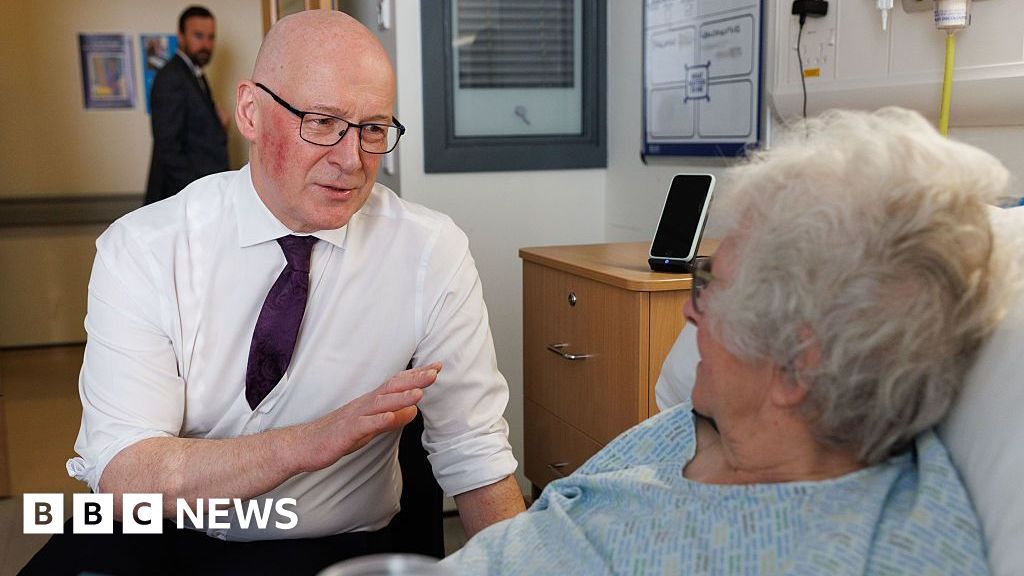
Scots should not have to travel further for health care under the government's plans to cut the number of health boards from 14 to two, John Swinney has suggested.
The BBC asked the first minister about the impact of such changes for people who are already travelling long distances - such as women living in the far north who have to travel 100 miles down the A9 to give birth in Inverness.
Swinney said it would "not be my intention" for people to travel further, with initial modelling showing the country divided into two east and west health boards.
He also said he could not put a "specific figure" on NHS job losses, but he had been "open about the fact that public sector employment will fall".
Speaking to BBC Scotland's The Sunday Show , Swinney said he wanted to maximise the number of health care services delivered locally as long as it was done safely.
This is so that there is "equity of access" regardless of where people live, he said.
Swinney added: "The example in Caithness is an issue about the delivery of maternity services in Caithness. And that's driven not by efficiencies, it's not by costs, it's delivered by the question of patient safety.
"What I want to make sure is that by removing health board boundaries we can maximise the number of local services that can be provided as close to home as possible for individuals in different parts of the country."
Patients and health care professionals have raised a number of concerns about the provision of paediatric and maternity care in Scotland.
A nine-month review of all maternity services was scheduled to begin this autumn after NHS staff and experts called for improvements to poor and sometimes deadly care as part of a BBC Disclosure investigation .
Meanwhile, all planned paediatric surgery at Dr Gray's Hospital in Elgin was suspended last month because of concerns about patient safety. This could remain the case until December , according to NHS Grampian's chief executive.
The plan to cut health boards from 14 to two was announced in Swinney's programme for government earlier this week.
He said it was the "most significant structural reform in the NHS in the era of devolution".
But questions remain about how these two boards would work in practice and what the consequences would be for those living in the islands.
Work began on the proposal last November and maps the country into east and west, with the chief executives of NHS Greater Glasgow and Clyde and NHS Lothian taking the lead.
It has been proposed that health care in the islands would be absorbed by local authorities, though no decisions have been made on this.
Hospital pauses all planned paediatric surgery after care concerns
Investigation into Scotland's maternity units to start in autumn
Swinney to cut Scottish health boards from 14 to two and roll out £2 bus fare cap
It is also unclear whether this new structure will result in financial savings by cutting senior roles or streamlining departments.
The trade union Unite branded the plan to cut health boards a "slash and burn programme for the NHS".
Swinney was asked several times by the BBC how many NHS jobs would be lost as a result of the changes.
He said: "I can't put a specific figure on that today and I simply wouldn't be giving a comprehensive answer if that was the case.
"What we've got to work our way through is a programme of reform to make sure that we put people right at the very centre of the delivery of public services so they can see the enhancement in the provision of those services in their localities."
The first minister would also not be drawn on how he would make savings to cover the potential £5bn shortfall in the public finances by the end of the decade.
He said there were "lots of variables" in public finances and that the SNP had demonstrated they could balance the budget through challenges including Brexit, the Covid pandemic and the financial crash.
Opponents have criticised Swinney's remarks and urged him to be clearer on how the plans would work.
Scottish Labour's acting leader Jackie Baillie said "It's hard to tell whether John Swinney is being evasive or simply has no idea what he is going to do, but either way it's not good enough.
"People's jobs are on the line and our public services could be plunged into chaos – Scotland deserves to know what lies ahead.
"The SNP must come clean about what it is planning, how many jobs are at risk and what it will mean for our public services."
Scottish Conservative finance and social security spokesman Craig Hoy said: "John Swinney was asked a basic question about his own plans and repeatedly refused to answer it.
"He cannot say how many NHS jobs could be lost yet expects Scots to believe he has a grip on the SNP's £5bn budget black hole.
"This is a first minister completely out of his depth, trying to bluff his way through the mounting financial chaos his party has created."
Reform UK Scotland leader Malcolm Offord accused Swinney of trying to dodge the question of job cuts with "word salad" answers.
He told The Sunday Show: "What I'm surprised to hear is that a government that has been in situ for 19 years still cannot put names and numbers around the reorganisation."
Topics in this story
Gathered from external sources. Rights to this text belong to whoever originally published it.