Thrombectomy: 'My treatment was a miracle' says stroke patient
An expanded service means the time of day or night a stroke occurs is no longer a barrier to treatment.
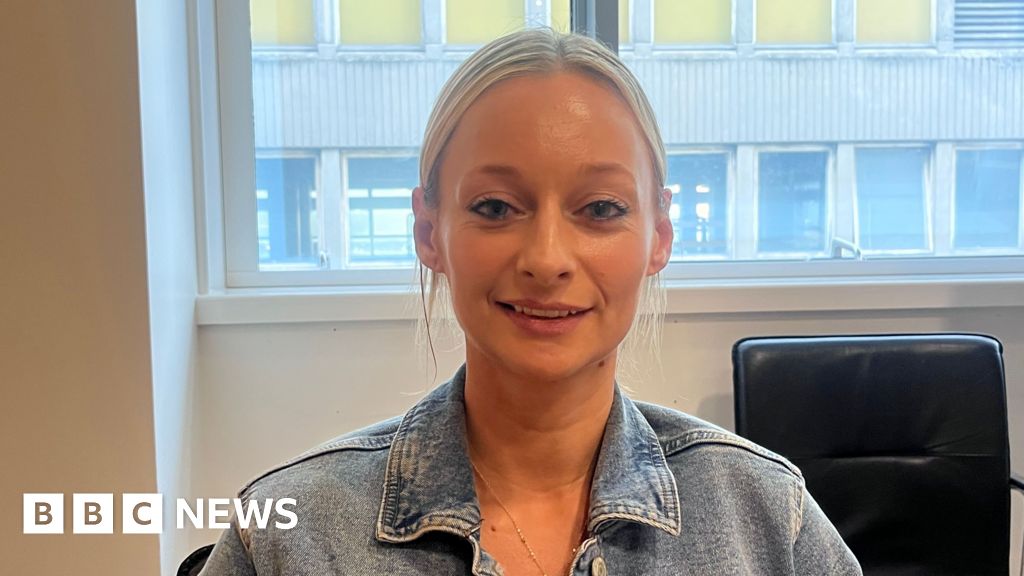
When Gemma O'Hara woke up in the night with "intense pain" in her neck, sickness and vertigo she knew something was "not right".
The 40-year-old, who had just come back from holiday, had suffered a brain stem stroke.
Gemma was able to have a thrombectomy, which removes blood clots and restores blood flow to the brain, a procedure she has said is a "miracle treatment" that has enabled her to recover well.
Northern Ireland's regional thrombectomy service, which had only been available between 08:00 and 17:00 is now operating 24 hours a day, seven days a week after a £5m investment through Stormont's Programme for Government (PfG) Elective Care funding.
Gemma, from Ballymena in County Antrim, said the expansion is "amazing" because of the difference the treatment made to her recovery.
"You have to get treated so fast. You can't let time go past when it's to do with your brain," she said. "If I didn't get it in time I wouldn't be the way I am now."
'I may not be here if my stroke was at different time'
New stroke suite brings life-saving treatment to Kent
'I had a stroke at the weekend so didn't get a thrombectomy'
The mother-of three had the stroke in September 2025 and said that, while her symptoms were not classic stroke symptoms, she knew she needed medical help.
By the time she arrived at the Antrim Area Hospital, she had numbness, could not walk or talk and felt "locked in my body".
She was scanned and given thrombolysis - clot-busting medication - before being transferred to the Royal Victoria Hospital in Belfast for a thrombectomy.
Gemma said that within minutes of having her procedure she was "sitting up, back to myself again" and waiting for her family to arrive.
"It's a miracle treatment because I was so unwell and for something that can happen fairly quickly like that, and to recover so well, it's amazing," she said.
'I was going to the gym and trying to look after myself'
She said having a stroke was "so unexpected".
"I was always working, going to the gym and trying to look after myself.
"So for everybody that was a big shock for me to have a stroke because they always thought I would have been the fittest one."
Gemma said one of her "biggest fears" had been the possibly of having another stroke during the night, when thrombectomy was previously unavailable.
She said the 24/7 service gives her "peace of mind" that she would be able to receive treatment if it happened again.
The expanded service, which began on 14 September, means the time of day or night a stroke occurs is no longer a barrier to accessing treatment.
Dr Patricia Gordon, stroke consultant at Belfast Health Trust, said about 10% of patients who have a stroke have a large clot that can be removed through a thrombectomy.
She said the procedure increases a patient's chances of making a good recovery by more than 50% and reduces the risk of death by almost 20%.
"Whenever you have a stroke that requires a thrombectomy - that was one of the major and main arteries being blocked in the brain.
"Those are the most severe type of strokes that you have.
"Untreated, there's a risk of death from those types of strokes."
She said that if patients survive they can be left with "significant disability" depending on where the blockage is - but "it could be weakness down one side, loss of speech or sometimes loss of function altogether then as well".
The consultant said the impact of having a thrombectomy is "quite significant".
"You're going from a very dependent state to a nearly independent state again by more than 50% if you can get the clot out in good time," she said.
The service will build capacity towards 300 thrombectomy procedures annually, about double what it has been doing during reduced hours.
Gordon said the stroke team has advocated to expand this service for some time and it is "transformational" for people.
She said having it 24/7 means that it is available to all patients and there will be staff there to perform it.
"You can see that there's a huge amount of staff that are needed to be able to fill rotas and to be there to be able to treat patients," she said.
"It will largely transform patients' lives from being potentially significantly dependent to independent."
The service is delivered at the Royal Victoria Hospital Belfast through a regional pathway involving stroke teams at the Causeway, Antrim Area, Royal Victoria, Ulster, Craigavon Area, Daisy Hill, Altnagelvin and South West Acute hospitals.
Artificial Intelligence-supported imaging is being used to help clinicians rapidly identify patients who may benefit.
In June 2022, a commitment to expand the regional thrombectomy service to 24/7 provision was published in the Reshaping Stroke Care Action Plan.
According to the Department of Health, about 3,000 people have a stroke each year in Northern Ireland, which is one person every three hours, and more than 43,000 stroke survivors live in the community.
In 2024, Nisra recorded 883 stroke deaths.
Health Minister Robbie Butler said Northern Ireland was the first of the UK nations to provide a 24/7 thrombectomy service for its entire population, which he described as a "landmark moment".
"Thrombectomy is one of the most significant advances in modern stroke medicine and can dramatically improve a patient's chances of recovery," he said.
Topics in this story
Gathered from external sources. Rights to this text belong to whoever originally published it.