Pontypool boy to go to US for cancer vaccine after drug withdrawn
Teddy Sloman was diagnosed with high-risk neuroblastoma, a rare and aggressive childhood cancer.
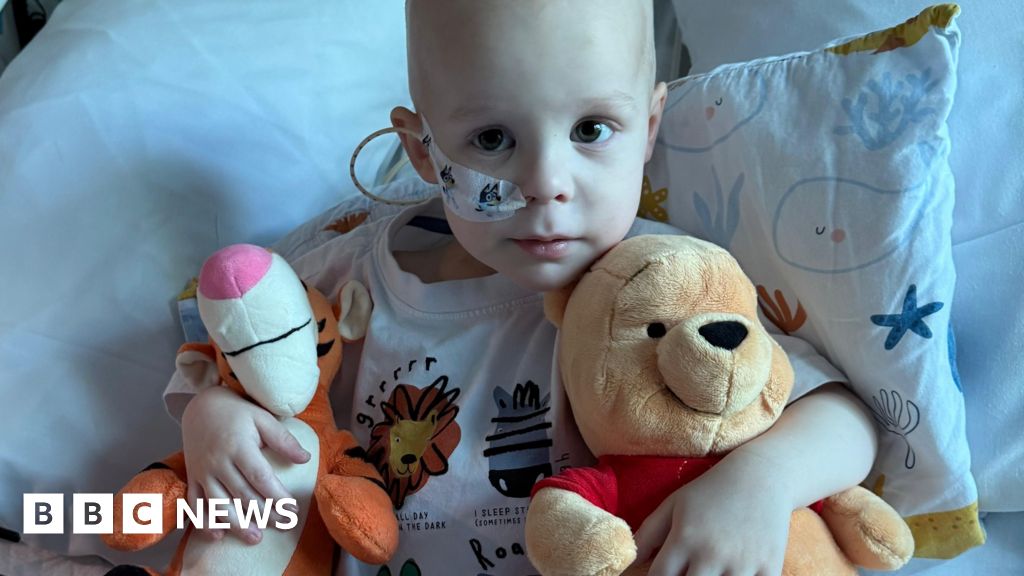
A mother who is preparing to take her three-year-old son to the US for a vaccine trial says it has given her family a "glimmer of hope" for his future.
Almost a year ago, doctors warned Teddy Sloman's parents that he might not survive life-saving surgery after being diagnosed with high-risk neuroblastoma , a rare, aggressive childhood cancer.
But recent scans showed no active disease, and the family are preparing to fly to New York next month for what his mum Sarah hopes will be "the final chapter" of his treatment and "the end of this ridiculous nightmare".
"We've now given him the absolute best chance that we could possibly have in the world of medical science," she said.
Sarah, from Pontypool, Torfaen, said the process since Teddy's diagnosis had been "incredibly difficult" as they were often dealing with problems they could not have anticipated.
As a paediatric nurse herself, she previously said her medical knowledge had been both "a blessing and a curse" .
An experimental treatment aimed at preventing the return of the type of cancer Teddy has is no longer available in the UK, so his family raised £250,000 to access the vaccine trial in New York.
Sarah said the scan results felt like "Christmas came early" after months of fearing Teddy would relapse, and like they were finally "moving forward to the next step".
But she added they had to "mentally navigate all of these things" when all they "really want to do is stay at home and enjoy being a family for once".
The Welsh government said improving cancer care was a top priority and it was "acutely aware" how much it meant to people.
Teddy was diagnosed in July 2025 after months of symptoms that were initially thought to be teething, illness and constipation.
He stopped eating and drinking, was sleeping for hours in the day and night, and began vomiting.
Sarah felt a mass in his abdomen and was first told "it was just faeces".
With Teddy still feeling unwell, Sarah took him back to The Grange Hospital in Cwmbran in July.
A locum doctor in charge of the children's assessment unit said it was "not normal" for Teddy to have these symptoms and ordered a scan, later finding out that the mass was "actually a significant tumour".
Sarah said hearing the diagnosis was "surreal".
"I, as a student nurse, had been in that exact situation sort of 20 years ago... and it just felt so surreal, like an out-of-body experience.
"This is my work world. This is not supposed to be my personal life."
Teddy's tumour was so large it filled his entire abdomen, pressing on his organs and making it hard for him to eat or even breathe, and the cancer had spread to his bone marrow.
Sarah said: "Everything that we didn't want it to be, it was. So it's the most aggressive, the most rare, the most everything else."
Aneurin Bevan health board said it recognised how "distressing it can be for parents when their child is seriously unwell, particularly when symptoms are complex and difficult to diagnose".
It added that it welcomed the family to contact them to discuss any concerns so they could be "reviewed fully".
The family spent 10 months in Noah's Ark Children's Hospital for Wales and also had to travel to Birmingham and London for specialist treatment.
This led to long-term implications, and Teddy now receives his food entirely through a tube and has to learn how to eat and drink again after already having to learn to walk three times due to being in bed for long periods.
Sarah said she felt "mum guilt" as her youngest son Joey, who is nearly two, spent most of his time with grandparents and relatives while Teddy was in hospital.
"We started running on fumes a long time ago, but you just do what needs to be done," she said.
Sarah said due to a measles outbreak in New York, they had made the "heartbreaking decision" to leave Joey in the UK during their first trip.
Over the past few months at home, the pair had been playing together and telling each other "they love each other", she said.
"It's those little things that you don't want to lose, you don't want to let go of.
"You want them to grow up together, looking out for each other and doing all the things that all the siblings [do]."
She added: "All of those things now feel like they're possible, whereas this time last year they didn't."
In June, the family found out that maintenance drug difluoromethylornithine (DFMO), which could prevent Teddy relapsing, had been withdrawn from the NHS , by the US-based company which owns it following a clinical trial.
Those who were already receiving the drug were allowed to continue for two years, but it was not available to new patients, such as Teddy.
Sarah said they were the only family they knew of going through the private treatment process.
To get an official referral for the clinical vaccine trial, Teddy's family had to send a urine sample, get a bone marrow aspirate, and for his scans to declare "no active disease".
"To have the results come back... and for them to say that there's no active neuroblastoma cells, it was Christmas come early. It was everything that we'd hoped for for so long," said Sarah.
Teddy has officially been accepted as a patient for the vaccine trial in New York, and will have his initial appointment in November - but it comes at a hefty price.
"If he relapses the survival rates drop to single figures. So if there's a tiny chance that this vaccine can do some good [it's worth it]," Sarah said.
"At one point we were looking at selling the house and getting loans and all sorts because we just didn't see [another option].
"There's nothing in the world you wouldn't do for your children."
Friends launched a campaign to raise £250,000 and reached their target in 12 weeks, with Sarah admitting she thought "we'd never make it in a million years".
The fundraiser has since been increased to £350,000 to help with ongoing costs, and more than £300,000 has been raised so far.
She added: "It's absolutely incredible and there are not enough words in the world to thank people."
Despite everything, Sarah described Teddy as a cheerful "social butterfly" who had remained positive throughout.
"His friends are learning how to jump in muddy puddles and do climbing frames and Teddy's learning how to take blood pressures and use a stethoscope."
Sarah said more focus, support and research was needed for childhood cancers and that funding was "harrowing" compared to adult cancers.
"We shouldn't need to be raising all this money to fly the other side of the world for drugs," she said.
"I just want Teddy's story to be known so that the next person coming behind us doesn't have to go through this excruciating journey that we have."
The Welsh government said improving cancer care was a "top priority", with a 10-year strategy focused on better prevention, diagnosis and treatment aimed at improving services and outcomes for patients of all ages.
It added that, through Health and Care Research Wales , there was funding for "early stage clinical trials for children and young people" through a partnership with Cancer Research UK.
Children's laureates to donate to Sally Rooney after UK sales halted over Palestine Action support
First minister says Welsh spending powers takes step forward after Andy Burnham meeting
Men jailed for 'abhorrent' operation trafficking women from Europe into UK for sex work
Gathered from external sources. Rights to this text belong to whoever originally published it.