Merthyr man saved by off-duty police sergeant after cardiac arrest
James Ashley from Merthyr Tydfil suffered a cardiac arrest in a shop in Cwmbran.
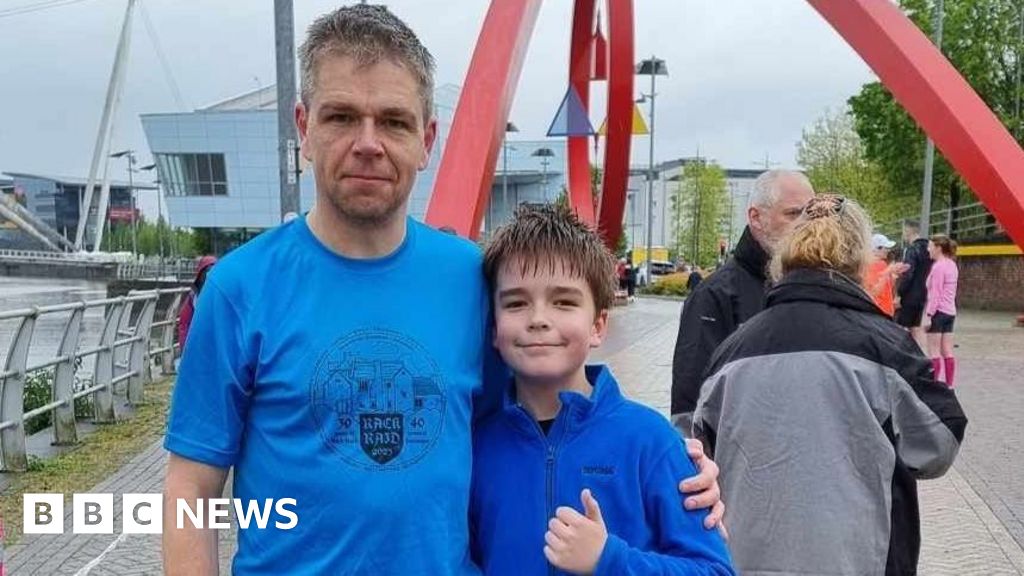
A dad who suffered a cardiac arrest and collapsed in a shop said his 12-year-old son could have lost his dad if a "hero" off-duty police officer had not saved him.
James Ashley, 52, from Merthyr Tydfil, had just finished parkrun and was shopping in Cwmbran when he was hit by a "wave of dizziness" and fell to the floor on 4 April.
Sgt Adam Hollings from Gwent Police was nearby and immediately started CPR.
"I clinically died twice but by the time the paramedics got there, I was sitting up talking... the difference with Adam knowing what he was doing is that my son didn't lose his dad as a 12-year-old," he said, and called him an "absolute hero".
Hollings, who has spent 21 years on the force, was awarded a Royal Humane Society Resuscitation Certificate for his role in saving Ashley's life.
"We're very lucky to have the first aid training that we do, and if we can occasionally be in the right place at the right time to help people out, then fantastic," he said.
The 40-year-old from Abergavenny told Radio Wales Breakfast that even though he was off-duty his training and lifesaving skills kicked in and he acted on "autopilot".
He told someone in the shop to call an ambulance, and then used a defibrillator.
A defibrillator is a device that gives a jolt of energy to the heart . It helps get the heart beating again when someone is in cardiac arrest and their heart has stopped.
Ashley was taken to University Hospital Wales in Cardiff and has since made a full recovery.
"The difference with Adam knowing what he was doing is that my son didn't lose his dad as a 12-year-old," he said, calling his saviour an "absolute hero, a legend".
The pair were reunited a week later when Hollings visited in hospital.
"The nicest moment in all of it was meeting James and his family," Hollings said.
"Being able to see that me doing a little bit there got him to the hospital in time so he could have the lifesaving care that he needed, and know that he was there for his family, that's the real reward.
Ashley said Hollings was a "lifesaver", but also "just a smashing bloke".
Ashley had undergone first aid training himself from a previous job and said even though he was "rusty now", he encouraged others to use their skills if they have them or to get the training.
"If you think, 'Oh, you know, I'm sure there'll be someone there' and 'Oh, it's someone else's opportunity to do it' or 'I can't be bothered or whatever', you absolutely can make a difference to people's lives," he said.
"And it's not just maybe the person you save, it's the people around them who you're helping."
Sharon Owen, CEO of Calon Hearts, a Welsh charity that provides defibrillators and training, praised Hollings for his "quick thinking".
She said it showed "just how important it is to know CPR and have the confidence to act."
"When someone suffers a cardiac arrest, every second counts," Owen added.
"Don't be afraid of getting it wrong - call 999, start CPR and follow the call handler's instructions.
"Doing something is always better than doing nothing."
Owen said people needed to try to overcome any embarrassment they have about performing CPR on a stranger.
"Research shows that women are less likely than men to receive CPR, partly because people may feel uncomfortable touching a woman's chest.
"But when someone's life is at risk, embarrassment should not come into it. Everyone deserves the same chance of survival."
If you find someone collapsed, make sure it's safe to approach
Check if they respond by gently shaking their shoulders and asking them loudly "are you ok?"
If they don't respond, shout for help and ask someone to call 999 or 112 for an ambulance, or put your phone on hands-free and call yourself
Open their airway by gently tilting their head back and lifting their chin, and look, listen and feel for up to 10 seconds for normal breathing
Kneel by the casualty and put the heel of your hand on the middle of their chest. Correct hand placement for CPR on a person with breasts may mean that your hands may touch some of the breast. This is okay
Put your other hand on top of your first hand and if you can, interlock your fingers
Lean forwards so your shoulders are over your hands, keep your arms straight and press down hard to a depth of about 5-6cm before releasing the pressure, allowing the chest to come back up. Push at a rate of 100 to 120 per minute
Listen to instructions from the 999 operator if you still have them on the phone. They will tell you what to do and help you to push at the right speed
Continue chest compressions until emergency help arrives or the person starts showing signs of life and starts to breathe normally
Terminally ill mum who can't talk, walk or dress herself refused Pip payment
'Tone deaf at best' - advice to stock up on essentials worries experts and low-income families
Celebrity Traitors' Joe Lycett's tribute to viral TikTok nan
British Heart Foundation - What is a defibrillator?
Topics in this story
Gathered from external sources. Rights to this text belong to whoever originally published it.