Yayoi Kusama, whose art evoked hallucinatory wonder, dies at 97
Her hypnotic, unconventional works propelled her from near-obscurity to a place in the world's most prominent museums.
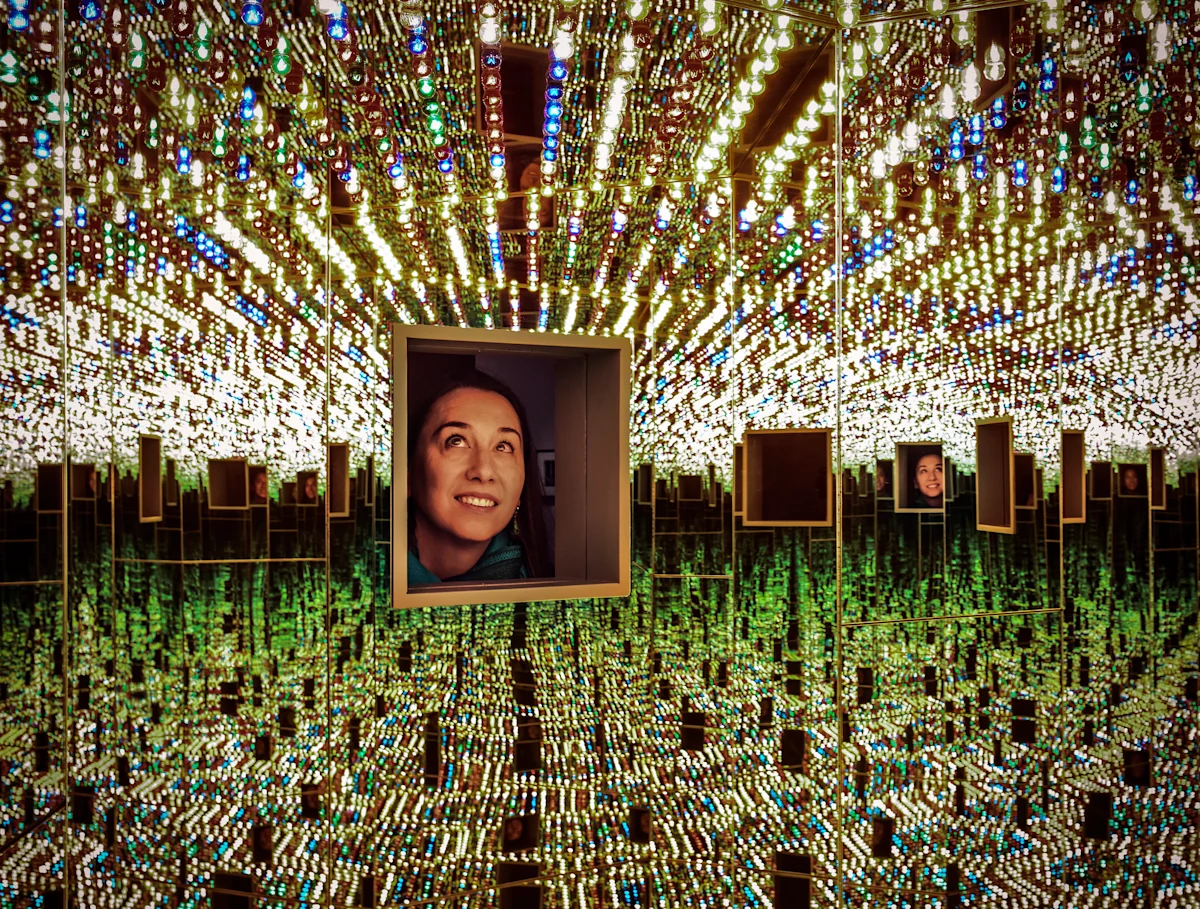
Yayoi Kusama, the beguiling Japanese artist who was a member of the 1960s avant-garde, disappeared from public view for decades and found global recognition late in life through her polka-dot paintings and mirrored, Instagram-friendly "infinity rooms," died Aug. 14 at a hospital in Tokyo. She was 97.
Her death was announced Wednesday in a statement on her website, which did not cite a cause.
Ms. Kusama, a largely self-taught artist, rose from near-obscurity to near-ubiquity in the art world, even as she battled mental health issues and lived for decades at a psychiatric institution in Japan.
Tenacious, obsessive and, in the eyes of her critics, relentlessly self-promoting, she became a pop-culture fixture, making brightly colored, instantly recognizable paintings, sculptures and installations that were exhibited at major museums and made her one of the world's top-selling contemporary artists.
Her work was immersive, hypnotic and repetitive by design. For her long-running "Infinity Nets" series, which began after she moved to Manhattan in 1958, she covered her canvases with delicately curved brushstrokes, dots or webbed lines. She later applied her approach to three-dimensional objects, including more than 20 of her "infinity mirror" rooms, reflective spaces that she filled with hundreds of kaleidoscopic LED lights or with silver orbs, polka-dot covered gourds and other eye-catching objects.
Ms. Kusama said she was inspired by hallucinatory visions she had experienced since childhood, in which she could hear the voices of flowers, pumpkins and dogs. Art served as a form of therapy: She wrestled with many of the vivid images in her head by re-creating them in her art, and at times was said to paint without interruption for 40 to 50 hours straight.
"I don't consider myself an artist," she wrote in a 1975 autobiographical essay, "Odyssey of My Struggling Soul." "I am pursuing art in order to correct the disability which began in my childhood."
By her own reckoning, she was an outsider many times over: a woman raised in wartime patriarchal Japan who broke into the male-dominated New York art scene, making her own mark alongside 1960s artists including Andy Warhol , Frank Stella , Claes Oldenburg and Donald Judd.
Like them, she was credited with helping move American art beyond abstract expressionism. Much of her work in that period featured a sexually charged blend of humor and provocation, including cheeky, handsewn phalluses — protuberances made of cotton-stuffed canvas and coated with enamel paint — that she applied to chairs, sofas, dresses and even rowboats.
Created as part of her "Accumulations" series, the works were a riposte to the patriarchy, she said, but also a way of "conquering" her fears around sex, which Ms. Kusama confronted more bluntly through naked "happenings" that she organized around the city, inspiring and mirroring performances by feminist artists such as Charlotte Moorman, Carolee Schneemann and Yoko Ono.
For a time, the happenings occurred weekly, taking on conservative taboos and also serving as protests against the Vietnam War. During her 1968 "Nixon Orgy" in Lower Manhattan, Ms. Kusama bluntly offered to have sex with the president-elect if he would call for a ceasefire. "Anatomic explosions are better than atomic explosions," she announced in leaflets distributed on the street.
The next year, she organized a "Grand Orgy to Awaken the Dead." Nude performers kissed and embraced in a fountain outside the Museum of Modern Art, in an unauthorized spectacle that Ms. Kusama described as a critique of the museum's focus on "dead" art, made by dead artists, over the work of the living.
Ms. Kusama's orgiastic happenings made front-page news, often accompanied by pictures in which she was shown wearing skintight, polka-dot unitards or posing nude.
To admirers, she was ahead of her time, blurring the line between her art and herself. Other tastemakers considered her an exhibitionist and seemed to share the assessment of New York Times art critic Roberta Smith, who wrote decades later that Ms. Kusama's happenings were "more like extended streaking incidents than actual performances."
Reflecting on her work, Ms. Kusama's manager, James Galotta, told The Washington Post in 1969: "We're not trying to change anybody's ideas. We just want them to think about alternatives. Yayoi is the kind of person who, if 500 years from now everybody was walking around nude, she'd be the only person wearing a dress."
Despite a fair amount of attention, Ms. Kusama withdrew from the art world in the early 1970s. Her mental health worsened over the years as she worried about other artists stealing her ideas. Her blatant hunger for media attention turned many art critics against her.
After a series of nervous breakdowns and suicide attempts, she checked herself into a Japanese psychiatric hospital in 1975. She became a permanent resident of the hospital in 1977, opening a studio nearby and making her art between the two spaces for decades.
With the rise of Instagram in the 2010s, viewers began waiting in line for hours to spend seconds (or, at best, a few minutes) inside one of Ms. Kusama's mind-bending infinity rooms.
First designed in the mid-1960s, the spaces — cosmic fun houses where the mirrored walls seemed to multiply each individual light into hundreds of shimmering stars — were exhibited at institutions around the world, including the Smithsonian's Hirshhorn Museum and Sculpture Garden, which brought together six of the rooms in 2017.
The exhibition was so popular, museum director Melissa Chiu said in a 2025 interview, that it broke the Smithsonian Institution's website twice.
"A whole group of visitors came to see the show who wouldn't ordinarily think of going to a museum," Chiu told The Post. "When we think of artists having moments, it's when they kind of transgress — or go beyond — just the art world, and we had all these visitors who didn't know her name, but they were coming to see her work." The venue held a smaller show in 2022.
Ms. Kusama capitalized on the attention, licensing her work for tote bags, shirts and key chains covered with her signature polka dot designs. She also branched into fashion, collaborating with Marc Jacobs on a 2012 Louis Vuitton collection, and became something of a fashion emblem in her own right, known for her distinctive red bob. Jacobs brought back some of her designs for a show in 2023.
By 2019, she was designing a balloon for the Macy's Thanksgiving Day Parade : a red tentacled figure with a bulbous nose, fishlike mouth and, of course, plenty of polka dots.
The youngest of four children, Yayoi Kusama was born in Matsumoto , near the center of Japan's main island, on March 22, 1929. Her parents ran a plant nursery and had a troubled marriage. She said her mother forced her to spy on her philandering father.
"He ended up having an affair with a geisha and deserted us to be with her in Tokyo," Ms. Kusama told the Guardian in 2009. "I was stuck in the middle of a long-running feud, and I felt mentally cornered."
By age 10, she said she was experiencing vivid hallucinations. She wrote in her 2002 autobiography that she encountered her first pumpkin — a human head-sized orb that spoke to her — at a seed farm she visited with her grandfather, and was drawn to its "generous unpretentiousness" and "spiritual balance." Violets, she said, also seemed to speak to her, and patterns overwhelmed her vision.
She began seeing a psychiatrist, who urged her to paint what she saw.
Her mother, who hoped Ms. Kusama would one day marry into a wealthy family and become a housewife, tried to stop her from becoming an artist, throwing away her paintings and insisting that she could only go to art school if she agreed to attend etiquette school as well.
Ms. Kusama worked in a factory during World War II, sewing parachutes for the Japanese army. After the war, she studied traditional Japanese-style painting at what became Kyoto City University of Arts. She began sending letters and her watercolor paintings to American artist Georgia O'Keeffe seeking advice, and O'Keeffe guided her to galleries that might show her work.
Ms. Kusama made her New York solo show debut in 1959, with a collection of abstract "Infinity Nets" paintings at the Brata Gallery that artist Judd, reviewing the show for ARTnews, praised her as "original" and "advanced in concept."
Starting out, Ms. Kusama was a relentless networker, hunting for patrons who could subsidize her rent and seeking out like-minded artists who could offer advice and community. (O'Keeffe, among others, helped her look for galleries to exhibit in.)
She moved around New York and eventually lived in what she described as a freezing, "much-too-large" loft with broken windows in Manhattan's Greenwich Village neighborhood. "I had only one blanket," she told ArtForum. "Since I could not sleep, I got up to face the canvas and continued painting meshes of a net till dawn. Day after day, I forgot my coldness and hunger by painting."
In 1962, she met Joseph Cornell , an artist 26 years her senior. He pursued Ms. Kusama with a deluge of letters, love songs and daily phone calls, and he gave her some of his work that she could sell to support herself. They settled into an intense platonic relationship. "I disliked sex, and he was impotent, so we suited each other very well," she recalled.
As Ms. Kusama began exhibiting at New York galleries, she accused some of her contemporaries of copying her work. She criticized Oldenburg's soft sculptures, made with fabric and stuffing, as imitations of her own phallus-covered chairs and objects.
When Warhol debuted cow-covered wallpaper at the Leo Castelli gallery in 1966, Ms. Kusama was devastated by what she considered the theft of her idea to plaster the walls as she had done a three years earlier for a solo show at the Gertrude Stein Gallery. She began covering the windows of her studio so other artists would not be able to peek inside.
Her frustration deepened in 1966, when artist Lucas Samaras garnered widespread attention for exhibiting a mirrored room at the Pace Gallery in New York. His show overshadowed Ms. Kusama's earlier forays into mirrored installations at the Castellane Gallery, where she had set up an infinity room filled with countless phalluses covered in red polka dots and, months before Samaras's show, exhibited "The Peep Show," an octagonal mirrored room that included openings allowing viewers to stick their heads inside to see thousands of dazzling lights.
Ms. Kusama said she fell into a deep depression and attempted suicide by jumping from her window. She survived unscathed, landing on a bicycle that broke her fall.
That same year, she showed up at the Venice Biennale uninvited, where she set up an unauthorized "Narcissus Garden." She marketed the 1,500 mirrored spheres as "your narcissism for sale," hawking them for $2 apiece. She recalled that when exhibition officials complained, she asked them, "Why can't I sell my art like ice cream or hot dogs?"
When she returned to New York, she continued organizing similarly controversial performances. By the end of the decade, the press had soured on her nude happenings and publicity stunts.
"Kusama, whose gross lust for publicity never leaves room for taste, managed to put on the year's most boring freak show," a Village Voice critic wrote.
Ms. Kusama's career fell into a lull when she returned to Japan in 1973, the year after the death of her partner, Cornell. After attempting suicide in 1975, she checked herself into the Seiwa psychiatric hospital in Tokyo, where she became a permanent resident and began writing semiautobiographical novels with titles such as "Manhattan Suicide Addict."
For nearly two decades, Ms. Kusama largely disappeared from the American art scene. She found her way back to the spotlight with help from Alexandra Munroe, an authority on modern and contemporary Asian art, who saw some of Ms. Kusama's sculptures at a gallery in Tokyo and spearheaded a 1989 retrospective at the Center for International Contemporary Arts, a new venue in Manhattan.
Reviewing the exhibition in the Times, Smith praised Ms. Kusama as "an artist who fits in everywhere yet stands alone," with a distinct sensibility that operated outside the confines of pop art, minimalism and surrealism. "Her work," she added, "is both pure and polymorphously perverse, intuitively systematic and a little mad."
The show launched a new era in Ms. Kusama's career. Invited to represent Japan at the 1993 Venice Biennale, she became the first artist from her country to be honored with a solo exhibition and covered the walls of the Japanese Pavilion with orange and black polka dots, filling a mirrored room in the center with matching pumpkins.
Ms. Kusama went on to have major exhibitions at museums including the Museum of Modern Art in New York, the Tate Modern in London and the Broad in Los Angeles. In 2006, she became the first woman to receive the Praemium Imperiale , a top Japanese art prize. She later opened her own museum in Tokyo.
In 2023, Ms. Kusama came under scrutiny when the art website Hyperallergic resurfaced a racist statement she had made in her 2002 autobiography, "Infinity Net," describing Black people as violent, primitive and hypersexual. She responded with an apology to the San Francisco Chronicle, just as her new show was opening at that city's Museum of Modern Art.
"My message has always been one of love, hope, compassion and respect for all people," she said. "My lifelong intention has been to lift up humanity through my art. I apologize for the pain I have caused."
Information on survivors was not immediately available.
Ms. Kusama spoke often about battling her mental illnesses to stay alive, attributing her survival to art. One of her late-career paintings, a black square flecked with orange and surrounded by a malevolent jagged-edged border, was titled, "I Who Have Taken an Anti-Depressant."
"I was given a sad life by fate, but I think I won a happy life," she told ArtForum in 1997. "Not one day has passed when I didn't think of suicide, but I'm very glad to be alive now."
Topics in this story
Gathered from external sources. Rights to this text belong to whoever originally published it.