I know Elizabeth Holmes is a fraud. So why was I rooting for her?
A new documentary codirected by Nathan Fielder attempts to understand Elizabeth Holmes as she prepares for her prison sentence.
I know — and we should all know — that Elizabeth Holmes is a fraudster . The former CEO of the failed blood-testing company Theranos was convicted in 2022 on three counts of wire fraud and one count of conspiracy to commit wire fraud. For more than a decade, her role in the scam has been rehashed in articles, podcasts, books and a fictionalized TV show.
So why does it seem like so many of us are still hoping to root for her, to unearth some sort of exculpatory evidence that complicates the narrative of her as a villain?
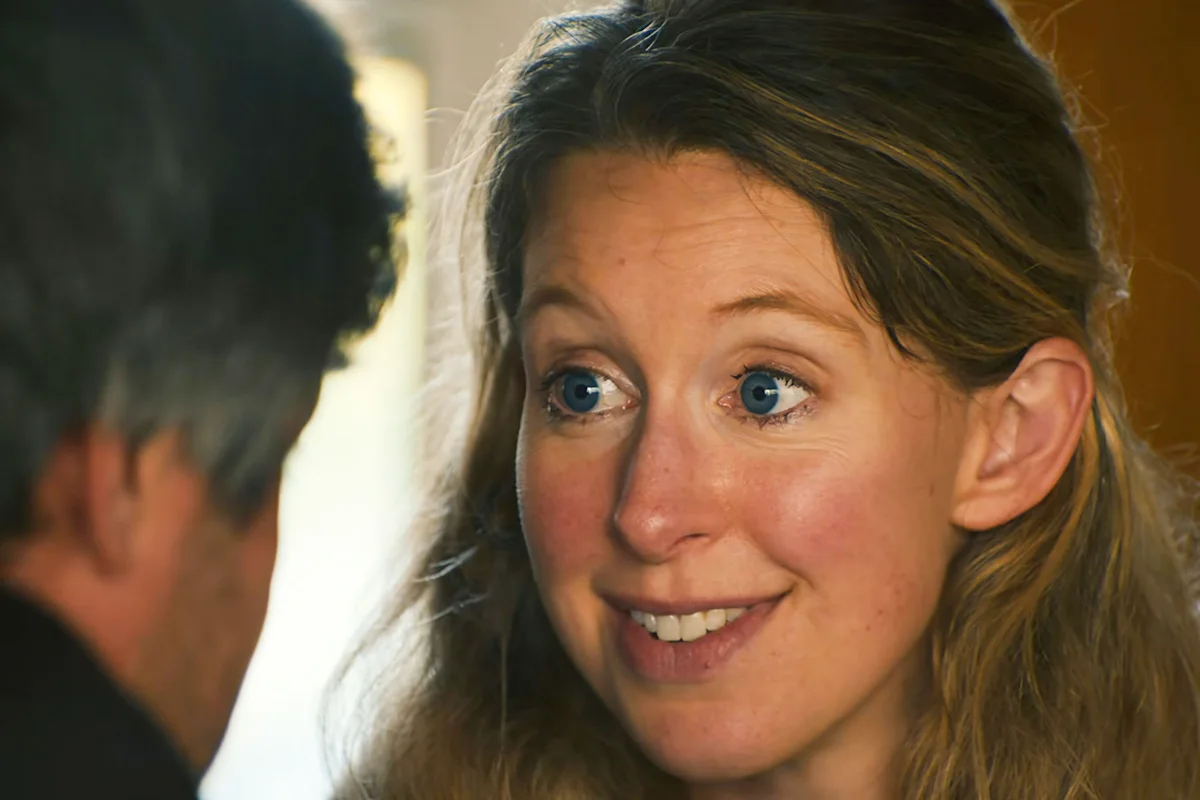
You Can See Everything, a critically lauded new documentary, follows Holmes and her partner Billy Evans as she prepares for her 11-year prison sentence. The subjects' goal, they state on camera, is to grant total access to their home lives to challenge public scrutiny of Holmes. This is a fairly obvious ploy for empathy that almost spoils its own shot: Look at this mom, disheveled and overwhelmed, with her big, watery eyes and perpetual split ends . She's going to prison, even though she swears she's never told a lie.
But the person Holmes and Evans choose to give access to is perhaps the most bizarre and fascinating documentarian possible. The film's co-director, who's shown on camera more than Holmes herself, is comedian Nathan Fielder. His breakout moment came from the show Nathan for You, in which he satirically pulled off dozens of business scams — you know, the kind of thing Holmes is trying to absolve herself from. He moves in with Holmes and her family in the 34 days before she turns herself in.
In one scene, Fielder, who is not an investigative journalist or a scientific expert but also not a pushover, interrogates Holmes about the ineffectiveness of Theranos's now infamous blood-testing device. She maintains that it can do everything she said it could (which, I must emphasize again, is demonstrably and unequivocally false). But it's the same argument she hewed to in court. Her insistence suggests she might actually believe that's the truth. And ultimately, the documentary focuses more on her persona and her relationship with the truth than on the details of the scam that's already been settled in the eyes of the law.
Fielder said at a post-screening Q&A in September that Holmes came across as "so genuine," he wanted to believe her too, even though "I know she's a liar."
But in his unfettered access to Holmes's family, a new narrative does take shape: Evans emerges as the real antagonist . He commands conversations, takes control of Holmes's image and constantly speaks for her, even on X. We start to see Holmes as just a passenger in her own life, overpowered by a man who clearly wants to capitalize on her infamy but won't even let her beat her own eggs.
As Evans talks about wanting to start a mysterious new venture with Holmes, it's hard to ignore how a pattern is emerging — she's going into business with someone she's in a relationship with, who has a much stronger personality than her. At Theranos, Holmes was in a relationship with the company's COO, Sunny Balwani, who was 19 years her senior when they became romantically involved (she was 19 years old at the time). She claims he emotionally and sexually abused her while manipulating her into fraudulent business decisions, which he denies .
In an Oct. 19 essay for Stat News , Theranos whistleblower Tyler Shultz writes, "I've always thought that Elizabeth was with Sunny in part because of his abusive personality, knowing she could use it to her advantage." Shultz believes that Balwani abused Holmes, but that Holmes also set Balwani up to be the company's fall guy. In court, he was convicted on all 12 counts, but she was convicted on only four.
We're left to wonder if Holmes is easily manipulated by these men because she's vulnerable, or whether she chooses coercive partners because she can use them to her advantage. Fielder wonders this too.
Another line of inquiry the documentary explores: whether Holmes, with her highly specific (and meme-able ) affect, may be neurodivergent . Fielder probed his own possible neurodivergence on his previous TV show The Rehearsal . In his interactions with Holmes, it's clear he recognizes something similar in her — for instance, she claims not to understand what's funny about the famous Abbott and Costello " Who's on First?" comedy routine .
It seems that Holmes wants us to think of her as a mom who operates on a different wavelength from the rest of the world. So much of her initial success at Theranos was likewise predicated on the fact that she was a successful young woman in a cutthroat field who was just a little odd. The way she always looks a little uncomfortable and out of place has made her a joke on the internet, and we're not laughing with her.
John Carreyrou, the journalist whose bombshell reporting on Theranos brought the company down in 2015, has a different read. He loves the documentary because of how boldly it puts her lies on display.
"By letting them train their ultra-long zoom lenses on her face while subjecting herself to Mr. Fielder's polite but insistent questioning, Ms. Holmes handed them — and us — a microscope with which to observe and dissect her lies," he writes for the New York Times . The long stares, head nods and half-smiles I saw as heartbreaking indicators that she's out of touch with social cues, Carreyrou saw as tells.
Still, even after parsing all this evidence, I cannot shake my empathetic feelings toward Holmes, and I know I'm not alone, despite the reality of her crimes.
"The woman that I saw on screen looked, frankly, like a broken woman," Shultz, who arguably has more reason to be mad at her than anyone else, says in an interview with CBS . "She is not playing victim. She is an actual victim."
Niloufar Esmaeilpour, a therapist, tells me that it makes sense we're inclined to root for Holmes's redemption. But it also means that she's pulling one over on us just like she did her investors.
"It's easier for humans to believe that she was manipulated by men, rather than accept that women could be ruthless manipulators too, as this belief fits better with more typical gender role expectations," she says. "That you would want to cheer for her shows that your innate empathy functions perfectly; therefore, these same manipulations used by Holmes to fool her investors are being exploited by her to hack into the viewers' psychological programming."
It's human to want someone to be redeemed, especially when they're seen as relatable or their victims are seen as imperfect. Anna Delvey, the "fake heiress" scammer who was convicted of grand larceny, among other financial crimes, has appeared on Dancing With the Stars and walked a runway at NYFW . Gypsy Rose Blanchard , who pleaded guilty to plotting her mom's murder after years of alleged medical abuse, was released from prison to "yasss queen!" fanfare that gave her a career as an influencer. Even Jen Shah, the former Real Housewives of Salt Lake City cast member who was incarcerated with Holmes after pleading guilty to conspiracy to commit wire fraud , has returned to the internet to a chorus of calls for a second chance .
There's perhaps some recognition that there's a double standard at play here, that men are often rewarded for a certain brazenness that women are punished for. Holmes, Delvey, Blanchard and Shah also have compelling backstories in which they overcame some other villain. My compassion is not an endorsement of bad choices, but a desire to find humanity in even the cartoonishly manipulative.
Loi Medvin , a psychologist, found herself having the same conflicting emotions in response to the documentary as I did. On some level, we are both sympathetic to the argument that Holmes, described as the youngest self-made female billionaire in history at age 30 , had to take desperate measures to get ahead. It's not good, but it's relatable. And that's when Medvin dunked on me.
"There's an interesting contradiction here too," she says. "In wanting to see a woman as misunderstood or taken advantage of, we may inadvertently diminish her own agency and responsibility."
If what I really want from Holmes is to see her stand on her own and be successful apart from manipulative men, I have to believe she is capable of making her own decisions. That includes rectifying the harm that she personally caused investors and hopeful patients. She still hasn't done that . Because of that, I want to defend her more than she wants to accept redemption.
Instead of propping her up in my mind as a misunderstood girlboss, I have to do what Shultz, Fielder and so many others have already done: Accept that she is both vulnerable and responsible. She is guilty, though I want her to be innocent.
Topics in this story
Gathered from external sources. Rights to this text belong to whoever originally published it.