Bristol singer on a mission to help people through music
Lady Nade, from Bristol, has performed at hospitals, prisons, care homes and schools.
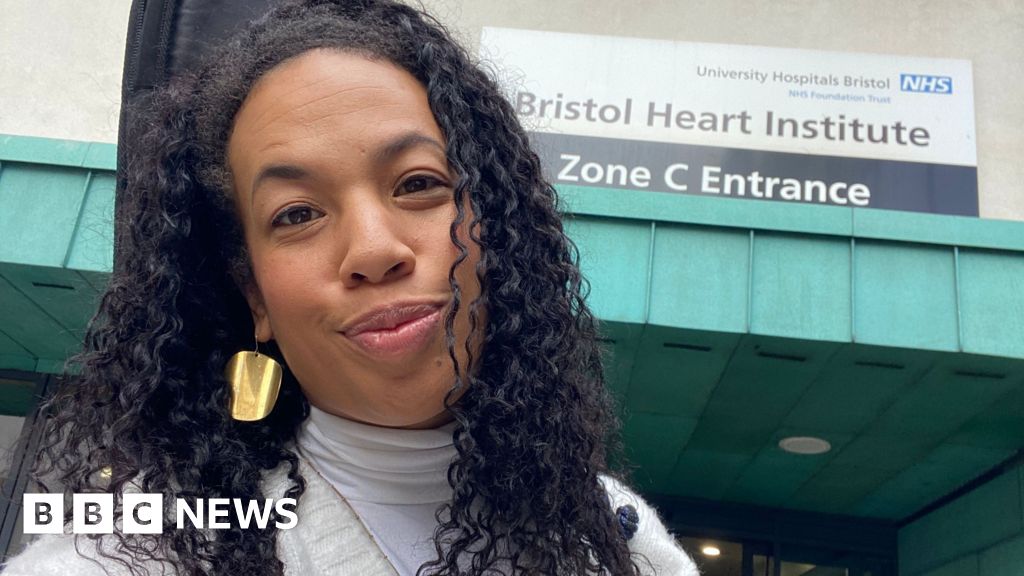
A singer who used music to cope with childhood grief said she has made it her mission in life to help other people's wellbeing with the medium.
Lady Nade, from Bristol, turned to singing and songwriting at the age of 10 after her grandmother passed away. As a teenager, she embarked on a career in the field through free music workshops.
Now working as a music facilitator, she said her work had allowed her to build "incredible connections" with schoolchildren, prisoners, hospital patients, hospice patients and bereaved families.
"I have this sort of vision and mission that music should be accessible to all. I want to be part of that advocacy because music empowers people," Lady Nade said.
Mother expected to plead guilty over child deaths
PC banned for 'derogatory' WhatsApp comments
AI not a threat to films, say Shaun the Sheep creators
The Bristolian, who has released three albums since 2016, credited her grandparents for encouraging her to sing and perform as a child.
When her grandmother passed away, Lady Nade wrote letters and poems to her in an attempt to process her grief.
Her grandfather introduced her to a range of music through his collection of 1950s and 1960s rock 'n' roll, folk and Americana records, which helped her to develop her own taste and work.
"Me and my grandad would bond over listening to different mixtapes... it was part of my healing and grieving and I'd sing along at the top of my lungs and it'd remind me of these memories of my nan," she said.
During her teenage years, Lady Nade attended free music workshops at Bristol Beacon where she learned to sing and write songs with the help of mentors.
Through the scheme, she became a mentor herself and started working in the community as a Live Music Now facilitator.
The charity aims to create inclusive social impact and opportunity through music.
Lady Nade said: "Prisons, hospitals and care homes are inaccessible when it comes to music and art.
"Being able to actually outreach and be mobile and take music and turn it into a therapy and a process is so, so important.
"It helps people with their mental health and wellbeing. Music helps with senses, it helps the nervous system, it helps with anxiety, it helps with mood and it can help with memory."
The NHS recognises music as a form of therapy and employs specialised healthcare professionals to deliver sessions to people with a variety of needs.
Music has been linked to a wide range of health benefits - including lower blood pressure, improved heart rate and the release of endorphins .
Clare Maddocks, from the British Association for Music Therapy, works as a health and care professions council-registered music therapist who specialises in neurology.
She said the therapy method was suitable for everyone and no musical experience or skill was needed in order to benefit.
"We have a strong link between our emotions, our memory and music.
"Anytime we engage with music, we elicit a multimodal response in the brain.
"That means that music automatically taps into cognitive processes such as mood regulating parts of the brain and it also really helps to awaken the brain... then we can use that to help with our mood.
"You can start listening to a song and you can be feeling one way at the start of the song, but by the end of it, you might notice there's a bit of a shift happening in you," she said.
Lady Nade has performed in hospitals - including Southmead and Bristol Royal Infirmary - for patients suffering from neurological, mental and physical conditions, as well as in palliative care settings.
She said she previously performed for a palliative care patient - who used to play the trumpet - who sang along with her before he "peacefully passed away" later that day.
The bereaved family described her session as "a gift" that helped them to cope with "the worst time of their lives".
Lady Nade said sharing, performing and releasing her music - which often explores themes of identity, love and loss - felt like "a calling" for her.
"I realised through my work and through grief that shared grief validates other people's experiences.
"Grief can be validated when it's shared, but when we keep it in to ourselves, it can't be validated."
Follow BBC Bristol on Facebook , X and Instagram . Send your story ideas to us on email or via WhatsApp on 0800 313 4630 .
Orchestra helps man with autism feel he belongs
Music therapy means I can now lift my hand again
The music therapy helping patients to 'come alive'
Topics in this story
Gathered from external sources. Rights to this text belong to whoever originally published it.