Harano Sur: Uttam Kumar at 100
At a hundred, Uttam Kumar, the Mahanayak or great hero of Bengali cinema, is the most agreed-upon man in Bengal. The agreement conceals a long negotia.
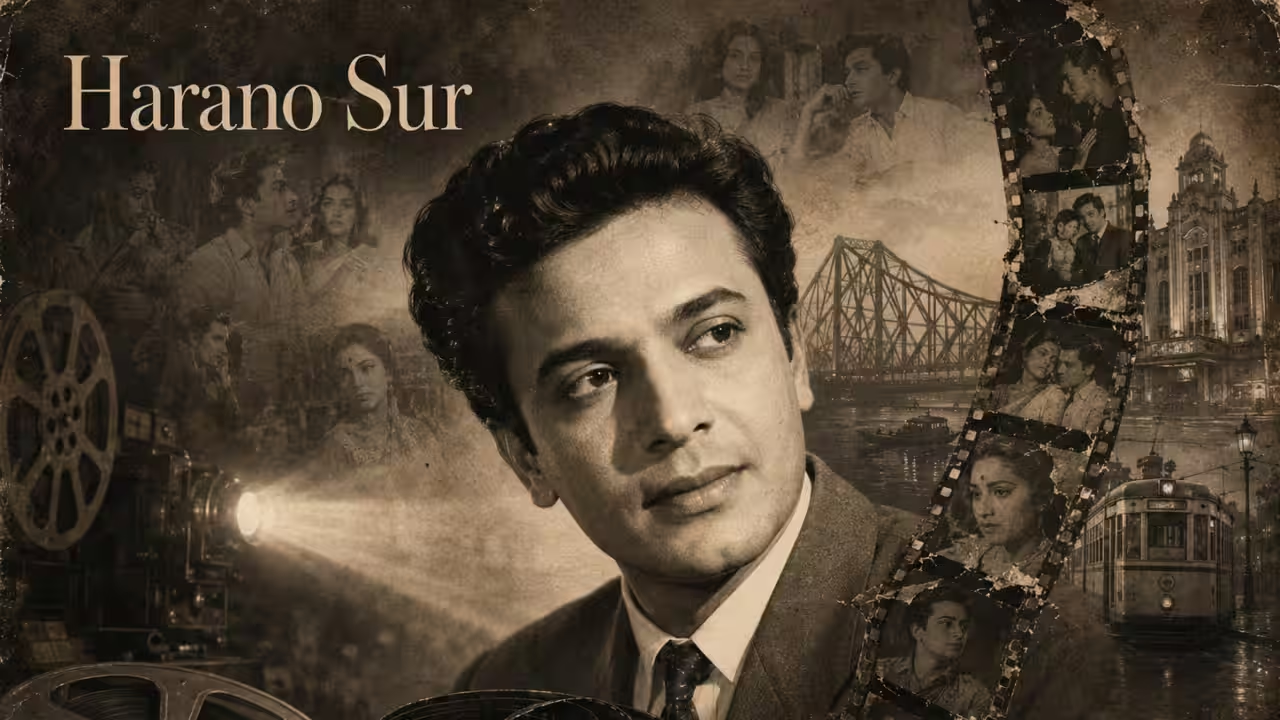
At a hundred, Uttam Kumar, the Mahanayak or great hero of Bengali cinema, is the most agreed-upon man in Bengal. The agreement conceals a long negotiation, in which Bengal accepted certain things about him, refused others outright, and has still not accepted the one obligation that matters.The centenary arrived on schedule on September 3 and with better than usual paraphernalia: statues garlanded at Tollygunge, the home of the Bengali film industry, and at Ahiritola, the north Kolkata street where he was born; a twenty-foot cutout outside the iconic single-screen Bijoli cinema; a padayatra with artistes; LED vans doing the rounds; an exhibition of booklets and behind-the-scenes stills at Nandan, the state-run film centre; and a commemorative stamp and cover from the Department of Posts.And, beyond the day itself, the apparatus of a year: a foundation stone in New Town for a film centre on three acres; a twenty-member advisory board with the Chief Minister as chief patron; a year-long calendar; and a festival opening, inevitably, with Nayak, Satyajit Ray's study of a matinee idol, written for him.The Prime Minister posted a tribute in the morning and directed everyone to what he had said about the actor on Mann Ki Baat, his monthly radio address, the previous Sunday: that he had kept working through early failure, and should be admired for it. All of this is true, and almost none of it is interesting, because perseverance is the one quality you can commemorate without showing anybody a film.The more useful question on a hundredth birth anniversary is not what Bengal loved about Uttam Kumar. Bengal has been answering that compulsively since July 1980, when he died. The more interesting question is what Bengal was prepared to accept from him, and what it was not.From Flop Master General to MahanayakBegin with the acceptance, because it was neither instant nor free.Arun Kumar Chattopadhyay was born on 3 September 1926 at his maternal home on Ahiritola Street, in north Kolkata, the son of a man who ran the projector at the Metro cinema, which is to say that he came to the cinema through the back of the hall.He matriculated in the second division, took a clerk's job at the Port Commissioners on two hundred and seventy-five rupees a month, changed his screen name three times before one finally stuck, and by twenty-six had accumulated enough failure for the trade to nickname him the Flop Master General, a joke reportedly performed to his face on studio floors. Then came Nirmal Dey's Basu Paribar in 1952 and Sharey Chuattor in 1953, then Agni Pariksha in 1954, and a Bengal that had laughed at him for four years decided, within two, that he was the only face it wanted to look at.What it had decided to look at was itself, improved.The Bengali Uttam Kumar played was urban, salaried, educated, courteous and emotionally contained, a man who could be poor without being coarse and prosperous without becoming a boor, and he arrived exactly when a post-Partition middle class, remade by the 1947 division of Bengal and the refugees it drove west, needed evidence that such a man could still exist in Calcutta.The Encyclopaedia of Indian Cinema puts it more precisely than most tributes will this week, noting that his early romances revived the humanist tradition of the bhadralok, Bengal's respectable, educated middle class, while quietly discarding some of its more conservative furniture. He was a lover who did not chase; he waited, in Saptapadi, and returned much later to the wreckage, in Jatugriha. He made room for his heroines instead of rescuing them. Bengal accepted him because he flattered it in a register it recognised as good taste, which is the only kind of flattery the bhadralok has ever accepted.Three things Bengal withheldHaving granted him that, it began withholding other things.First, the ordinary latitude it might have extended to a private citizen. In 1963 he left the house he shared with Gauri Devi, whom he had married in 1948 and never divorced, and lived for the next seventeen years with the actress Supriya Devi. The audience that had built a cult around his on-screen restraint then conducted a running commentary on the arrangement for the rest of his life and a good while after it. Bengal was happy to watch him play a murderer in Kuhak, a rotting landlord in Stree, a bought politician in Bagh Bondi Khela. What it would not do was allow the man anything the character might have got away with.Second, it withheld the national career.He turned down Bees Saal Baad, turned down the second lead in Sangam, and then, in 1967, produced his own Hindi debut, Chhoti Si Mulaqat, a remake of Agni Pariksha with Vyjayanthimala in place of Suchitra Sen, his partner in the original and the other half of Bengali cinema's definitive screen couple. It failed so spectacularly that it left him close to bankruptcy. Bombay took him properly only once, with Shakti Samanta's Amanush in 1975, shot in Bengali and Hindi at the same time, which ran for the better part of two years and became the biggest hit of his career; when the same team tried again with Ananda Ashram, the Bengali version ran for months and the Hindi one died.There is no evidence that Bengal mourned any of this. A Mahanayak who belonged equally to Bombay would have stopped being quite so completely Bengal's property, and one of the uses of Uttam Kumar was precisely that he proved Bengal did not need Bombay's permission to produce a star.Third, and most instructively, Bengal withheld the right to be anybody else.On 23 September 1976, All India Radio dropped Birendra Krishna Bhadra's Mahishasuramardini, the recital that had woken Bengal before dawn every Mahalaya since the 1930s, on the day that opens the Durga Puja season. In its place came a new programme narrated by Uttam Kumar and scored by Hemanta Mukherjee, known outside Bengal as Hemant Kumar, which is to say by the two most beloved voices in the province. Listeners stoned Akashvani Bhavan, All India Radio's Kolkata headquarters. The switchboard was overwhelmed, demonstrations were held in Calcutta and elsewhere, the ministry was forced to climb down, Bhadra was restored, and the new version was exiled to Sashthi, the sixth day of the Puja, where it has survived ever since as a curiosity. It took Bengal roughly a fortnight to reject the most popular man it had ever produced, on the one occasion he stepped outside the frame it had built for him. He apologised. He did not try again.Worshipped, but not readThe most consequential withholding, however, came from his own constituency's clerisy.Bengal in his lifetime had a critical establishment that treated popular cinema as an embarrassment to be tolerated in the interests of the box office. The result was that the first actor in India to win the National Award for Best Actor, given to him in 1968, the first year of the category, for Antony Firingee and Ray's Chiriyakhana, generated a myth and remarkably little scholarship. Sayandeb Chowdhury, whose 2021 book remains the only serious critical biography, describes a star kept in a kind of solitary confinement by his own fame, and notes how little Bengal's learned circles bothered to understand his range, his production work or his stewardship of an entire industry.Ray, who wrote Nayak for him and about him, had no such difficulty and said plainly that there would not be another like him. It is a peculiar arrangement in which the director is canonised, the star is worshipped, and only one of them gets read.The industry's balance sheetThat stewardship is the part of the legend the garlands rarely reach.Uttam Kumar produced films from 1957, directed from 1966, composed music for Kal Tumi Aleya, and in 1968 left the existing actors' body to set up Shilpi Sangshad, a welfare organisation for technicians and small artistes, running it until his death. When the fund ran dry, he made a film to replenish it: Bon Palashir Padabali in 1973, which he directed himself while persuading some of the industry's biggest names to work for nothing. It went on to become the year's highest earner.He was not merely the ornament of Bengali cinema. For thirty years he was, to an extraordinary extent, its balance sheet, which is why the industry did not simply mourn him in 1980 but visibly began to falter without him, and why Anandabazar Patrika, Bengal's largest Bengali daily, could compress the event into two words: Cholochitre Indrapatan, the fall of Indra in the cinema, which is Bengali for the toppling of a colossus.Why governments prefer birthdaysWhich brings us to the present negotiation, and to what is being accepted this week.For four decades, remembering Uttam Kumar was centred on 24 July, the anniversary of his death, and took place largely in a folk register: Shilpi Sangshad's own festival at Nandan, the retrospectives, the television reruns, the Mahanayak Samman that the previous government instituted in 2012 and handed out every July at Uttam Mancha, the south Kolkata auditorium named after him. The centenary completes a migration that has been under way for some years, from the day he died to the day he was born, which is to say from a mourning that belonged to the audience to an anniversary that can belong to the state.Governments prefer birthdays. Birthdays are about arrival.Every government has taken its turn. The Left Front, then in power in West Bengal, put up the Tollygunge statue in 1993. The metro station was renamed and the first stamp issued in 2009. The Trinamool Congress government created the award in 2012. A BJP government four months old in Bengal, looking for a Bengali inheritance nobody can reasonably contest, has now given him a year, a board, a stamp, three acres and a padayatra, with the Prime Minister supplying the moral.Nobody in this sequence needs to be insincere, which is precisely the difficulty. Uttam Kumar is loved almost without exception, and a figure loved without exception is available to everybody. Standing next to that smile has never cost a politician a single vote.The vaults nobody has openedWhat none of them has accepted is custody.In 2018, when the Film Heritage Foundation brought its restoration workshop to the Kolkata International Film Festival, its founder, the archivist and filmmaker Shivendra Singh Dungarpur, pointed out that Bengal had lost every silent film it made between 1918 and the early thirties and that his foundation had identified more than a hundred Bengali titles in need of urgent rescue. On that list sits Harano Sur, the 1957 film Uttam Kumar produced himself, the year's biggest earner, whose title translates as the lost tune.Soumitra Chatterjee, Ray's other great leading man and the only serious rival Uttam Kumar had for the Bengali audience, was asked about the same crisis and said he doubted whether the classics of Barua, the Devdas director P.C. Barua, or Uttam Kumar, or even his own early work, could still be saved. Eight years later, the state's own information secretary describes Uttam Mancha as dilapidated, the film directorate's brief already includes restoration of the holdings in government vaults, and yet the most basic public question remains unanswered: which of Uttam Kumar's two hundred and eleven films survive as negatives, which survive as scratched prints, which exist only in some distributor's family cupboard, and which are simply gone?Meanwhile, the state says the purpose of all this is to introduce him to a generation that missed him.That generation's actual access too often consists of YouTube uploads mastered from video cassettes, and Oti Uttam, the Bengali director Srijit Mukherji's 2024 film in which the Mahanayak appears as a ghost assembled from footage drawn from fifty-four of his own films, with his voice cloned by an American AI company because there was no other way left to make him speak a new line. The exercise cost about a crore and a half.Sit with that for a moment: a generation that has rarely had the chance to see a clean print of Chowringhee has already paid to watch a synthetic reconstruction of the man who was in it.The appetite is proven. The supply is a policy failure.The test is 2036So let the padayatra proceed, and let the foundation stone be laid. The test of this centenary will not be what gets unveiled between now and next September, but whether, in 2036, a nineteen-year-old in Barrackpore can watch a properly restored Jatugriha on a legal platform, in a decent transfer, subtitled by somebody who knows Bengali.Publish the vault inventory. Fund restoration before construction. Clear the rights, which are scattered across heirs and defunct distributors and grow harder to trace every year.Bengal has spent a century deciding what it would and would not accept from Uttam Kumar. The one thing he actually needs from us now is the one obligation we have still not accepted.The lost tune (harano sur) stays lost, cutout notwithstanding.Give your child the gift of confidence! Claim your exclusive TOI Masterclass spot today!
Topics in this story
Gathered from external sources. Rights to this text belong to whoever originally published it.