Matthew Rhys was always the Main Man. You just didn’t know it till this year’s Emmys
At the 78th Primetime Emmy Awards, Welsh actor Matthew Rhys achieved an unprecedented milestone in modern television history. Winning two Lead Actor a.
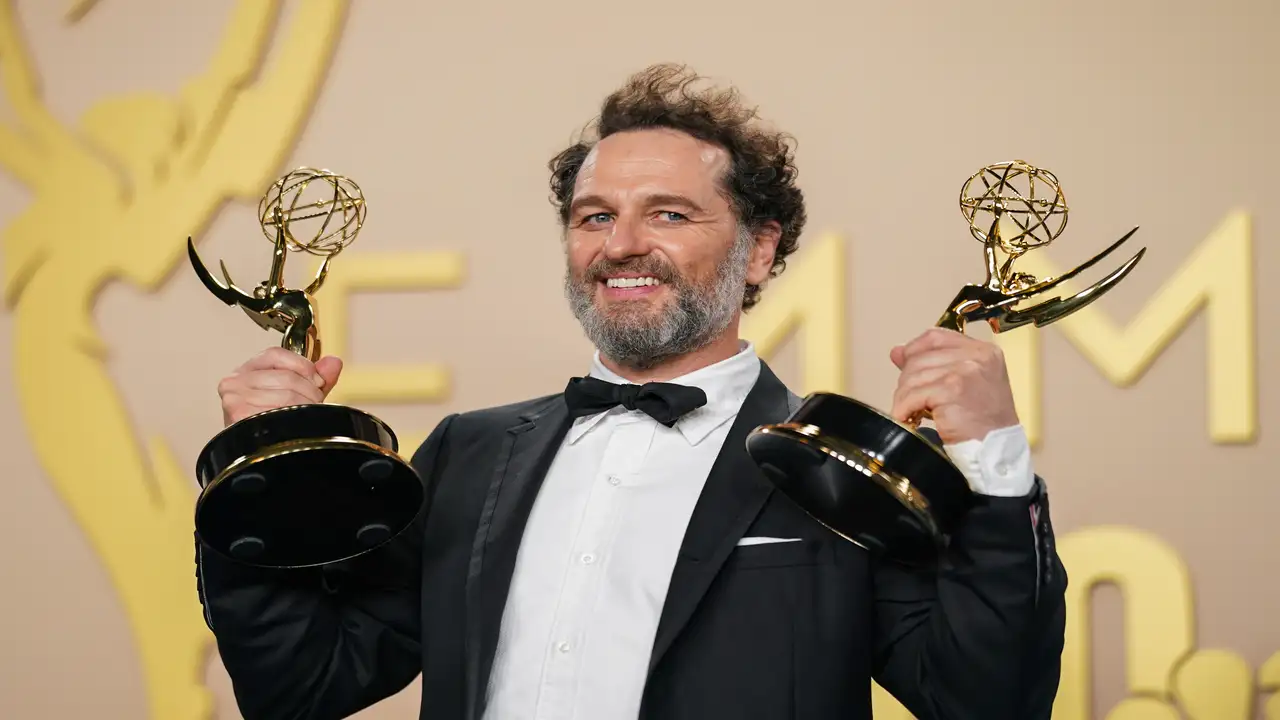
At the 78th Primetime Emmy Awards, Welsh actor Matthew Rhys achieved an unprecedented milestone in modern television history. Winning two Lead Actor awards in a single evening—one for his portrayal of the unhinged real estate developer Nile Jarvis in Netflix’s limited series The Beast in Me, and another for his performance as an anxious island mayor in Apple TV+’s breakout comedy Widow’s Bay—Rhys secured his place in the industry record books.For the ones who have followed the Welsh actor’s career closely, this hasn’t been a surprise at all. In fact, it is delayed gratification. Matthew Rhys has been the main man for a while now. A lot of people just didn’t notice how much – i.e., just how prolific his career has been since he played one of the brothers in Brothers & Sisters, which premiered 20 years ago. In 2006.Combined with his 2018 Lead Actor in a Drama win for FX's The Americans, Rhys became the first male actor to win top lead acting honours across all three major television categories: Drama, Comedy, and Limited Series. He also became the first performer ever to collect two lead acting Emmys on the same night.For casual viewers, the double win may have looked like a sudden arrival. But for anyone who has watched Rhys over the past two decades, it feels more like the industry finally catching up with an actor who has been quietly building one of the most interesting careers on television. His achievement is not just about two trophies on one night. It is about the remarkable distance he has travelled as a performer, from a relatively understated supporting player to one of television’s most versatile leading men.From the quiet man to the man who can do almost anythingTo understand why the Emmy sweep matters, let’s look at the journey rather than just the destination. Before the chaos of Widow’s Bay or the menace of The Beast in Me, Rhys built his reputation through performances that depended heavily on restraint, silence and what was happening beneath the surface.His American breakthrough came with Brothers & Sisters, where he played Kevin Walker, a corporate lawyer and one of the members of the complicated Walker family. The role introduced him to a large American television audience and established something that would remain central to his career: the ability to make a character’s pulse in every scene. You didn’t feel it was a performance.Then came The Americans, the role that changed the way audiences saw him. As Philip Jennings, a Soviet spy living undercover in suburban Virginia, Rhys had to play a spy, also a family man, husband and father – a man who had to hide a great deal from everyone. But in that subterfuge was the revelation of Rhys as a consummate actor.Philip could not announce his emotions because the entire character was built around concealment. Much of the performance was therefore in the small details: a pause, a look, a tired posture, a change in his voice — and of course his many disguises (read different wigs).The actor in Rhys made Philip’s exhaustion feel physical. As an audience, you feel you are in his place, feeling and doing everything he does. Even if it’s murder. He was a killer, but he was also a man increasingly uncertain about the life he had chosen.The performance was powerful because of Rhys’ “volatile restraint”. Sounds a bit of an oxymoron, but that was precisely what his eyes conveyed. He rarely pushed it too far. The emotions were often held back, allowing the audience to feel the pressure building underneath. That performance earned him his first Primetime Emmy for Lead Actor in a Drama in 2018.Then came Perry Mason, where Rhys took on a very different version of a familiar character. Instead of the polished courtroom lawyer audiences already knew in Brothers & Sisters or the spy in The Americans, he played Mason as a damaged, brooding private investigator in Depression-era Los Angeles. Some called his character a “loser”. And he played it to perfection. This performance was built around a man carrying considerable emotional weight. Losing more than winning.By this time, there was a pattern emerging. Rhys was becoming exceptionally good at playing complicated men who did not necessarily explain themselves. His characters could be angry, wounded, morally conflicted or exhausted, but the performance rarely told the audience exactly what to feel. Rhys trusted the character and, more importantly, he trusted his audience.And then he changed the rules.Two new characters, two completely different MatthewsThe real surprise of his recent career has been the extent to which Rhys has allowed himself to become unpredictable. In The Beast in Me, he plays Nile Jarvis, a wealthy and intimidating real estate developer, who becomes embroiled in a psychological battle with his neighbour. It is a role that draws on a side of Rhys that audiences had rarely seen. The actor brings a dangerous charisma to Jarvis, making him difficult to read and even harder to trust.The performance has a volatility that is very different from the controlled tension of Philip Jennings. Rhys can suddenly become threatening, aggressive or almost unnervingly charming. This character felt capable of changing direction any moment.At the same time, Widow’s Bay allowed him to go in the opposite direction. As an anxious small-town mayor dealing with a haunted island, Rhys embraces physical comedy, panic and deadpan humour. The character is nervous, overwhelmed and frequently out of control.This is where the Emmy story becomes quite interesting. It is one thing for a dramatic actor to successfully move into comedy. It is quite another to do it while retaining the qualities that made audiences take you seriously in the first place.Rhys does not simply play the mayor for laughs. He finds the fear underneath the comedy. His nervous energy becomes part of the joke, while his timing keeps the character from becoming a caricature. Physical comedy also requires a different kind of confidence because the actor has to be willing to look foolish. And Rhys does it with confidence.The same performer who spent years communicating through a raised eyebrow or a barely audible change in tone was now into physical chaos.The two performances, arriving in the same Emmy cycle, make a larger point about the actor’s career: he was always an actor waiting for television to give him enough room to display his full range.Wales gave him the ear that Hollywood could not hearThere is another part of the Matthew Rhys story that is easy to overlook: his Welsh identity. Born in Cardiff, Rhys grew up speaking Welsh as his first language and attended Welsh-medium schools before studying at RADA in London.His connection to Wales has remained an important part of his identity, even as much of his professional life has unfolded in the US. His Welsh identity gave him something that became extremely useful in Hollywood: an unusually sensitive ear for language.For years, many American viewers simply assumed Rhys was American. His performance as Philip Jennings was so convincing that his real accent became almost irrelevant. He has spoken about modelling his American speech on George Clooney’s voice in ER, and his ability to inhabit American accents has become one of the less visible skills behind his performances.It is easy to forget how much technical work goes into making an accent disappear. An actor is not only changing pronunciation. Rhythm, breathing, pitch and the placement of sounds all have to change. Rhys has made that process look effortless.And yet he has often spoken about accents with a sense of humility, treating them as something that requires constant attention rather than a skill he has completely mastered.Rhys’ greatest strength is that even after decades in the business, he seems more interested in getting the work right than in behaving like someone who has already arrived. “I’ve realized that nobody's going to die if I don't get it right and that there are a number of things out there, beyond acting, that are very interesting and fulfilling,” Rhys had once said in an interview.The career that was built by waitingThere is something old-fashioned about Rhys’s career. He did not become an overnight superstar. He accumulated roles, experience and credibility over time. That is the most important currency in a world that loves and creates overnight stars daily. But Rhys wasn’t one of them. By choice. It wasn’t just every script he chose. An actor’s life is also defined by the roles he doesn’t choose. His grounded Welsh roots never let temptation be the ultimate decider. It was restraint for the actor in terms of his performance. And discerning in terms of roles to pick.Before Brothers & Sisters, there had been years of British television and film work, including The Edge of Love. But Brothers & Sisters gave him global visibility. The Americans gave him prestige. Perry Mason allowed him to carry a darker, more complex series. His latest projects have expanded the range even further.The interesting thing is that Rhys himself has not always seemed convinced that he belongs in the room. He has said so in many interviews. Despite playing powerful, intimidating and emotionally complicated men, he has spoken openly about his own insecurities. He has described himself as a “nervous Nelly” and talked about the identity crisis and lack of confidence that helped push him towards acting in the first place. “I've suffered from an identity crisis my entire life. It's why I went into acting,” he had said.That contrast between the actor and the characters is one of the more fascinating things about him. On screen, he can dominate a room. Off screen, his public persona is often self-deprecating and slightly awkward. His characters may know exactly what they want. The actor has often described himself as someone who worries about saying the wrong thing.Perhaps that is part of why his performances feel so convincing. He does not appear to be playing confidence from a distance. He understands the instability beneath it.His career also suggests that he was never particularly interested in chasing celebrity for its own sake. He kept choosing difficult characters and complicated stories, allowing recognition to build slowly around the work.Television eventually caught up with that strategy. As the medium began to move away from simple heroes and villains towards damaged, contradictory and morally-complicated characters, actors like Rhys had more opportunities to demonstrate what they could do.Seen together, these roles make the Emmy double win easier to understand. They are not variations of the same performance. Each requires a different physicality, rhythm and emotional register. And somewhere underneath all of them is an actor who has spent years learning how little he needs to do to command attention.Range is not necessarily about doing something completely different every time. It is about finding a different truth for every character.Even Hollywood’s “First Family” keeps it privateRhys’s life away from acting has also become part of his public story, particularly his relationship with actress Keri Russell.The couple first met casually before reconnecting while working together on The Americans. They began dating in 2014 and have since built a family life in New York while keeping much of it away from public scrutiny.Their relationship has become a favourite among television audiences partly because of the contrast between their professional visibility and their private approach to fame.That privacy was particularly noticeable during the Emmys. Rhys did not thank Russell during either of his acceptance speeches, something that might have seemed surprising given their history.The reason was simple: Russell had asked him not to.The couple had already joked about the subject during Rhys’s 2018 Emmy acceptance speech, when he teased Russell from the stage. Her reaction became one of the memorable moments of that ceremony.Years later, the joke had evolved into something more meaningful. Rhys respected her wish to keep their private relationship away from the public performance of an awards ceremony.Backstage, however, he was generous in his praise of Russell, calling her a “class act” and speaking warmly about the way she supports other actors. He also revealed that he keeps his Emmy awards in the basement and plans to bring them upstairs when Russell wins one of her own.It is a small detail, but it fits the larger Rhys story. For all the spectacle surrounding awards, fame and television history, he still seems more interested in the people and relationships that exist away from the spotlight.The Emmys did not make Matthew Rhys the main manThe easiest way to look at Rhys’s extraordinary Emmy night is as a breakthrough in terms of record-setting and acting credentials. But that would be misleading. He broke through a long time ago.There is also something satisfying about the timing though. Rhys is not a newcomer suddenly discovering success. He is an actor who has spent two decades working, experimenting, disappearing into characters and letting his career grow at its own pace. Some time ago, in an interview, Rhys had said: “In my twenties, I thought I was Robert De Niro and I invested all of myself in my acting. But as I’ve gotten older, I’ve calmed down a bit. I’ve thrown my game plan out of the window.” Possibly the best decision of his life.And that’s why Matthew Rhys has always been the main man.Get the latest Bollywood & Entertainment News, and more. Download the TOI app.Give your child the gift of confidence! Claim your exclusive TOI Masterclass spot today!
Topics in this story
Gathered from external sources. Rights to this text belong to whoever originally published it.