Billionaire tax divides California Democrats, draws myriad questions
California voters this midterm cycle will decide whether the state will impose a wealth tax on billionaire residents, as wealthy Californians organize against the measure and experts say its potential broader impact on the state’s economy is nuanced. By voting “yes” on Proposition 40, Californians would support a one-time 5 percent tax on billionaires’ wealth.…
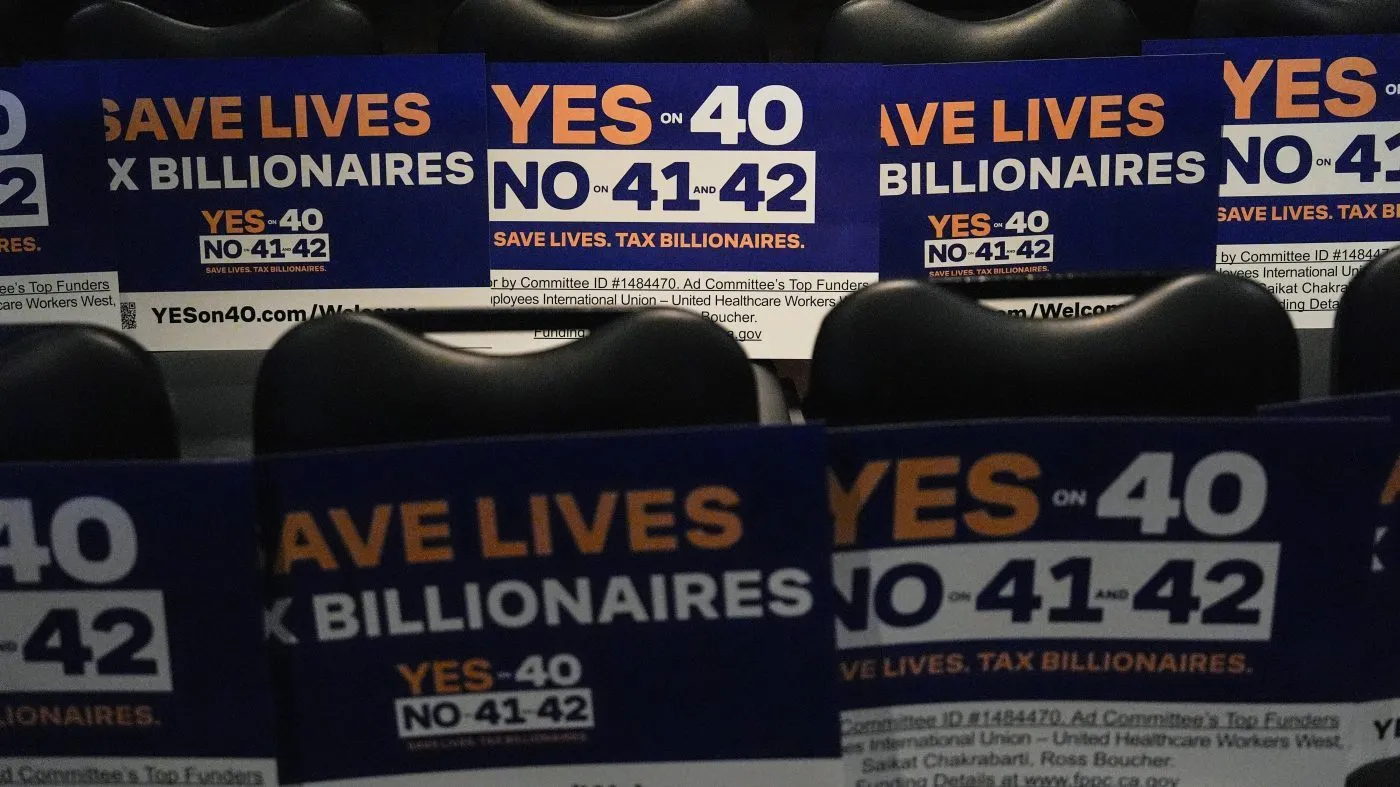
California voters this midterm cycle will decide whether the state will impose a wealth tax on billionaire residents, as wealthy Californians organize against the measure and experts say its potential broader impact on the state’s economy is nuanced.
By voting “yes” on Proposition 40 , Californians would support a one-time 5 percent tax on billionaires’ wealth. The government revenue from the wealth tax — which no state to date has imposed — would primarily go toward state healthcare programs, with the remainder earmarked for food assistance and education initiatives.
The Golden State would collect “tens of billions of dollars” from the wealth tax on the roughly 200 billionaires in the state, per an analysis from the nonpartisan state Legislative Analyst’s Office (LAO), which noted the increase in revenue would be “ spread across several years .”
But polling indicates it is unclear the measure will receive the simple majority support needed to pass. Even if it does, questions remain about next steps for the state and downstream effects.
“When you see eye-popping numbers like that, I can see how that looks … very appealing,” Tracy Gordon, the director of the Urban-Brookings Tax Policy Center, told The Hill. “But I think the concern is … what would the response be, both legally and economically, in terms of people leaving the state?”
If California went through with the tax, it would raise $100 billion over the next five years, according to the United Healthcare Workers West, the labor union that backed the measure’s addition to the ballot.
The revenue from the tax, the group argues, could offset cuts to California’s federal funding under the One Big Beautiful Bill Act, which President Trump signed into law in July 2025.
The law could result in the state losing $30 billion in federal funding annually through 2028, per an analysis from the California State Assembly’s Committee on Health.
“California faces a fundamental fiscal challenge: How do we protect essential services when the federal government is withdrawing billions of dollars in support?” Sam Wilkinson, a senior policy associate at End Child Poverty California, said this week on a press call.
Wilkinson, whose organization supports Proposition 40, added that the 5 percent billionaire tax “would provide critical resources to help California” grapple with the federal funding cuts.
The measure, however, has not quite unified Democrats in the state. While the state Democratic Party along with the AFL-CIO and Teamsters unions support Proposition 40, California Gov. Gavin Newsom (D) is against it .
Newsom, a potential 2028 presidential contender , wrote in a June Substack post that he supports a federal billionaire tax . But the outgoing California governor noted the state ballot measure “dedicates almost all of the revenue” from the tax to healthcare.
“There is nothing for housing, nothing for childcare, nothing for public safety workers who must answer 911 calls, and nothing for our public universities that have powered California’s economy for a decade,” Newsom wrote, adding, “This is not how we should set California’s budget priorities.”
California’s billionaires also oppose the ballot measure and have lobbied against it via Building a Better California, a nonprofit dedicated to fighting the proposed tax.
Since January, the group has received more than $333 million in the form of 123 contributions, according to data from the office of California Secretary of State Shirley Weber (D). That includes $102 million from Sergey Brin, the co-founder of Google who moved his primary residence from California to Nevada earlier this year.
Gordon, a California native, noted “some types” of wealthy individuals move in response to taxes , citing research that shows entrepreneurs and scientists decide where to live based on tax policy.
Such a development in California, she argued, would be “concerning” for the state government, which relies on those individuals for revenue in the form of income taxes.
In its analysis of Proposition 40, the state’s LAO noted that billionaires leaving the state in response to the measure passing would reduce government revenues by less than $1 billion per year.
“This could mean less money for the state’s General Fund, which is the account that pays for most public services, including education, health care, and prisons,” the office added.
The measure is also far from a sure thing to pass, polling shows.
Fifty percent of respondents to a recent University of California Berkeley/Los Angeles Times survey opposed it, while 42 percent supported it and 8 percent were undecided. The 8-point edge for the opposing side was outside the poll’s margin of error of 3 percentage points.
Plus, voters could nullify a successful Proposition 40 by greenlighting either Proposition 41 or Proposition 42 . The latter measure, which Newsom and Building a Better California support, proposes barring the state from establishing new taxes on the “ownership of financial assets or other personal property.”
If Proposition 40 overcomes those hurdles and passes, how California will implement a 5 percent tax on billionaires’ wealth remains unclear.
Analysts from the nonpartisan California Budget and Policy Center noted in August there will “likely” be legal challenges to the levy, specifically regarding the provision stating the tax would apply to billionaires who were California residents on Jan. 1 of this year.
“Because a wealth tax is untested at a state level in the United States, it carries real uncertainty: courts may strike down the measure or portions of it, conflicting measures could lead to years of litigation, and no one can say how the location decisions of billionaires might change and what that would mean for California’s long-term finances,” the analysis added.
Gordon, of the Tax Policy Center, also raised how California would “measure” an individual’s wealth base subject to the tax, noting some billionaires have much of their wealth tied up in corporate shares.
That, she argued, will make it “tricky” for California to go through with the tax if Proposition 40 passes.
“In general, I think taxing income is a lot easier than taxing wealth,” Gordon said.
Topics in this story
Gathered from external sources. Rights to this text belong to whoever originally published it.