Iran’s Disappearing Oil Is Becoming Everyone’s Problem
Tehran’s shrinking export revenues raise the risk of renewed disruption to Hormuz, threatening 13 million b/d of oil flows and a fresh global price shock.
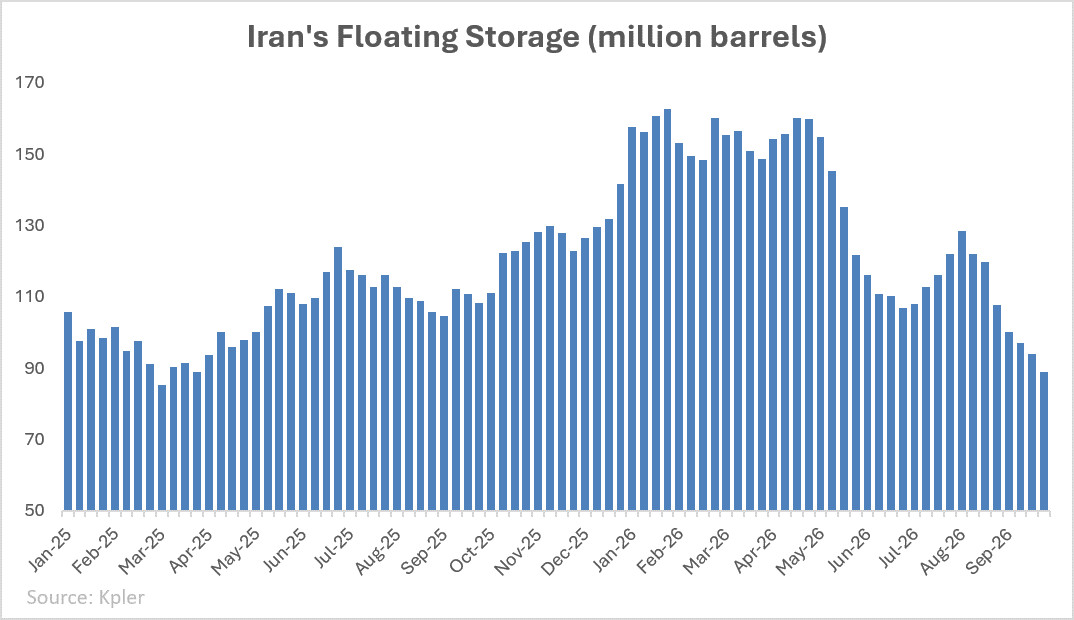
Iranian oil is disappearing from the market just as its biggest buyer returns for more. China's recovering crude demand is colliding with the loss of a supplier that sustained its independent refiners through the crisis, forcing them to compete for increasingly expensive alternatives. The consequences reach beyond China: every replacement barrel tightens supplies for other buyers, while Tehran faces a growing incentive to disrupt the Strait of Hormuz, which is now carrying an unexpectedly strong 13 million barrels a day (just 5 million below pre-crisis level), while its own oil remains trapped.
Iranian crude has long been an underestimated part of the global oil balance. After Bashar al-Assad's government fell in December 2024, breaking the political relationship that sustained Iranian shipments to Syria, China became Iran's only crude buyer - in 2025, it received an average of 1.4 million b/d. The war initiated by the US and Israel in late February initially made Iran even more important to Chinese buyers: while Tehran blocked other tankers from crossing Hormuz, its own cargoes passed freely, lifting Chinese intake of Iranian oil to around 1.76 million b/d in April.
That competitive edge ended with the US blockade announced on April 13. Loaded tankers could no longer leave the Gulf, while empty vessels could not enter. Loadings at Kharg Island, Iran's main export terminal, collapsed from 1.8 million b/d in March to 260,000 b/d in May. A June 17 memorandum allowing Iranian cargoes to pass for 60 days offered temporary relief : loadings recovered to 740,000 b/d in June and 890,000 b/d in July. But the reprieve expired in August, shipments slumped again to 250,000 b/d, and no Iranian loadings were observed in the Gulf in September.
The more important part of the story, however, was unfolding outside the Strait. Iran had accumulated a vast floating stockpile that allowed deliveries to China to continue even when fresh cargoes could not leave the Gulf. In mid-April, that cushion stood at about 160 million barrels, spread across waters around South, Southeast and East Asia. Drawing on those stocks , China still imported 1.37 million b/d of Iranian oil in May, just 10% below February's level. But the buffer was shrinking; floating storage fell to 106 million barrels by mid-June before the temporary reopening replenished it to 128 million by mid-July.
That replenishment of available floaters has since stopped. China still received 980,000 b/d of Iranian crude in August, but only 475,000 b/d in September, with arrivals ceasing from September 26 (all of the last arriving cargoes had been loaded in June).
Topics in this story
Gathered from external sources. Rights to this text belong to whoever originally published it.