Congress must get its head out of the sand and finally fix the budget
Both Democrats and Republicans have adopted an “ostrich policy” over the years when it comes to federal spending and debt. It’s long past time to get our fiscal house in order.
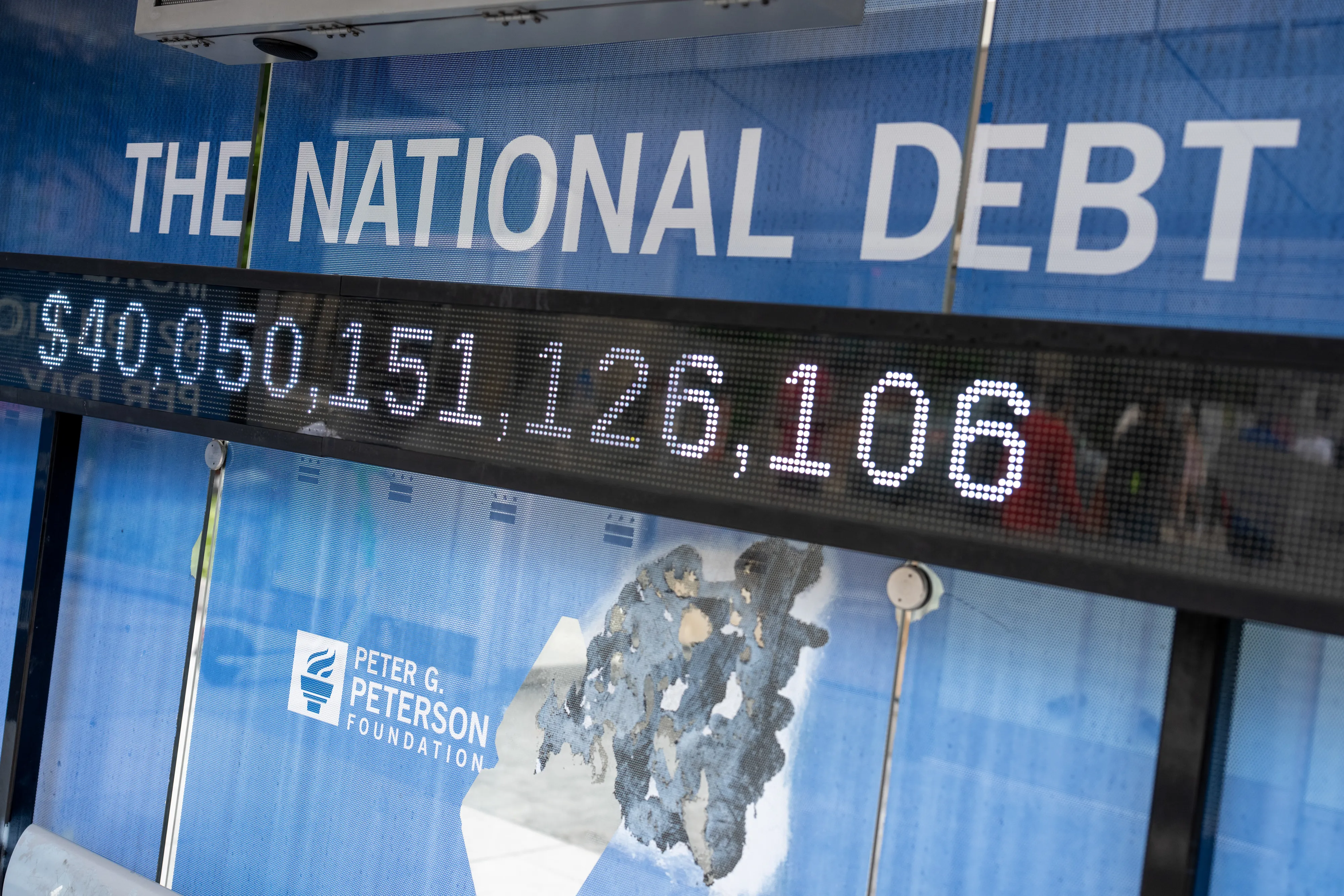
Americans recently learned that our total national debt has surpassed $40 trillion . Publicly held debt (at more than $32 trillion) is now eclipsing the nation’s annual gross domestic product, and annual interest payments top $1 trillion. On our present trajectory, the public debt will exceed 120 percent of GDP within a decade , with interest claiming more than $2 trillion of the annual budget.
These figures should get our attention regardless of our previous degree of concern for fiscal matters. But the Trump administration and both congressional parties seem to have hardly taken notice. A look at recent history helps explain this, while also revealing that evasion and avoidance have not always been the norm.
I recently viewed an archived interview I gave in 1987, a few months into my first term in the U.S. House, on the long-running PBS show “North Carolina People with William Friday.” Friday asked me, “What about the House has surprised you most?” I had forgotten the answer I gave, but in retrospect it seems clear: the preoccupation of all of Washington with the deficit and the debt.
Former President Reagan’s tax and spending policies had produced what his budget director later described as “fiscal excesses that had never before been imagined.” He had then scrambled to replace the lost revenue. The decade that followed was fixated on fiscal issues.
The budget debate often displayed what we derided as “smoke and mirrors” and “rosy scenarios.” But on three occasions, plans were adopted that dealt seriously with the challenge, combining sizable reductions in projected spending with substantial increases in revenue.
The first plan, in 1990, was made possible when then-President George H.W. Bush backed off his “ Read my lips: No new taxes ” campaign pledge in a bid to reduce the deficit. But the hard-won bipartisan agreement was not complete. Vowing never to raise taxes, House Minority Whip Newt Gingrich (R-Ga.) led a sizable group of Republicans in opposition to the deal, defying the president and their own House minority leader.
The second comprehensive plan narrowly passed in 1993 , President Bill Clinton’s first year in office. It closely resembled the 1990 plan in the balances it struck, but was passed with Democratic votes alone. The final plan , negotiated in 1997 between Clinton and the Republican-led Congress, was less ambitious, but it sealed the deal, paving the way — helped by a strong economy— for four annual budget surpluses and a reduction of the publicly-held debt by $485 billion .
The fiscal situation rapidly deteriorated during the George W. Bush administration, thanks to huge tax cuts , post-9/11 security spending , and a major recession that began in 2007. Bush’s successor, President Barack Obama, took office viewing the reversal of this fiscal decline as part of his mandate to revitalize the economy. His failure still resounds powerfully.
Obama first appointed a bipartisan commission , chaired by former Sen. Alan Simpson (R-Wyo.) and Erskine Bowles, formerly Clinton’s chief of staff. The commission formulated a comprehensive plan modeled on, but going beyond, the 1990 and 1993 agreements. However, it failed to get the required supermajority vote among its members. Intensive talks between Obama and House Speaker John Boehner (R-Ohio) then likewise failed , seemingly showing that a “grand bargain” on the 1990s model had become politically impossible.
I served on the Budget Committee during much of my time in the House, worked on the comprehensive agreements, and was proud to support them. I was wary, however, of exaggerated predictions of fiscal catastrophe. I opposed simplistic balanced-budget amendments to the Constitution, feeling compelled to formulate an alternative that created more flexibility for capital investments. I certainly supported countercyclical spending during economic downturns, including the coronavirus pandemic. But the warning signals are now far stronger, and the dangers harder to exaggerate. As Bowles puts it, both parties have adopted an “ostrich policy,” refusing to deal with “$2 trillion deficits as far as the eye can see.”
At these deficit levels, the likelihood of crowding out other public and private investments and inflating interest rates is real, as interest payments on the national debt exceed the annual defense budget.
The bond market , the only debt-related indicator the Trump administration seems to heed, is reflecting investor doubts that current trends are sustainable. Rather than rivaling the much-touted “abundance” and “affordability” agendas, fiscal discipline should be seen as their necessary corollary.
We are again hearing calls for commissions and grand bargains. Indeed, we must muster the bipartisan political will to deal with the fiscal crisis that is closing in on our country. A commission would help delineate the full dimensions of the challenge, but it remains to be seen whether again attempting a comprehensive grand bargain is the preferred approach. We may need to proceed in increments, and we will need benchmarks to chart our progress.
At a minimum, and very soon, shortfalls in Medicare and Social Security must be addressed — more borrowing for these programs from general funds must not be an option. A major tax overhaul is necessary. The present system is failing massively to produce needed revenues, while greatly exacerbating economic inequality. The congressional appropriations process is in desperate need of revitalization and repair, starting with reclaiming the constitutional power of the purse from a profligate administration.
These are heavy lifts, and there are more, but getting our fiscal house in order ranks high among the generational challenges we must face.
David E. Price represented North Carolina’s 4th District in the U.S. House from 1987 to 1994 and from 1997 to 2022. He served on the Budget Committee and chaired the Appropriations subcommittees on Homeland Security and Transportation-HUD. He is professor emeritus of political science and public policy at Duke University.
Topics in this story
Gathered from external sources. Rights to this text belong to whoever originally published it.