The architecture of Viksit Bharat: Capital, sovereign tech, and structural reform at the TOI Ideas for India Summit 2026
India’s trajectory toward 2047 is no longer defined by abstract demographic projections, but by the hard-nosed structural mechanics of economic
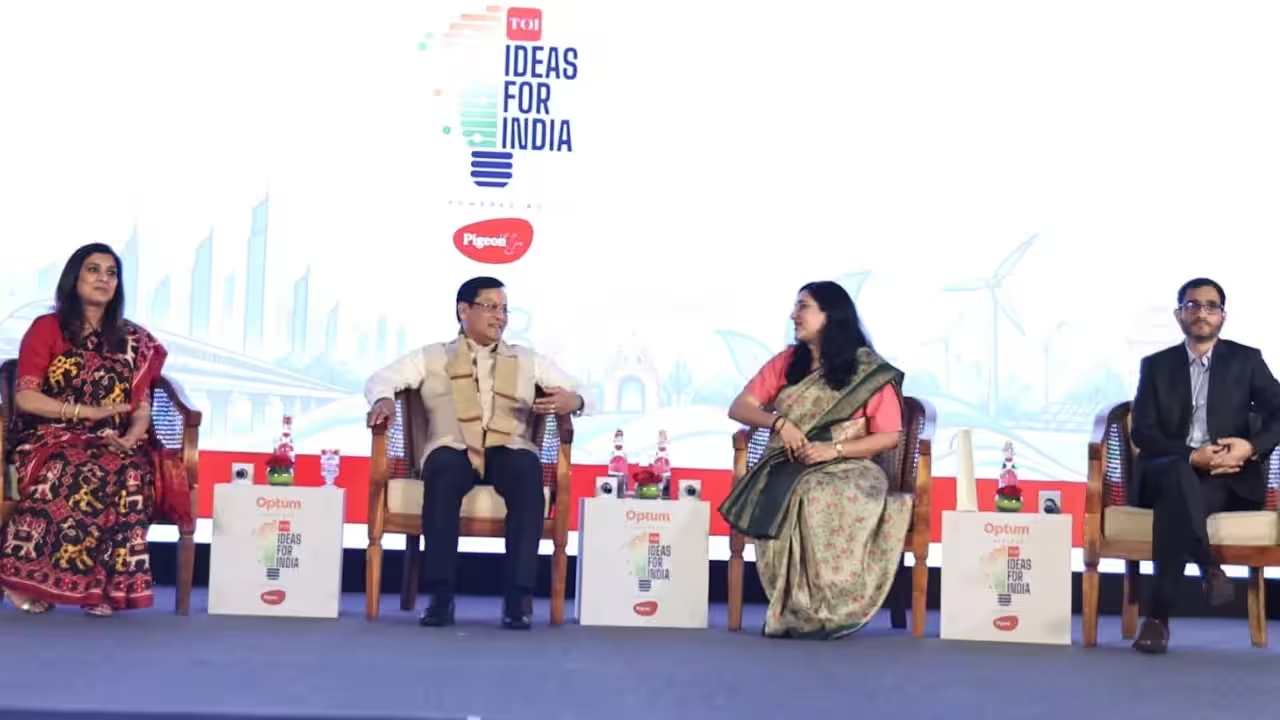
India’s trajectory toward 2047 is no longer defined by abstract demographic projections, but by the hard-nosed structural mechanics of economic self-reliance.At the second edition of the TOI Ideas for India 2047 summit, convened by The Times of India in association with Optum and powered by Pigeon; industry titans, policymakers, and strategic minds gathered in New Delhi for a series of high-level roundtables. To capture the comprehensive breadth of the summit's flagship discussions, the deliberations were officially codified in the Ideas for India 2026 Compendium, serving as a strategic playbook for the nation's economic stakeholders.] Rather than offering conventional platitudes, the deliberations cut straight to the core challenges of national scale: decoupling from foreign supply chains, rewriting the calculus of capital deployment, modernizing archaic legal frameworks, and weaponizing indigenous technology. As the summit feted seven exceptional innovators whose ground-level solutions bridge deep-tech defense and sustainable agriculture, the overarching consensus was clear: India’s ascent to a developed economy demands an aggressive, institutional overhaul of how the nation manufactures, governs, and innovates.The macro blueprint of sovereign tech, capital architecture, and industrial scaleThe opening dialogues established an uncompromising premise: sovereign technology and industrial autonomy are non-negotiable prerequisites for a $35-trillion economy. Getting the tone during the inaugural panel, Rohit Agarwal, Senior Vice-President - Transformation,Innovation, Enablement, at Optum Operations Global, emphasized that India’s greatest opportunity lies not merely in its vast population scale, but in the sheer number of problem-solvers it is capable of cultivating.Building on this vision, Union Minister Sarbananda Sonowal framed national ambition through the lens of strategic insulation, pointing to monumental capital outlays—such as the Rs 76,000-crore Vadhavan Port and the Rs 70,000-crore shipbuilding revitalization package—as critical levers to eliminate India’s historic vulnerability to foreign transshipment hubs. Yet, infrastructure alone cannot bridge the deficit. Kular Systems Chairperson Geetanjali Kirloskar injected a sharp fiscal reality into the room, noting that India’s R&D expenditure languishes at a meager 0.65% of GDP. For Viksit Bharat to move from rhetoric to reality, capital must flood high-impact frontiers like semiconductors, advanced materials, and biotechnology.This recalibration of capital extends directly into corporate strategy and manufacturing. BCG India Head Rahul Jain argued that India’s unique geopolitical neutrality positions it as the premier alternative global manufacturing base, urging domestic industries to locally produce everything currently imported by leveraging newly minted free-trade agreements and scale efficiencies. However, financing this industrial renaissance requires abandoning conventional venture capital playbooks. OfBusiness and Oxyzo co-founder Asish Mohapatra delivered a blunt assessment to aspiring founders: chasing equity prematurely misses the mark. Instead, businesses must extract liquidity directly through operational cash flows, customer advances, and debt channels, where institutional liquidity runs twenty to thirty times deeper than equity. Complementing this macro view, Optum Global Senior VP, Operations, Surinder Singh argued that national productivity cannot remain the exclusive domain of corporate behemoths; true economic resilience requires deploying shared digital intelligence to rescue starved micro, small, and medium enterprises (MSMEs) from forecasting blind spots.Institutional modernization through judicial efficiency and resource securityEconomic momentum inevitably collides with foundational institutional friction, most notably within the country's legal and ecological architectures. South Delhi MP Bansuri Swaraj introduced a pragmatic blueprint for integrating artificial intelligence into governance, arguing for the deployment of AI to adjudicate documentary-heavy matters, such as cheque-bouncing disputes and rent-control cases, within days rather than months. By insisting on strict human appellate panels and erecting a firewall against AI involvement in personal liberty cases, Swaraj underscored a sophisticated approach to judicial automation. Furthermore, her proposal to implement digital tracking IDs for undertrials establishes a vital humanitarian baseline: that no citizen should languish in state custody merely due to administrative delays in filing bail.Ecological security runs parallel to governance reform. Kent RO Founder Mahesh Gupta addressed the compounding crisis of water contamination, highlighting that public infrastructure cannot single-handedly shoulder the emerging threat of microplastics infiltrating drinking water. The roundtable revealed that safeguarding the nation's water tables requires moving past state-dependent funding models. As Jal Shakti Minister C.R. Patil noted, monumental water conservation networks have been successfully engineered across the country with zero government capital, driven entirely by strategic community mobilization and corporate social responsibility (CSR) endowments.Human capital re-engineering and the ecosystem of grassroots innovationAs artificial intelligence and automation compress traditional corporate hierarchies, flattening entry-level hiring pyramids into diamond-shaped structures that prioritize human judgment over routine execution, the human capital paradigm is undergoing a seismic shift. Partner & Chief People and Culture Officer at GT Bharat Prashant Mehra and Stovekraft Founder & MD Rajendra Gandhi emphasized that industry can no longer afford to treat academic institutions as passive pipelines. Corporations are increasingly forced to co-design curricula during students' formative years, shifting the market valuation entirely away from static degrees and toward demonstrable, job-ready proficiencies in robotics, manufacturing supervision, and tech integration.This urgency extends directly into the creative and entrepreneurial trenches. Actor and cultural commentator Avinash Tiwary delivered a sobering critique of the domestic innovation ecosystem, observing that grassroots inventors in hubs like Hyderabad and Bengaluru frequently find their breakthroughs bottlenecked by a lack of laboratory access and institutional grants—effectively forcing Indian innovation to run on charity. Pointing to regional infrastructure models like Telangana’s T-Works, Tiwary and fellow panelists underscored that scaling indigenous capabilities, from edge-AI counter-drone swarms to agricultural-waste biodegradable packaging; requires robust, institutionalized prototyping sandboxes.The horizon toward 2047Ultimately, the deliberations at the TOI Ideas for India summit underscored that the architecture of a developed nation is not forged in a vacuum of solitary breakthroughs. It is constructed at the intersection of sovereign industrial policy, unyielding judicial reform, hyper-efficient capital allocation, and grassroots technological self-reliance. As these institutional threads converge, India’s transition to 2047 transitions from an aspirational milestone into an inevitable operational reality.Disclaimer: This article is part of a Brand Initiative, Ideas for India, by TOI in partnership with Optum.You use AI every day. Now get your AI Quotient. Take the AIQ test.
Topics in this story
Gathered from external sources. Rights to this text belong to whoever originally published it.