Industrialised personalisation
You have been inside the hotel for less than a minute when the waiter at the restaurant door greets you by name.
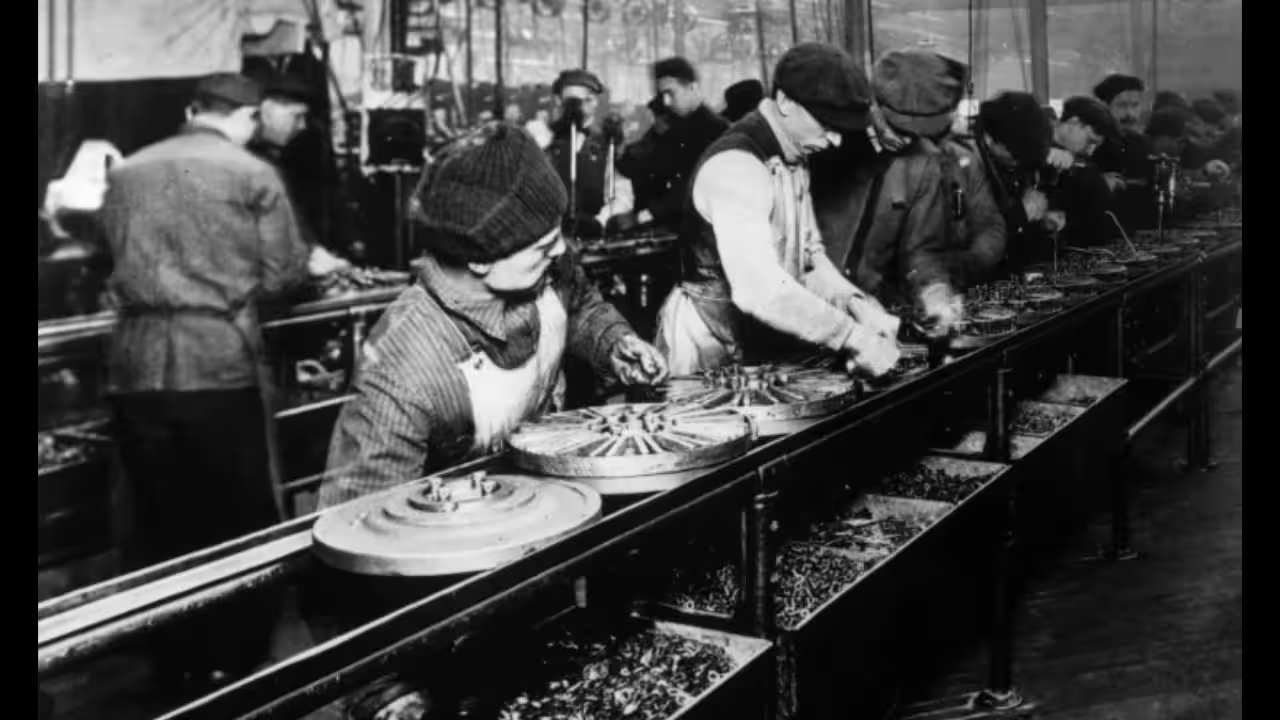
You have been inside the hotel for less than a minute when the waiter at the restaurant door greets you by name. Your usual table, the one by the window, is already laid. Before you open the menu the waiter asks whether it will be the sole again, as it was in March, and you, who eat out a good deal and are hard to impress, feel for a moment like the only guest in the building. You have not said anything. The waiter takes your coat with a small bow and leads the way.In 1911, Frederick Winslow Taylor's ‘The Principles of Scientific Management’ held that the best way to do each job should be worked out in advance, and taught. He wrote, “In the past the man has been first; in the future the system must be first.” Industrial production could then continue seamlessly, with each new worker fitting into the role with ease.The same logic had already moved from products into service, from Fred Harvey's railway restaurants in 1876 to White Castle's hamburger stands in 1921, and in 1948 the McDonald brothers rebuilt their restaurant around a nine-item menu and ran the kitchen like an assembly line. Let's follow a new hire called Dan on his first morning at the McDonald's on Sand Lake Road in Orlando, the chain’s largest outlet. For a moment he is overwhelmed by the arcade, ordering kiosks and a sea of impatient customers. The hour of briefing he was given steadies him. He matches each order number to its table, carries the tray over and says, as taught, “Have a nice meal!” In under a day few can tell he is new. This is industrialised industrialisation, with systems in place but execution still a little rough around the edges.In time, Dan moves to a job at a formal dining room where he trains for a whole week. He moves more fluidly now, personal worries don’t reflect in his demeanour, and his ‘thank you’ with a smile and a gentle nod sounds less rehearsed. The management has done its work well, and it takes a trained eye to see that his manner at the next table is no different.Attention reaches further at Eleven Madison Park, where, Will Guidara has said, whoever greeted you would have looked you up online beforehand. In ‘Unreasonable Hospitality’ he describes training the staff to set every plate so that in the event that a guest turned it over, he’d find the Limoges stamp facing him, right side up.At the Ritz-Carlton, Joseph Michelli reports, guest relations staff share news of arriving guests' anniversaries and celebrations at the daily lineup. You could arrive on a special day and find champagne, a handwritten card and pastries waiting in the room. The Ritz keeps the record of such care in Mystique, a database of guest preferences fed by notes that staff are trained to jot down. If you stayed at one of its hotels, the waiter would likely have drawn on it.Industrialised personalisation, in the world of service, means a system set down so completely that anyone properly trained can replicate it and make an experience feel personal.Dan leads you to the window. When the sole comes, it is cooked the way it was in March.You use AI every day. Now get your AI Quotient. Take the AIQ test.
Topics in this story
Gathered from external sources. Rights to this text belong to whoever originally published it.