Apple’s new CEO John Ternus reveals the foldable iPhone Duo
Apple’s unveiled its first foldable phone, the iPhone Duo, marking the biggest change to the iPhone in its nearly 20-year history. Follow live updates.
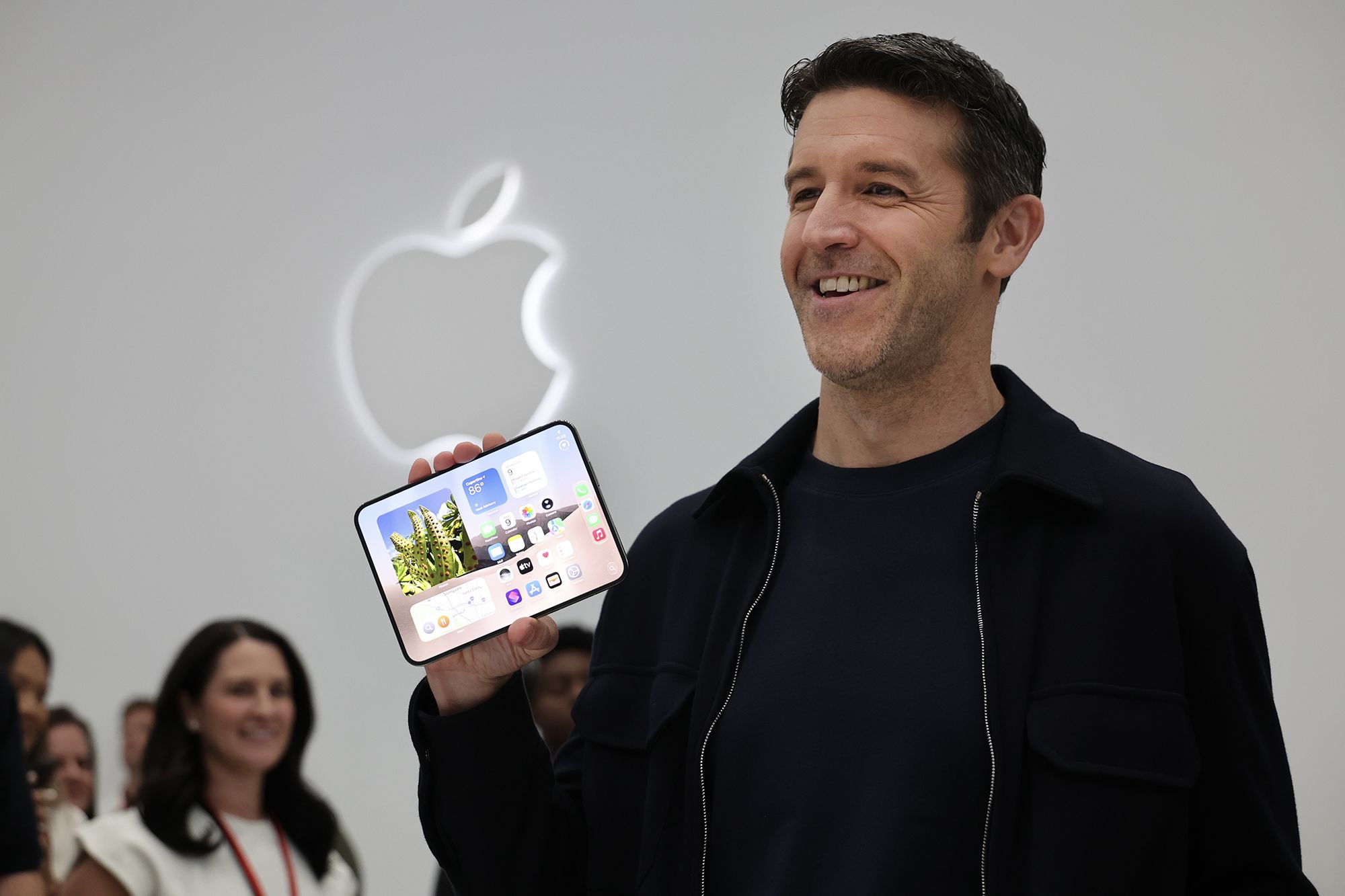
• Apple unveiled its first foldable phone, the iPhone Duo , marking the biggest change to the iPhone in its nearly 20-year history.
• The tech giant also introduced the iPhone 18 Pro and Pro Max , AirPods 5, Apple Watch Series 12 and Apple Watch Ultra 4. The company is now giving people a way to lease a new phone , after raising the prices on its newest devices.
• This was John Ternus ’ first event as chief executive after taking over from Tim Cook earlier this month. Sharing his vision for Apple’s future, he framed the iPhone as the best personal device for AI , as it already has strong privacy protections.
The new iPhone Duo foldable offering could account for 10% of Apple’s total iPhone revenue next year, Gene Munster, managing partner of investment firm Deepwater Asset Management, predicted in an X post following the event.
The hefty $1,999 starting price tag for the Duo — $700 more than the next most advanced iPhone model — could bring Apple more revenue per user.
“Higher pricing across the premium iPhone 18 line-up could also sway some customers toward the foldable, narrowing the perceived jump to a completely new form factor,” analyst Paolo Pescatore said.
Dan Ives, founding partner of research and investment firm Yorkville Ives, told CNBC that the iPhone Duo is the first new Apple product in 10 years, since the AirPods that could “move the needle,” adding that it could kick off a larger innovation cycle for Apple.
Despite the excitement, Apple stock ( AAPL ) ended the day down 0.28% — perhaps a reflection of investor skepticism about just how many consumers will be willing to pay up for the expensive new device.
Apple’s newest products aren’t the only ones getting a price bump.
Older models of iPhones that are still available to purchase new from Apple will now cost $100 more, according to the company’s website.
For example, a 256 gigabyte iPhone 17 is selling for $899 on Apple right now. It previously started at $799 . The iPhone Air now starts at $1,099 after previously being at $999. And the relative value iPhone 17e now costs $699, compared to its release cost of $599 .
Sites from retailers like Target , however, still show the previous prices for iPhones.
In June, Apple raised the price of different products like the MacBook and iPads due to memory shortages, but it notably did not increase the price of the iPhone or AirPods at the time. Former Apple CEO Tim Cook told the Wall Street Journal this year that price hikes on its products are “unavoidable.”
Here’s how much each of the newest slate of Apple products will cost:
iPhone Duo: Starts at $1,999, with the highest-memory option topping out at $3,199.
iPhone 18 Pro: Starts at $1,199, going up to $2,399.
iPhone 18 Pro Max: Starts at $1,299, up to $2,499.
Apple Watch Series 12: Starts at $399, up to $1,249.
Apple Watch Ultra 4: Starts at $799, topping out at $899.
The outer display of the iPhone Duo has 5.4-inch screen and provides 90% of the screen area of iPhone 18 Pro. It will also soon be compatible with the Apple Pencil.
Users can perform all the usual tasks on the outer display while the iPhone is folded, such as answering texts and calls or checking quick notifications.
The outer display also serves as a preview screen when taking photos. Traditionally, if you photograph a subject with the back camera of your phone, they see the phone’s shell. With iPhone Duo, the subject of the photo can see themselves in the outer display.
This summer, Mike Howard, vice president of memory coverage at research firm TechInsights, told CNN that “we should start thinking about a $1,500 iPhone instead of a $1,000 (or) $1,200 iPhone.”
Apple has now surpassed those estimates, with the most expensive model of the foldable iPhone Duo topping out at $3,199. That’s about $200 more than a standard 16-inch MacBook Pro .
There’s been a surge in demand for memory chips thanks to the AI boom. But chipmakers can’t produce enough of the crucial computer hardware for both consumer devices and data centers, leading to shortages that are driving up prices for tech .
Former Apple CEO Tim Cook already told the Wall Street Journal this year that price hikes on its products are “unavoidable.” Apple already hiked the prices of many of its products over the summer, including MacBooks and iPads.
Apple seems to be somewhat aware of the strain on many consumers’ wallets, introducing a lease program for its newest line of iPhones.
CNN’s Lisa Eadiccio contributed to this report.
Your phone knows a lot about you. It can keep your calendar, it can read your emails and text messages, and it can see through your camera. Apple devices will go beyond a technological tool, the company said, into one that “is always with you” and is “deeply personal.”
It’s part of a new intelligent personal hub, in which Apple will use artificial intelligence to form “a deep understanding of your personal context.”
“This includes your calendar, your relationships, your routines, the most private details of your daily life,” Apple said.
Apple showed off “an entirely new version of Siri,” using an example of a woman asking Siri about a recipe her mother said they should make together.
“Mom sent you an email with recipes for Grandma’s peach pie and Grandma’s lemon meringue pie. She mentioned in a message that she wants to make one of Grandma’s pies together when she visits,” Siri replied.
The woman then took a photo of a fruit stand and asked Siri which fruit would work best for the recipe, which Siri was then able to choose and add to a grocery list on a third-party app.
Apple did assure privacy protection while taking a swipe at competitors, saying “others see that data as something to collect and store. They move it to their servers and ask you to trust them. But honestly, trust only goes so far when your data is no longer yours to control.”
The foldable iPhone Duo starts at $1,999 – and that’s for the most basic foldable, with 256 gigabytes of memory.
There are four storage options ranging up to to two terabytes, with all that memory adding another $2,000 to the price of the most expensive model, topping out at $3,199, according to Apple’s website.
Customers can pre-order the phone starting October 16. The phone will be available in the market starting October 23.
Apple showed off a laundry list of uses for the 7.6-inch continuous screen that can fold in half.
Users can use two apps at the same time, using a split screen view. On apps like Safari, they can browse two windows simultaneously, which the company used to show off uses like comparison shopping.
Apple also showed how the new iPhone can be used when it’s partially folded. It can prop itself up on a table or flat surface to watch a video hands-free. Apple also showed how the folded iPhone can stand up all night to be used as an alarm clock “with the ability to wake you up with a gentle glow.”
The many uses of a super-large screen were also touted, from editing videos to new Netflix features that allow users to scroll vertically, like a TikTok feed.
Apple is rolling out a foldable phone, the iPhone Duo, with a larger display that promises to still fit in users’ pockets — the biggest change to the look and function of the iPhone in years.
Apple is entering a niche but growing market that’s currently dominated by Samsung. But Ternus said most existing foldable phones currently feel like “two phones awkwardly stuck together.”
By contrast, the iPhone Duo will feature a screen similar to the size of a passport when folded. And when unfolded, the Duo will feature a single, continuous 7.6-inch screen that can be used in landscape or horizontal orientations that is Apple’s thinnest iPhone ever.
The phone’s controls — the dock on the home screen and status indicators — will be on the right side of the iPhone Duo’s screen, rather than on the bottom, to make it easier for users to reach and use them with their thumbs.
Apple is giving the Apple Watch a new tool called Audio Intelligence, and it’ll be available for the Apple Watch Series 12 and Apple Watch Ultra 4.
The Apple Watch will be able to identify sirens, alarms and other critical sounds for those who are deaf or hard of hearing.
Another feature called Siri Recap takes high-level notes in conversations.
Apple says it doesn’t store the recordings, the audio can’t be accessed and the audio is end-to-end encrypted. It also doesn’t identify the people speaking.
The launch comes as tech giants and startups are experimenting with new types of wearables that can listen to the world around you. Amazon, for example, acquired the audio recording wristband Bee last year.
If you don’t want – or simply can’t afford – to buy a new iPhone, now you can lease it. The program is called Apple Upgrade, after raising the price for its newest device.
Customers will be able to make monthly payment options over 12 or 24 months with “an easy way to upgrade to a new iPhone at the end of their lease,” Apple said.
The iPhone 18 Pro starts at $1,199 while the larger Pro Max will start at $1,299.
That’s pricier than last year’s iPhone 17 Pro and Pro Max, which began at $1,099 and $1,199 respectively.
Remember: Apple raised prices on other products like the iPad and Mac over the summer because of component price hikes due to the memory shortage.
Rich Dinh, Apple’s vice president of hardware engineering, said that the iPhone 18 Pro could reach 50% charge in 15 minutes and play six hours of video from five minutes of charging.
The iPhone 18 Pro has the same battery life as the iPhone 17 Pro Max despite its smaller size, Dinh said. The iPhone 18 Pro Max carries up to 30 hours of usage per charge and the 18 Pro has up to 24 hours.
Apple Watch is getting major health and fitness updates with Apple Watch Series 12 and Ultra 4, which could make the devices more competitive with other health-focused wearables.
The updates include improved and more frequent heart rate sensing, which the company says is “the most accurate heart rate sensing in a wearable.”
Apple’s new health sensing system will also enable a “readiness” score that combines a user’s recent activity, vitals and sleep, and a “health age” score that will compare a user’s health biomarkers to their actual age.
Users will also be able to integrate recent lab results with data gathered by their Apple Watch to get deeper insights from an updated version of Apple’s Health App.
The latest Apple watches will also get new AI capabilities and better performance with a new Apple chip.
Apple is adding “Apple Reference Image” — a type of watermark that someone could use to prove they took a real photo, which could become increasingly important in the age of AI.
Each photo taken with the iPhone 18 Pro and Pro Max will be assigned a digital signature when it’s captured. An unalterable version of the image will be stored in the photos app, in addition to the regular, editable photo.
“This is like having a digital negative that you can use to visually confirm what was actually in the shot,” an Apple executive said.
Apple will also support the industry standard SynthID method for marking images generated or edited with AI.
The AirPods 5 will feature higher, more immersive sound quality and improved, more customizable noise cancellation. And they’ll come with Apple’s Siri AI tools, including live translation.
They’re also more durable, with the ability to withstand more “rain, sweat and dust.”
The baseline AirPods 5 offering, with four hours of battery life, will cost $129. The company is also offering a version with five hours of battery life, on-AirPod volume control and a wireless charging case for $149.
Apple is also touting the iPhone 18 Pro’s camera. It now has a camera with a variable aperture, which allows it to adjust how much light it lets in based on the environment. The iPhone 18 Pro should also be able to capture better photos in low-light conditions more quickly.
Users will also be able to manually adjust the aperture between four options and change the shutter speed.
Camera upgrades are usually a big focus for Apple’s Pro phones, so it’s not surprising to see Apple further catering to photographers and creatives.
As anyone who’s experienced an overheating iPhone knows, managing the device’s temperature can sometimes be an issue. Apple has developed a new “thermal management system” to support the new chip in the iPhone 18 Pro and Pro Max without the devices overheating.
The system includes a “vapor chamber” with “deionized water” that cycles through the system, as well as a new graphite and copper material.
Apple detailed the new chip in the iPhone 18 Pro, which is called the A20 Pro, along with the phone’s new thermal management system.
The company claims the new thermal design – i.e. the way the phone regulates temperature – will make it a powerhouse for everything from running AI models on the phone itself to playing games.
Apple always details the new processors in its phones when announcing them. But this additional emphasis feels like the kind of color we were expecting to see now that Ternus, who previously oversaw hardware engineering, is CEO.
Apple CEO John Ternus kicked off today’s products announcements by framing the iPhone as the best personal device for artificial intelligence, as it already has strong privacy protections, along with knowing so much about its users already.
The comments also come as companies like Meta, Google and Samsung have been leaning into smart glasses as being the new type of computer for AI, while Apple’s been criticized for falling behind.
Topics in this story
Gathered from external sources. Rights to this text belong to whoever originally published it.