Why AT&T CEO sees a 'complementary dynamic' with Elon Musk's Starlink
AT&T CEO John Stankey sees opportunities amid Starlink's wireless expansion.
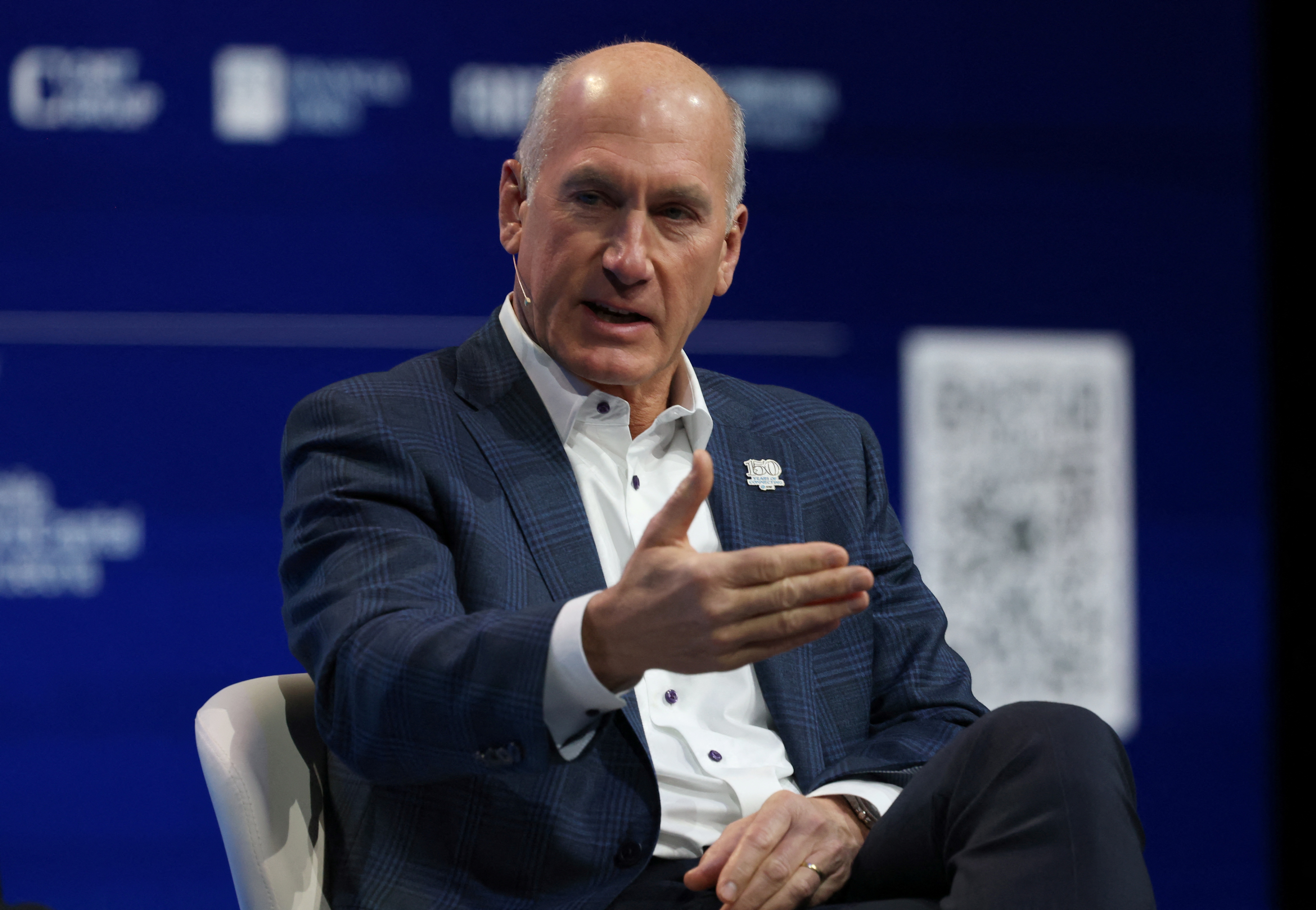
SAN FRANCISCO, Calif. — If you're thinking SpaceX's ( SPCX ) Starlink is going to run roughshod over well-established wireless operators such as AT&T ( T ), T-Mobile ( TMUS ), and Verizon ( VZ ), not so fast.
"It [Starlink] doesn't get through buildings very well," AT&T CEO John Stankey told Yahoo Finance from the Goldman Sachs Communacopia & Tech Conference (video above). "It does very well [with a] line of sight. If you have a lower-band spectrum, then it will have some decent penetration into some buildings. But it's not going to penetrate the skin of a high-rise. It's not going to penetrate a stadium where people are congregated to watch a World Cup game and be able to have the social experiences that they demand in those circumstances."
"I think customers have a pretty high bar of how networks have to perform," Stankey added. "And I think we're uniquely positioned to continue to meet those expectations."
Concerns are escalating across Wall Street that Elon Musk's Starlink could disrupt legacy wireless operators like AT&T, Verizon, and T-Mobile by transitioning from a rural broadband service into a direct mobile competitor.
Following its strategic acquisition of terrestrial spectrum and rapid deployment of advanced satellites, SpaceX has laid the groundwork to launch its own standalone cellular network alongside its direct-to-cell capabilities.
The expansion threatens traditional carriers' high-margin enterprise, emergency service, and rural subscriber bases, as well as lucrative international roaming revenues.
"I think they're going to find places where they clearly have a good solution," Stankey added. "In airlines and flights today, they have a fantastic broadband solution. In rural parts or territories, it's a very efficient way to get good bandwidth to people. I think we see that there's going to be some IoT-type applications, like connecting vehicles that are largely outdoors and maybe have line of sight to the sky, that they're going to have an opportunity to go in and do some things there that maybe we haven't done as effectively."
So, while Starlink will present competition, Stankey added, "there's also going to be the complementary dynamic of us being able to solve that other 2% of the use cases I talked about and bring our customers to those satellite operators, whether it be Amazon or SpaceX. They'll be the beneficiary of us aggregating that traffic and bringing it into the wholesale market to be able to be used."
Shares of AT&T & T-Mobile, seen as industry leaders in the space, have lagged the S&P 500 ( ^GSPC ) this year amid these swirling Starlink concerns.
Topics in this story
Gathered from external sources. Rights to this text belong to whoever originally published it.