European Countries Boost Variety of Renewable Energy Projects
More solar power projects paired with energy storage are taking shape across Europe, with a variety of investors supporting assets in the UK and Italy, among...
More solar power projects paired with energy storage are taking shape across Europe, with a variety of investors supporting assets in the UK and Italy, among other countries. Pumped storage projects also are receiving growing interest, with a major Ukrainian engineering group joining the International Hydropower Association (IHA) and now sharing its engineering expertise with that agency. Renewable energy got a recent boost in Portugal, where the government unveiled a National Energy Storage Strategy that says long-duration energy storage is now essential infrastructure for renewable energy–based power systems. Portugal's plan includes an expansion of pumped storage generation capacity within the country, and also supports competitive auctions, tenders for future projects, and reforms to the country's energy permitting process. Portugal has a goal of at least 5 GW of generation capacity from pumped storage by 2040.
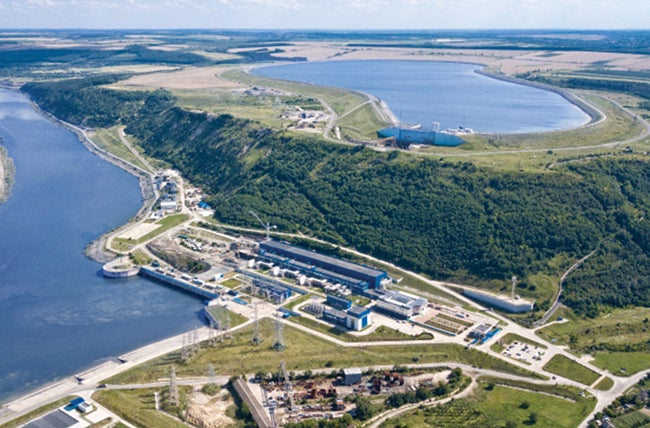
1. The Dniester PSP is a major hydropower and pumped storage project in Ukraine. Courtesy: Ukrhydroenergo (used with permission)
The IHA in July said Ukraine's Ukrhydroproject (UHP) has become a member of the group and will provide support to the global hydropower community. UHP, founded in 1927 and headquartered in Kharkiv, Ukraine, is considered one of Ukraine's leading engineering companies, specializing in hydropower and water management construction. The company for nearly 100 years has provided design and engineering services for hydropower plants, pumped storage facilities, and major water infrastructure projects in Ukraine and around the world. The IHA said UHP "has been the general designer behind several of Ukraine's most important hydropower developments, including the cascades of hydropower and pumped storage plants on the Dnipro and Dniester Rivers." UHP led development of the Dniester pumped storage plant (Figure 1), one of Europe's largest pumped storage facilities, being built by Ukrhydroenergo. The company said the Dniester PSP, as it is known, will feature seven hydroelectric units with a total capacity of 2,268 MW in generator mode, and 2,947 MW in pumped storage mode. The UHP also has supported projects in Vietnam, Mexico, Venezuela, Laos, Ethiopia, Poland, and elsewhere.
"Ukraine is a country at war with its energy infrastructure under specific target. Building on their 100 years of engineering experience, Ukrhydroproject is not only supporting the country to defend and build its infrastructure; it is also developing pumped storage to make the future energy systems more resilient and also bringing that expertise to projects all around the world," said Eddie Rich, CEO of the IHA. "We are pleased to welcome UHP to IHA and look forward to collaborating on the future of sustainable hydropower."Vadym Kraynyk, chairman of the board for UHP, said, "Sustainable hydropower is more than clean energy. It is the backbone of a resilient and secure energy system. At Ukrhydroproject, we see pumped storage as critical infrastructure for balancing renewable energy and strengthening energy independence, both for Ukraine and globally. Now is the time to work together, share expertise, and deliver the sustainable infrastructure."BNZ, an independent power producer that specializes in renewable energy projects, in July said it had partnered with Sungrow to deploy 240 MWh of battery storage across its Viterbo projects in Italy. The group said the agreement strengthens the development of its battery portfolio, which is expected to reach at least 850 MW in Europe. The Rinaldone (45 MW) and Camposcala (53 MW) solar plants in Lazio, Italy, which came online last year with a combined capacity of 98 MW, will now be hybridized with energy storage systems under the deal with Sungrow. The deal is part of the global framework agreement recently signed between Sungrow and Nuveen Infrastructure, which owns BNZ.The groups said the partnership will accelerate the rollout of BNZ's storage portfolio in Europe. BNZ is currently developing 530 MW of battery capacity as part of its 850-MW pipeline. The company already has deployed more than 2.7 GW of solar, wind, and energy storage. The contract with Sungow covers the battery energy storage system (BESS) equipment, including batteries, containers, power conversion systems, and medium-voltage equipment, as well as commissioning services, on-site acceptance testing, technical training, and a third-party energy management system. The deal also includes a long-term service agreement that covers extended warranties for key components, annual preventive maintenance, 24/7 remote monitoring, and performance, availability, and energy efficiency guarantees."The agreement with Sungrow represents a strategic step forward in our commitment to energy storage as a key pillar of the energy transition. Integrating batteries into projects such as those we operate in Viterbo will allow us to enhance grid stability and maximize the value of the renewable energy we produce," said Luis Selva, CEO at BNZ. The company said Italy will be one of its earliest deployment markets for energy storage. BNZ plans about 1 GWh of storage across eight projects, mainly in Lazio, Sicily, and Puglia. It said initial installations in those areas will begin before year-end.Javier Izcue, vice president of Sungrow Europe, whose territory includes southern Europe, the UK, and Ireland, said, "This framework agreement with Nuveen Infrastructure represents an important step towards further accelerating the roll-out of energy storage in Europe. Through our PowerTitan solution and a comprehensive, long-term service approach, we will support projects designed to bring greater flexibility, stability, and efficiency to the electricity system. We are proud to be working with industry leaders such as BNZ to drive the energy transition in key markets such as Spain and Italy."The IHA in July said it welcomed Portugal's pumped storage initiative, which includes a target of about 3.9 GW of pumped storage capacity by 2030, up from a current 3.6 GW. Officials in Portugal have said pumped storage is the predominant large-scale and long-duration energy storage measure for the country's energy system. Jean Barroca, secretary of state for Energy in Portugal, along with Maria da Graca Cavalho, the minister for Environment and Energy, presented the plan to the IHA and said there is widespread political support for energy storage, including pumped storage, as a national priority. Portugal currently generates about 80% of its electricity from renewable resources. Government officials have said more long-duration storage is needed to continue integrating renewable energy into the country's grid.Portugal's current energy storage assets include the Tamega hydroelectric complex, one of the largest storage developments in Europe. The Tamega installation is located on the Tamega River in northern Portugal. The power station, developed by Iberdrola, features three main installations—Gouvaes, Daivoes, and Alto Tamega—with a combined generation capacity of 1,158 MW."Portugal's new National Energy Storage Strategy is a strong signal that long-duration storage must be treated as essential national infrastructure," Rich said. "By outlining the strategic role of pumped storage, Portugal is showing how countries can build electricity systems that are not only cleaner but also more secure, flexible, affordable, and resilient. This is the kind of ambition needed to unlock the full potential of renewable energy across Europe. IHA welcomes Portugal's commitment and we look forward to working with stakeholders to accelerate the deployment of the storage infrastructure required for a reliable and secure energy transition net zero energy future."
Topics in this story
Gathered from external sources. Rights to this text belong to whoever originally published it.