Trump pledges $5K checks if Republicans do well in the midterms. Can he legally do that?
President Trump’s pledge to give $5,000 to every U.S. adult if Republicans keep control of both chambers of Congress in the midterm elections has raised questions over whether the plan could cross legal lines. The president announced the so-called “Trump dividends” on the first night of the Republican National Committee’s (RNC) midterm convention in Dallas this…
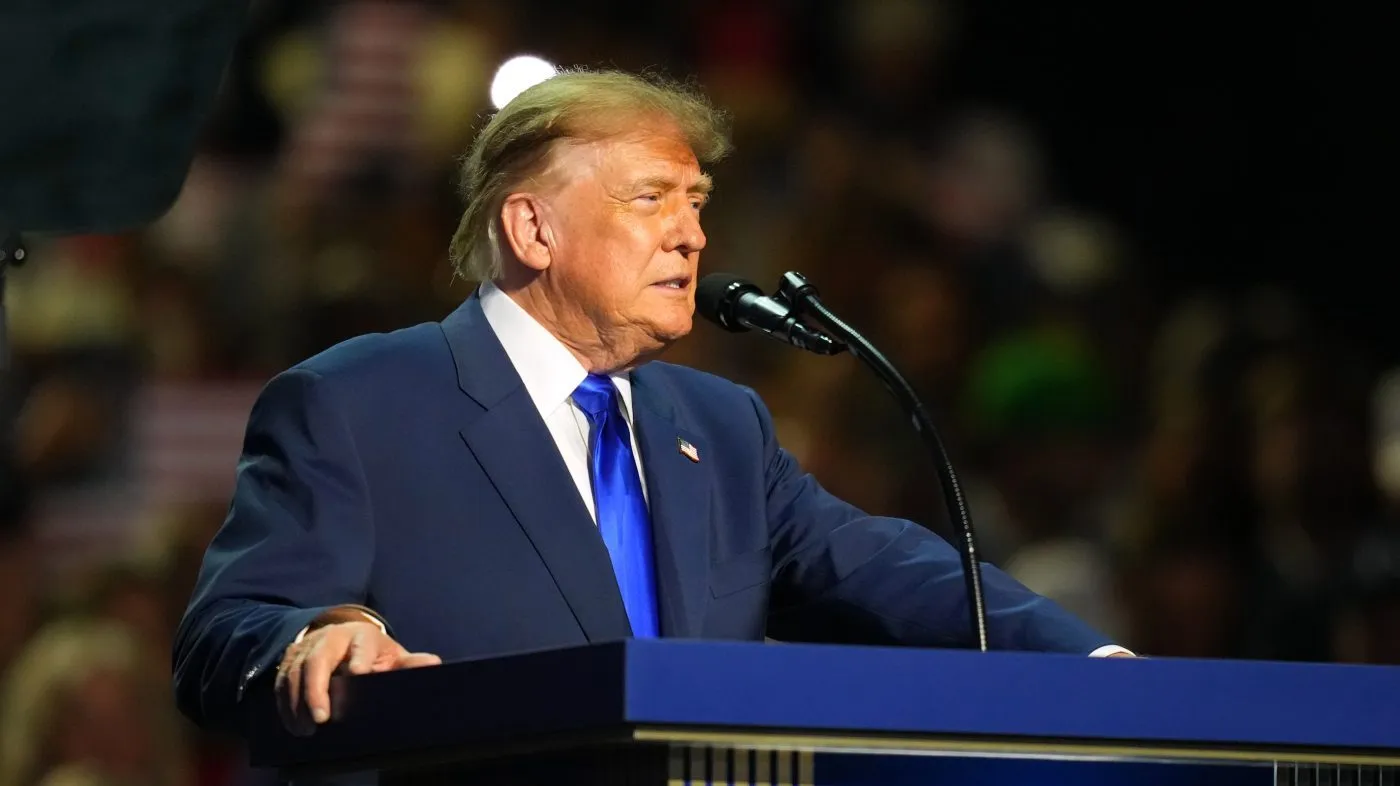
President Trump’s pledge to give $5,000 to every U.S. adult if Republicans keep control of both chambers of Congress in the midterm elections has raised questions over whether the plan could cross legal lines.
The president announced the so-called “ Trump dividends ” on the first night of the Republican National Committee’s (RNC) midterm convention in Dallas this week, suggesting the country’s roughly 270 million adults should share in his administration’s “tremendous economic success.”
“Very much like a successful company will do a cash distribution to its shareholders,” Trump said, caveating that the money “must be spent” only inside the country.
It was not immediately clear how the plan would work. The federal government would have to dole out an estimated $1.2 trillion, and doing so would likely require an act of Congress.
“It’s not something that the president can unilaterally do,” said Paul Berman, a professor at George Washington University Law School.
Congress holds appropriating power, meaning the executive branch cannot spend public money on something unless the legislature has specifically set aside funds for that purpose.
That was the case with the $1,776 checks sent to roughly 1.45 million U.S. service members around Christmas last year. Those payments came in the form of a one-time housing supplement that was added to the president’s sweeping tax and spending law known as the One Big Beautiful Bill.
And while Sen. Bernie Moreno (R-Ohio) has said he would introduce legislation to make the midterm dividends a reality, Trump insists he doesn’t need it.
“I think they will do it if we needed it, but we think not,” Trump told CBS News when asked about the need for congressional approval. “The country is doing so well. We’ve taken in trillions of dollars in tariffs and other things.”
Tariffs have generated roughly $341 billion in net revenue since the start of 2025, according to Treasury Department data cited by the Bipartisan Policy Center. At the same time, the Trump administration has been ordered to refund roughly $166 billion of that after the Supreme Court struck down its sweeping global tariffs in February.
“First of all, there isn’t enough tariff revenue to cover this,” Berman said. “Even if there were, that’s money that goes back to the public fisc, and then Congress is the one that has the power of the purse to allocate it.”
“So it would be, I think, not plausible to think that the president could simply give out this money,” he added.
Aside from the budgetary hurdles, there’s also a question of whether the dividends could amount to an unlawful quid pro quo.
Trump’s promise hinges on the GOP’s electoral success, a condition critics were quick to argue constitutes bribery.
“Nothing says confidence like trying to bribe people for votes,” Rep. Jim McGovern (D-Mass.) wrote Thursday on the social platform X.
Those criticisms also came from the other side of the aisle, with Rep. Ralph Norman (R-S.C.) noting “serious concerns” about how the plan would be paid for, and former Rep. Bob Good (R-Va.) referring to it as a “socialist-vote buying scheme.”
Federal law makes it illegal to offer and receive money or anything of value in exchange for voting or withholding a vote — what is typically understood as the classic form of bribery.
But experts say whether a campaign incentive —like the one Trump is proposing — steps over that line can depend on who benefits from it.
The Supreme Court held in a 1982 case involving a Kentucky county commissioner candidate who pledged to reduce his salary if elected that broad campaign promises are considered constitutionally protected speech.
“A candidate’s promise to confer some ultimate benefit on the voter, qua taxpayer, citizen, or member of the general public, does not lie beyond the pale of First Amendment protection,” Justice William Brennan, Jr. wrote in the unanimous opinion.
That ambiguity was the question facing state prosecutors tasked with determining whether billionaire Elon Musk had violated the law when he handed out two $1 million checks during a campaign rally in Wisconsin ahead of the state’s Supreme Court election last year.
Musk initially announced the incentive on social media as a show of “appreciation” for those “taking the time to vote.” But he later backtracked, clarifying in a separate post that the money would go to “spokesmen” for a petition against so-called “activist judges.”
Tim Gruenke, the Democratic district attorney in La Crosse County, Wis., ultimately decided not to pursue charges , saying he did not believe a jury was likely to convict Musk because “nobody was paid anything of value for voting or promising to vote.”
The Tesla CEO was separately sued in state court by a political watchdog group and several voters who argued that the handout was a “brazen scheme” to entice voters to pick his preferred judicial candidate. That case is currently pending.
Any prospective legal challenge to Trump’s divided plan would likely face roadblocks, as Berman says it would likely be difficult to prove standing in federal court.
“I mean that would be the biggest issue: Who is it who’s harmed?” he said, noting that a Democratic candidate who lost their election could theoretically make the argument. He also said it would be hard for Congress to mount a challenge because individual members typically don’t have standing to sue.
“With regard to people receiving the money, they would have a hard time showing that they are harmed because obviously they’re receiving money,” Berman added.
Topics in this story
Gathered from external sources. Rights to this text belong to whoever originally published it.