McDonald’s Sell-Off Hits 30% as Big Mac Inflation Spurs Pushback
McDonald’s Corp. faces a key challenge as it fights to reinvigorate a sagging stock price: Winning back the cost-conscious diners who believe its menu has be...
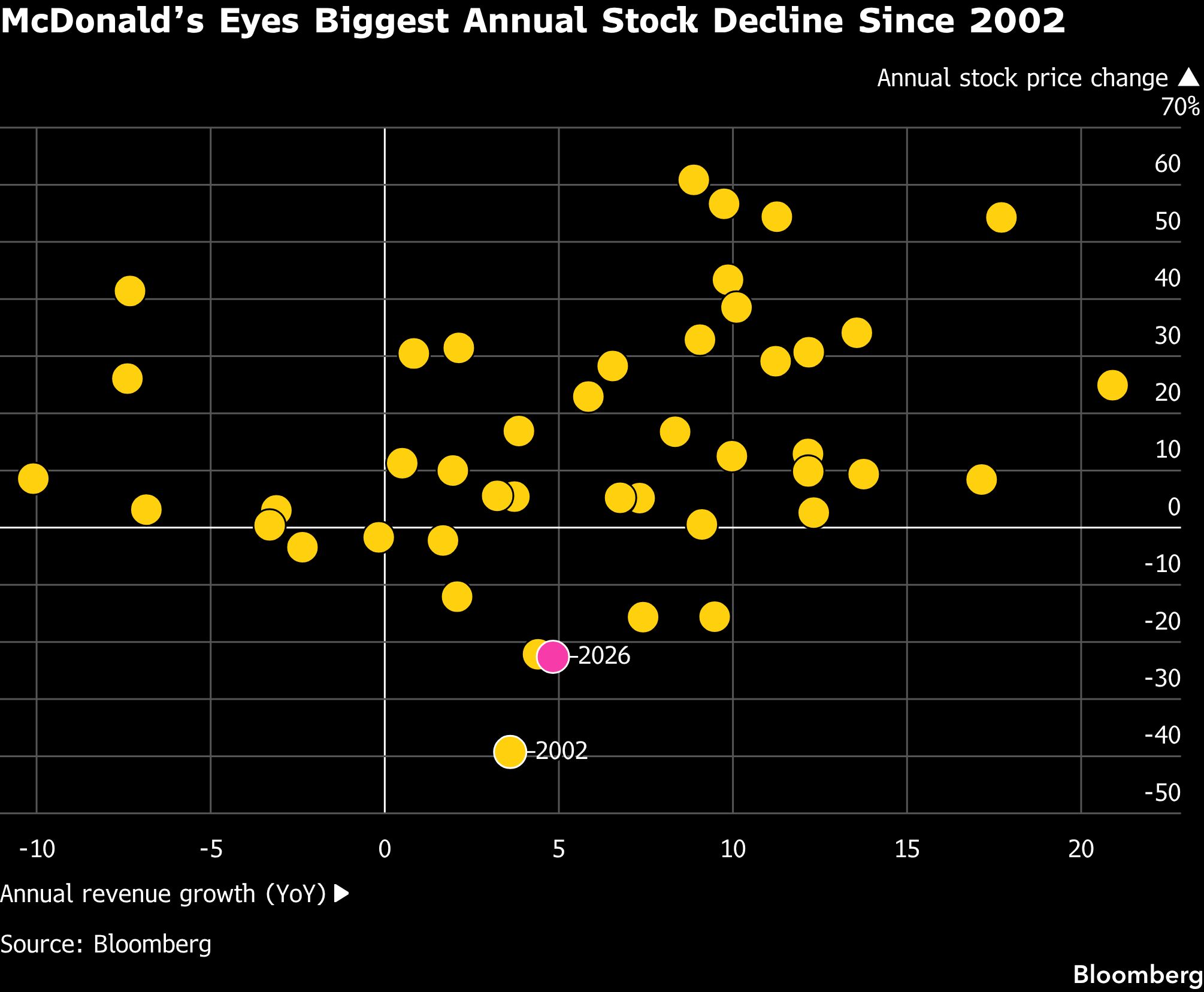
(Bloomberg) -- McDonald's Corp. faces a key challenge as it fights to reinvigorate a sagging stock price: Winning back the cost-conscious diners who believe its menu has become too expensive.
Shares of the Big Mac maker are down nearly 31% from their February high and on track for their worst annual return since 2002. The burger chain guided for "slightly negative" US sales for the current quarter during an investor day event earlier this week, while sales last quarter rose just 0.8%, their slowest pace in more than a year.
Those signals come alongside longstanding gripes from customers, who have complained about everything from menu prices to an in-store experience that has suffered from the loss of playgrounds and other popular features. Recent attempts at value offerings have had mixed results, while an $8.5 billion multiyear plan to improve service and food quality announced this week raised concerns that it would erode profits, sparking a fresh selloff in the company's shares.
"Their prices have gone up substantially, and it's no longer viewed as the best value in food," said Jacob Aiken-Phillips of Melius Research, who has the lone "sell" rating on the stock among analysts tracked by Bloomberg. "I could go to Texas Roadhouse instead and have an actual sit-down experience with my family that's not that much more expensive."
A McDonald's spokesperson on Friday reiterated the company's plans to act with urgency to put the US business in a stronger position exiting 2026.
In 2024, McDonald's hit back at social media posts criticizing rising prices: One widely circulated post showed a Big Mac meal costing $18, which McDonald's said was from one location in the US out of more than 13,700. That year also saw a boost from $5 meal deals, as the burger chain looked to counter perceptions that its food had gotten too expensive.
The Economist's Big Mac Index, typically used as a way to compare purchasing power parity between countries, shows that the price of the sandwich in the US has risen by around 23% between 2019 and the end of 2025.
McDonald's began hiking its menu prices after the pandemic to offset surging costs for ingredients like beef, rising labor wages and higher fuel.
Topics in this story
Gathered from external sources. Rights to this text belong to whoever originally published it.