Jack Ma's Buying Does Little to Ease Alibaba Share Sale Fallout
Alibaba Group Holding Ltd.'s efforts to revive sentiment after its $10 billion share placement has failed to dispel investor concerns over how it chose to fi...
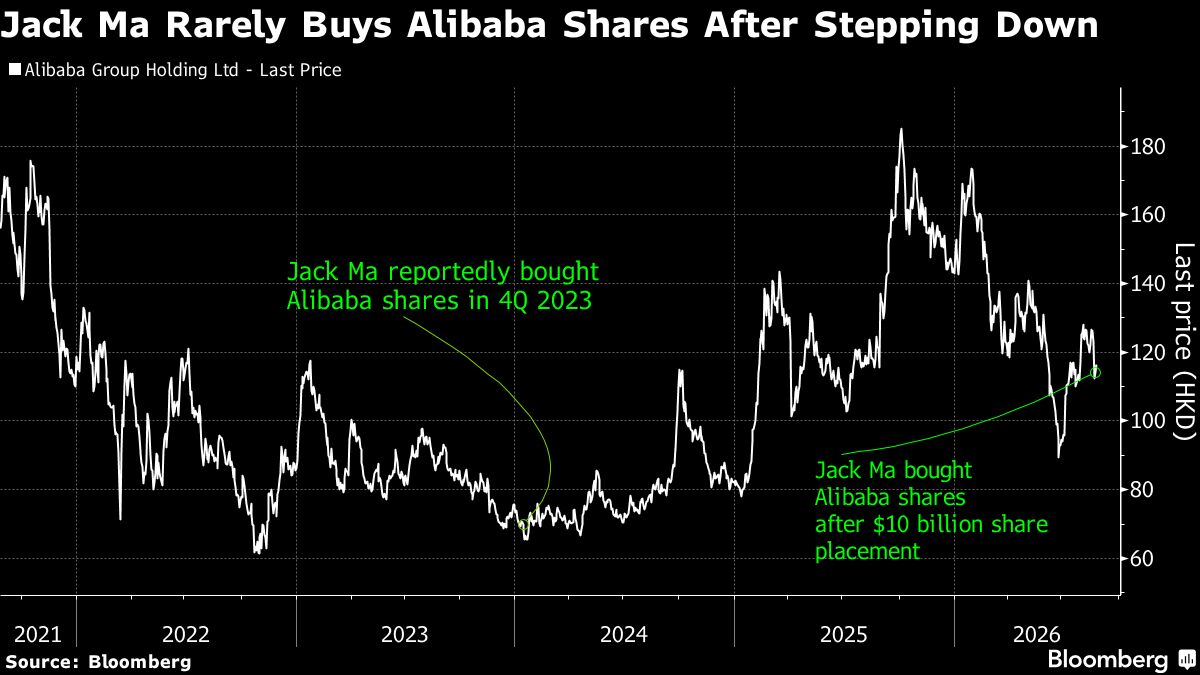
(Bloomberg) -- Alibaba Group Holding Ltd.'s ( BABA ) efforts to revive sentiment after its $10 billion share placement has failed to dispel investor concerns over how it chose to finance its AI ambition.
Lutnick's Intervention in Canada Talks Draws Praise, Blame
Apple Gears Up to Launch Its First New Mac Mini in Two Years
Xi Signals Defiance as US Threatens Sanctions Over Iran Help
US Weighs More Trade Measures Against Canada After Retaliation
Bessent's Mentor Druckenmiller Calls Bond Buying a Mistake
Co-founder Jack Ma and some of Alibaba's most senior executives have stepped in to buy shares, seeking to restore confidence after the deal triggered a major selloff. Yet the stock remains nearly 6% below its pre-deal close — a bigger drop than the 3%-3.5% earnings dilution analysts estimate from the share sale.
Muted investor response to the buying spree — with shares rising about 3% over two sessions after a 8.5% drop — suggests unease over the Chinese tech giant's decision while doubts linger over the AI outlay payoff. Moreover, Alibaba carried out the placement over a weekend through a Regulation S deal, limiting the offering to non-US investors. That narrowed the pool of potential buyers and may make the shares harder to resell quickly.
"Buybacks are now a common feature across most China Internet companies, so they are unlikely to serve as a meaningful differentiator for Alibaba," said Gary Tan, a portfolio manager at Allspring Global Investments. "Our sense is the market's reaction is driven more by the way Alibaba chose to raise capital than by the fundraising itself."
In January 2024, Alibaba shares surged after reports that Ma bought $50 million worth of shares in the previous quarter.
Yet the experience of other Chinese tech companies suggests they're no guarantee of a rebound. Xiaomi Corp., for example, is about 25% lower since founder Lei Jun bought shares in the open market in November. Tencent Holdings Ltd. also struggled to win back investors in 2022 and 2023 despite its massive buyback program.
The fundraising underscores Alibaba's willingness to spend to stay ahead of the artificial intelligence race, with its planned outlays coming closest among China's biggest technology firms to those of US peers. The company said in an emailed response to Bloomberg that the placement was intended to "extend the company's global AI leadership," with all of the net proceeds earmarked for its AI capabilities and infrastructure.
For shareholders, the bigger question is whether all that AI spending will pay off. Investors globally are already asking that, with Nvidia Corp.'s earnings this week a key test of the AI trade. Chinese tech firms like Alibaba may face an even higher bar.
Topics in this story
Gathered from external sources. Rights to this text belong to whoever originally published it.