Operator-chairs reshape mid-cap IT boardrooms
India’s mid-cap IT firms see 2026 chairman churn as AI disruption, PE pressure and consolidation drive demand for operator-chairs with scaling expertise.
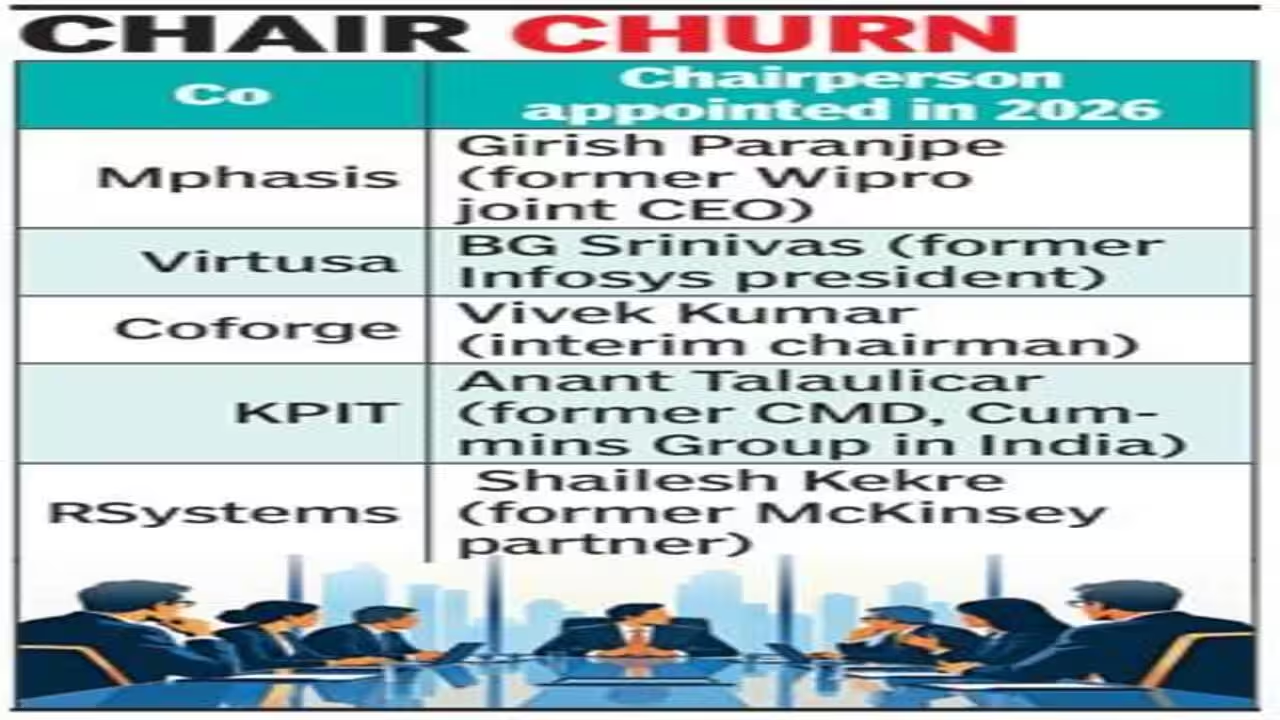
Bengaluru: India’s mid-cap IT sector is seeing a churn in board leadership, with at least five chairman-level changes in 2026 as companies navigate a disruption trifecta — AI reshaping the services model, PE pushing for growth and scale, and consolidation redrawing the competitive landscape.The shift is also bringing tech operators into the boardroom — executives who have built and scaled multi-billion-dollar businesses and are now being tapped to help companies navigate a technology and business-model reset.The stakes are higher as the $315 billion Indian IT services sector faces its biggest operating-model reset in decades, putting pressure on the pyramid structure. These operators bring hard-won experience of managing global clients, large teams, acquisitions and multiple technology cycles — allowing boards to challenge conventional assumptions and push management harder on growth, the AI game, pricing and differentiation.Former Infosys president BG Srinivas has taken over as chairman of private equity firm EQT-backed IT firm Virtusa, which has set an aspiration to reach $5 billion by 2030-31.Blackstone-backed Mphasis appointed former Wipro joint CEO Girish Paranjpe as chairman in January. Coforge, with PE investor Advent International among its shareholders, saw chairman OP Bhatt resign in September following concerns raised by an internal audit over the company’s board evaluation process. Vivek Sharma was appointed interim chairperson.Anant Talaulicar was appointed chairman of KPIT Technologies in July following the passing of co-founder and former long-time chairman Ravi Pandit. Talaulicar was chairman and managing director of the Cummins Group in India from March 2004 through October 2017. RSystems also overhauled its board this year, appointing former McKinsey partner Shailesh Kekre as chairperson.Phil Fersht, CEO of HFS Research, said what is different about this wave is that the chair’s job has become commercial rather than ceremonial. Clients are starting to demand outcome-based pricing, private equity owners want a credible plan for non-linear growth, and founders of mid-sized firms like Indium, Apexon and Virtusa need someone who has already sat across the table from a Fortune 500 CIO and lost a deal.“An operator-chair brings the scar tissue that a career banker or academic cannot, and my sense is that boards have worked out that a technology cycle this fast rewards judgment earned in the field over judgment earned in the boardroom,” he said.Venkat Shastry, managing partner at leadership advisory firm QuantumV, said very few Indian executives have run a billion-dollar technology P&L and are also genuinely board-ready.“Chair and senior advisory mandates are increasingly scoped with the same rigour as CEO searches. The trend of the operator-chair is becoming evident. With AI compressing technology cycles, and private equity readjusting its investment cycles and theses in response, boards may find it valuable to have leaders who have run and scaled businesses, rather than those with a purely advisory or governance background.” Shastry said, however, that this model succeeds only when the operator-chair coaches and challenges without running the business.Fersht said the risk, of course, is that experienced operators simply bring the playbook of the last cycle into a market that is writing a completely new one.“The best of these chairs understand that their value is not in recreating what worked 10 or 20 years ago, but in asking management much harder questions about AI, talent, pricing and where future value will come from.”Pranshu Upadhyay, regional director at Michael Page India, said the real challenge for organisations today is not defining strategy but ensuring the leadership capability, depth and readiness to deliver it at speed.“Boards that once focused mainly on oversight are now asking for something more: experienced operators who can advise founders and management teams on growth, scaling and portfolio choices as business models evolve,” he said.“That is also why we see this as a shift from pay-led attraction to growth-led leadership. Senior leaders want impact, and broader responsibility, and organisations need a structured way to bring that capability into the room. Operators who have scaled large technology businesses offer exactly that,” Upadhyay added.You use AI every day. Now get your AI Quotient. Take the AIQ test.
Topics in this story
Gathered from external sources. Rights to this text belong to whoever originally published it.