Why the young are restless: Their college degrees aren’t paying off
These young people borrowed money based on a promise. Now the payments are due, and the promise is turning up empty.
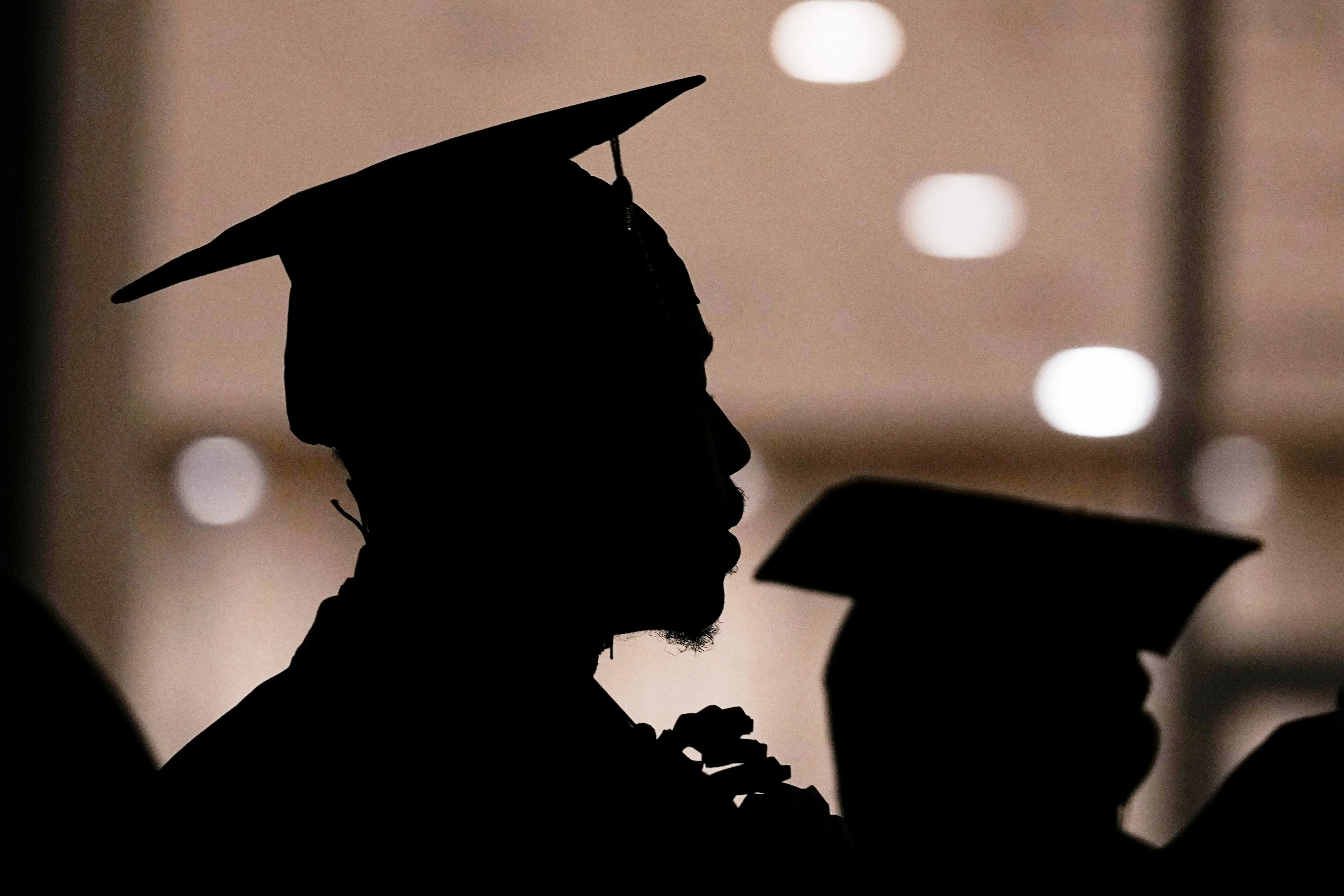
Over the summer, the Miami Herald told the story of a young man named Camron Drummond. In June, he found himself standing in line at a South Florida job fair in Amerant Bank Arena, holding a red folder filled with resumes. Employers at the fair included the Army, the Navy and several police departments. He was looking for IT work — “literally anything,” he told the newspaper.
Since graduating, he estimated he had applied to hundreds of jobs . By the time the piece went to press, six employers had gotten back to him — three just to say no. The furthest he got was the final stage of a customer service interview with a budget airline. Then the company stopped responding.
In the meantime, Drummond was working for DoorDash about seven hours a day, bringing home roughly $300 a week. He was crashing at his brother’s place, facing the prospect of having to start repaying $20,000 in student loans.
The New York Fed reported that unemployment for Americans ages 22 to 27 with bachelor’s degrees was 5.6 percent in the second quarter of this year. Unemployment for 20-to 24-year-old college grads hit 9.7 percent in July — a post-pandemic high — before falling back to a still-high 7.8 percent last month.
With regard to tech employment specifically, a recent Stanford study found that employment among early-career workers in the most AI-exposed occupations, including IT, has fallen by nearly 20 percent. For someone who studied computer science to build a secure career, that is a hard reversal.
Drummond put it this way: “When I stepped into the real world, it hit me like a truck.” Many young people share that feeling. They borrowed money based on a promise. Now the payments are due, and the promise is turning up empty.
Both political parties are trying to reach these voters. Democrats have largely framed the young as people whom a system has failed. Republicans have argued that the economy is strong and that many people underestimate how well they are doing. “You think you’re poor? You’ve never had it so good!”
Each message has part of the truth, but neither answers the question Drummond is asking: how does a graduate turn the degree he borrowed for into work that uses it?
Drummond did find work. Eleven days after the job fair , he received an offer for a customer service job at a car rental company, paying a little over $18 an hour. Relatively low unemployment means that jobs are there — just not the kind he wants. He is working, but he still hopes to return to technology.
The real problem is not that jobs in the field are scarce. The problem is that the path from a degree to a career is no longer certain like it once was. It has become slow, uneven, and too dependent on luck.
The point is not that college degrees have no value. Unemployment among college graduates over 25 years old was 2.5 percent last month — almost impossibly low, far lower even than the 4.4 percent unemployment rate among those with only high school degrees and no college. But the point is that too many young people are paying a lot of money and taking on debt for a route to a career that no longer reliably exists. A 22-year-old college graduate laden with debt may not be able to afford taking the same job that a debt-free high school graduate can work without worrying.
In 2024, Republicans very clearly understood where young men were listening. In the final stretch of the 2024 race, President Trump went on a string of podcasts and YouTube shows followed mostly by young men, including Theo Von, Logan Paul, and the Nelk Boys. Reuters reported that Trump had embraced new media more fully than Kamala Harris did.
He then sat down with Joe Rogan, whose audience is about 80 percent male, with 51 percent between 18 and 35. The Trump campaign treated these shows as a way to reach men who were skeptical of politics and had no interest in the cable news format. Whatever you think of the content of those conversations, the campaign identified a place where young voters were already spending their time and showed up there.
Importantly, Democrats had the same opening and didn’t take it. Harris’s team reportedly spoke with Rogan’s staff about an appearance, but the sit-down never happened. Former Democratic candidate Andrew Yang said before Election Day that the Harris campaign had mishandled the Rogan interview by not doing it. Harris did appear on other shows, but the contrast was clear. Republicans went to where young men were, and Democrats often waited for those men to come to them.
Democrats seem to have learned their lesson for 2026, whereas Republicans seem to have forgotten theirs.
The lesson for 2028 will not be to copy the format. The next candidate who wins this audience will need to do more than book with famous podcast host. Some of the hosts who backed Trump in 2024 have since turned turned against him .
Voters who feel talked down to will notice candidates who only perform and don’t actually care. The candidate who wins will need a message that answers the economic anger in Drummond’s story and then shows up consistently, before, during, and after the campaign.
What does this mean? Well, put simply, it means taking the young man’s frustration seriously. A podcast appearance can get a candidate in the door. It cannot get a graduate a job. The candidate who can speak plainly about the cost of the degree, the shrinking entry-level market, and the debt that follows, and who offers a concrete plan to fix it, will have a real advantage. The 2024 podcast strategy shwed that young men can be reached. The 2028 question is whether anyone can give them a reason to stay.
Dr. Liberty Vittert Capito is a professor of the practice of data science at the Olin Business School at Washington University in St. Louis.
Topics in this story
Gathered from external sources. Rights to this text belong to whoever originally published it.