85-year-old man sought to evict his son and daughter-in-law from self-acquired Delhi home, but authorities rejected plea over lack of proof of harassment; Delhi High Court overturns their orders and gives couple four weeks to vacate
Can children forcefully continue to live in their parents’ self-acquired property if the latter ask them to vacate?
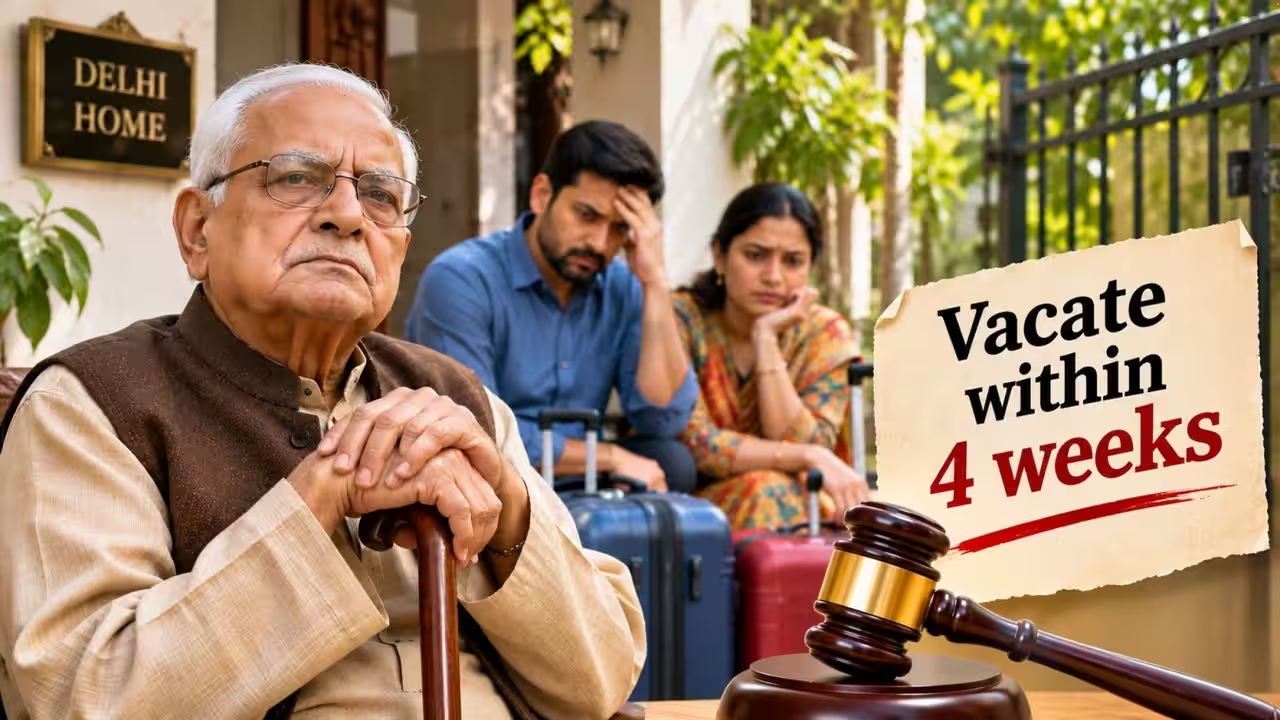
Can children forcefully continue to live in their parents’ self-acquired property if the latter ask them to vacate? An 85-year-old man has secured relief with the Delhi High Court asking his son and daughter-in-law to vacate the property.The court held that a senior citizen seeking eviction under the Maintenance and Welfare of Parents and Senior Citizens Act, 2007, does not necessarily have to prove that his children have ill-treated him.What the case is aboutAn elderly man owns a flat which he acquired from the Delhi Development Authority in 1980 and converted it into freehold in 2000. His eldest son and daughter-in-law had been living there since their marriage in 2003.The man claimed that he had asked the couple to arrange alternative accommodation after his second son married in 2005 and his youngest son married in 2008. He alleged that the couple refused to leave, that their behaviour towards him deteriorated over the years and that they stopped supporting him financially. He further claimed that their harassment intensified after his wife died in November 2020.The father alleged that in 2022, the couple threatened him and assaulted his youngest son. He said he filed a police complaint and subsequently approached the authorities under the 2007 Act, seeking eviction and maintenance.The District Magistrate rejected his application in 2023, observing that the allegations had not been proved and that the Act was being used to resolve a business dispute between the sons.The father appealed and in June 2025, the Divisional Commissioner set aside the original order and sent the matter back for reconsideration because the first inquiry had not determined whether the complaint was genuine.A fresh enquiry report again concluded that harassment had not been established. The District Magistrate rejected the application and the Divisional Commissioner upheld that decision in April 2026.The father then approached the Delhi High Court. His counsel argued that, as the property's absolute owner, he was entitled to live there peacefully and that proof of ill-treatment was not a prerequisite for eviction.The respondents disputed his account. Their counsel argued that the complaint had been made at the instance of the father's younger son amid a business dispute between the brothers. They also maintained that they had been looking after the father and had offered to pay him Rs 15,000 a month as maintenance.Why Delhi High Court asked son & daughter to vacateThe Delhi High Court noted that the father's ownership was undisputed. The son and daughter-in-law had not claimed ownership rights over the property and were living there because of their relationship with him. The father had also made it clear that he no longer wished to share his home with them.The court relied on the Supreme Court's August 4, 2026, decision in Ravi Kant Gupta v. State of Uttar Pradesh & Ors., which recognised that tribunals under the Senior Citizens Act could order eviction where necessary to protect a senior citizen.It also referred to the Delhi High Court's earlier ruling in Pritam Singh v. Government of NCT of Delhi & Ors., which recognised that proof of ill-treatment was not invariably necessary if the property needed protection so the senior citizen could live peacefully.The court found that the authorities had made proof of harassment an essential condition without considering whether the property needed protection.It criticised the first enquiry report for being inconclusive, observing: “A report which is, on its own showing, inconclusive could not have formed the basis of a finding that the allegations of harassment stood disproved.”The authorities had also failed to adequately consider the father's repeated police complaints and an earlier High Court direction requiring the police to assist him against any threat from the respondents.The existence of a business dispute between the brothers, the court said, could not by itself justify rejecting the father's grievance.As the judgment put it: “Merely because there may also exist a business dispute between the sons of the petitioner, the same, by itself, cannot be a ground to hold that the grievance of the petitioner is not genuine, or to deny him the protection afforded under the Act.”Ultimately, the High Court held that an elderly parent should not be compelled to share his home against his wishes when the relationship has deteriorated to the point of prolonged litigation.The Delhi High Court observed: “At the age of 85 years, the petitioner is entitled to live in his own house peacefully and with dignity.”The court set aside the Divisional Commissioner's order and the District Magistrate's order. It directed the son and daughter-in-law to vacate the property within four weeks and instructed the concerned Station House Officer to provide the necessary assistance if required.Adnan Siddiqui, Partner at King Stubb & Kasiva, told ET that father prevailed before the Delhi High Court because he is the absolute owner of the DDA flat.Neither his son nor his daughter-in-law has any independent interest in the property, as they were permitted to live there only with his consent. After the father decided that they could no longer stay in the flat because of the harassment he had faced, the Delhi High Court upheld his decision.Siddiqui says: "This case is significant as it highlights that, in addition to aspects relating to property, the entitlement of older people to live in their own home is also associated with their safety, and both mental and physical wellbeing."Money habits form by age 7. Is your child learning the right ones? Join the TOI Money Masterclass.
Topics in this story
Gathered from external sources. Rights to this text belong to whoever originally published it.