From Aden to Sanaa, Yemenis struggle to deal with soaring living costs
As fighting intensifies, Yemenis face a deepening economic crisis, with unpaid salaries and rising prices.
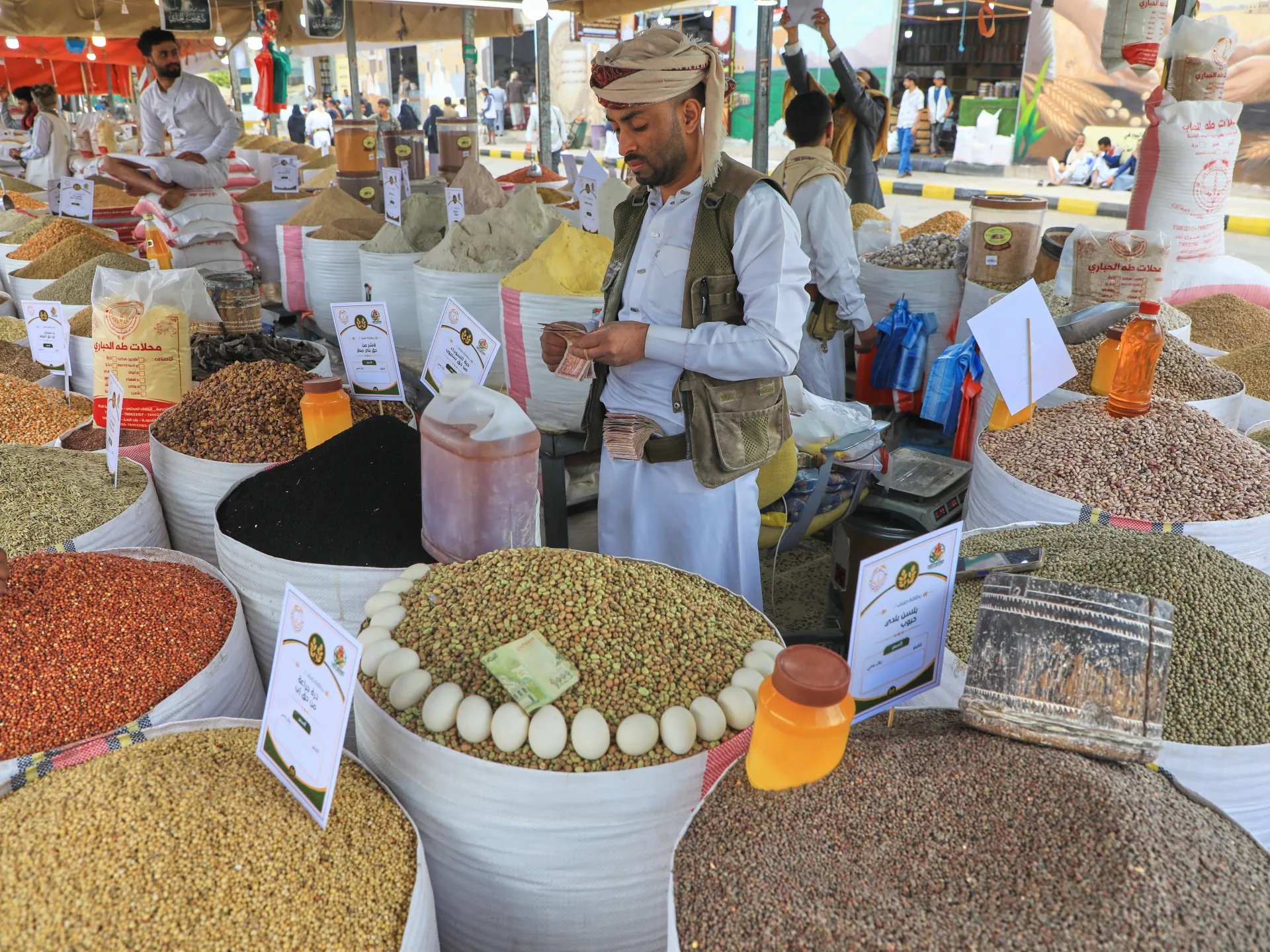
Sanaa, Aden and Marib, Yemen – As fighting intensifies across Yemen between the government and the Houthis, millions of people are confronting another battle far from the front lines: the deteriorating living and economic conditions in the country.
With salaries for large segments of the workforce either unpaid or irregularly disbursed – and the prices of goods and services rising – Yemen’s economic struggles have been compounded by a divided banking system that has made moving money between different parts of the country increasingly complicated.
From Aden’s struggling shoppers to displaced families in Marib and unpaid public-sector workers in Sanaa, Yemenis are being forced to make difficult choices about what they can afford, and what they must go without.
In Aden, the internationally recognised Yemeni government’s interim capital in the south, the problem is not so much a shortage of goods in markets as people’s inability to afford them.
Salaries have failed to keep pace with the rising costs of food , rent, healthcare and transport , leaving workers with little money left over at the end of the month.
The consequences are evident in the smaller quantities and cheaper products that now make up shoppers’ baskets, and the decisions they are forced to make about what to cut back on.
Bushra Abdullah Abdulwarith is a government employee in Aden. She earns 78,000 Yemeni riyals ($50) a month at the black market exchange rate while typical household food costs in government-held areas run about 130,366 riyals ($83), according to estimates by the Yemen Economic Tracking Initiative. And that’s before she factors in the cost of rent, transport, healthcare and other household expenses.
The economic difficulties facing Yemenis like Bushra illustrate how more than a decade of war has devastated the economy. According to the World Bank, real GDP per capita has fallen by approximately 58 percent since 2015.
The fragmentation of Yemen’s monetary institutions between the government and the Houthis – who have operated their own institutions since seizing the capital, Sanaa, in 2014 – along with the disruption of oil exports, and declining international assistance have all contributed to the economic decline.
Bushra told Al Jazeera that rising prices have forced many households to give up almost all non-essential purchases and cut back on some expensive basics, particularly meat. Other families, she said, have resorted to buying food in smaller quantities, sometimes on credit or loans.
The impact of rising prices is reflected not only in economic figures but also in the way people shop.
Ayman al-Maqtari, who works at a shopping centre in Aden’s Mansoura district, said that his customers now rarely buy non-essential items.
When it comes to the essentials such as rice, sugar, flour, and cooking oil, he has noticed that customers size up the price of each item before putting it in their baskets. They are also buying smaller quantities, for example, opting for a 5kg (11 pound) over a 40kg (90 pound) bag of rice.
“Many people have come to live day by day, or week by week,” Ayman told Al Jazeera, adding that more families are buying on credit when they run out of money before the end of the month.
The decline in purchasing power is also affecting commercial activity.
Across several streets and shopping centres in Aden, advertisements for discounts and special offers have become increasingly visible in shop windows and on retailers’ social media pages, as businesses attempt to attract customers and boost sales.
Weak demand, retailers say, is particularly evident for items that households can put off buying, such as clothing and household goods. A growing share of family income is spent on food, rent, healthcare and transport.
The Yemeni government approved a 20 percent cost-of-living allowance in May for public-sector employees in an attempt to ease the pressure of rising prices. But the amount is calculated based on each employee’s base salary, rather than their total pay, meaning the actual increase is relatively small for many workers.
Bushra, the government employee in Aden, said the increase has done little to improve her family’s financial circumstances. She described the allowance as “a temporary painkiller that does not reflect the scale of the actual pressure on people’s living standards”.
Her experience is far from isolated. In early October, the World Food Programme said its latest monitoring in accessible government-controlled areas showed that 74 percent of households were unable to meet their basic food needs.
One of the places where the crisis is evident is Marib , a government-controlled city east of Sanaa that is home to hundreds of thousands of displaced people. The sharp increase in the population over the war years, in what was previously a provincial backwater, has led to pressure on the city’s housing, employment and public services.
Government employees in Marib see their salaries disappear within the first few days after being paid, labourers struggle to find more than a few days of work and displaced families are forced to choose between buying water and milk.
Salah al-Zuhaifi works for a government institution in Marib. He said the war has separated him from his parents, who live in Houthi-controlled territory.
Alone in Marib, al-Zuhaifi said that inflation had eroded much of his salary’s purchasing power.
“No matter how much you earn, it will not be enough to meet your needs,” he said.
Abu Mohammed Nasser al-Asbahi, another government employee, described a similar struggle.
He told Al Jazeera that he earns 400,000 riyals ($250) a month, but more than half of that goes towards his rent, leaving little for his other expenses.
“We don’t even get to the first one-third of the month before the salary is gone,” he said, explaining that his family spends the rest of the month relying on loans and credit from local shops.
The healthcare sector in Marib has also been affected by widespread household spending cuts.
Pharmacist Khaled Mohsen told Al Jazeera that the rising price of medicines has prompted many patients to decline parts of their prescribed treatment and purchase only what they consider most essential.
People with chronic illnesses, meanwhile, have increasingly begun reducing their medication doses to make their supplies last longer before having to buy more, which creates serious health risks.
Residents of Sanaa and other areas of Yemen’s populous northwest, controlled by the Houthis – an armed group also known as Ansar Allah (Arabic for Supporters of God) – since 2014, are also facing a worsening economic and cost-of-living crisis similar to that affecting Yemenis elsewhere in the country.
Several factors are driving the crisis, particularly unpaid public-sector salaries, declining purchasing power, rising prices for goods and services, and the continuing consequences of the division of Yemen’s currency and banking systems in the early years of the war.
Many public-sector employees in Houthi-controlled areas have gone years without receiving regular salaries, with some sectors only receiving limited payments or half-salaries at irregular intervals.
Even when payments are made, they cannot cover families’ basic needs amid the rising cost of living.
Meanwhile, private-sector workers and business owners face growing pressures as a result of declining economic activity, multiple fees and levies, and a shortage of employment opportunities. The conditions have undermined incomes and job security.
The Yemeni riyal’s exchange rate in Houthi-controlled Sanaa is more stable than in areas controlled by the government. The Houthis have imposed strict monetary controls, banning the circulation of newer banknotes printed by the Yemeni government, and have also enforced a largely fixed exchange rate.
However, that does not necessarily translate into stronger purchasing power. Markets face difficulties caused by cash shortages and the division between monetary and banking systems operating in different parts of the country, including increased costs for moving funds.
That directly affects the many households relying on domestic and international remittances.
For residents in Houthi-controlled areas, the result is an economy in which the currency may be relatively stable, but livelihoods are precarious. Years of unpaid salaries and limited employment opportunities have left many families struggling to afford basic necessities, with few options beyond borrowing, cutting spending or relying on support from relatives.
Topics in this story
Gathered from external sources. Rights to this text belong to whoever originally published it.