A diverse product mix and new markets to match at INNOPROM India
At INNOPROM India, the discussion about diversifying trade took on a tangible form.
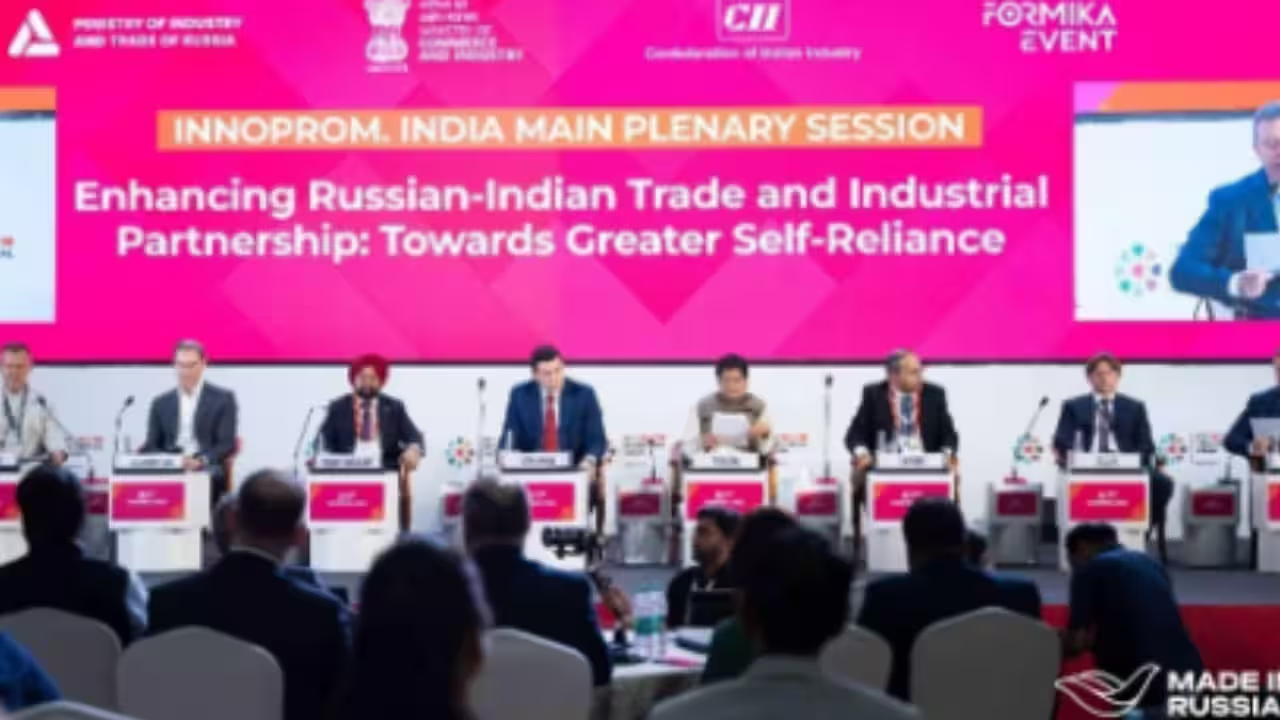
At INNOPROM India, the discussion about diversifying trade took on a tangible form. In a single exhibition hall, Russian excavators and truck cranes stood alongside glass insulators for high-voltage lines, endoprostheses, industrial warning systems, and materials for road construction.These products have different markets, different buyers, and different paths to market. But they share one question: what new connections can be built between Russian manufacturers and India’s growing market?The inaugural edition of the industrial trade fair was held between September 9–11 at Bharat Mandapam, New Delhi. The Russian Export Center brought a business mission of 23 companies to the exhibition. The delegation's geographic reach stretched from Moscow and St. Petersburg to the Chelyabinsk, Samara, Tomsk, Novosibirsk, and Sverdlovsk regions. What defined the mission was the number of industries represented — sectors that had rarely appeared together in a single narrative about Russia–India economic cooperation.Russia and India have long described their relationship as a Special and Privileged Strategic Partnership. In recent years, that partnership has been accompanied by a sharp increase in trade: bilateral trade reached $68.7 billion* in the 2024/25 financial year, while the first half of 2026 showed another 8% increase. By 2030, the two countries aim to bring bilateral trade to $100 billion.Russian exports are still dominated by oil and petroleum products, fertilizers, coal, vegetable oils, and precious metals. India, for its part, supplies Russia with pharmaceuticals, chemicals, steel, and seafood, although the trade balance remains heavily skewed. The challenge, therefore, is broader than simply increasing the total value of trade: the relationship needs more product categories, more companies, and more joint projects on both sides.The exhibition floor at INNOPROM India offered a glimpse of what that expansion could look like. SDM (United Machinery Group) presented road-construction machinery; Sinara Transport Machines showcased solutions for high-speed railways; UMEK presented high-voltage insulators; and CITO displayed endoprostheses and trauma-care products.Nearby, Indian partners were introduced to tire-pressure monitoring systems from RD Group, industrial warning equipment from Armtel, and asphalt-concrete modifiers from Stilobit.An assortment like this is difficult to reduce to a single sales pitch. Each solution has its own procurement, testing, and approval cycle. That is why the value of an industrial exhibition begins where the presentation ends: standing beside an actual product, buyers and engineers can discuss load requirements, standards, after-sales service, localisation, and potential pilot applications.The day after INNOPROM India closed, the main program of the 18th Brics Summit began in New Delhi, running from September 12–13. India placed four themes at the heart of its Brics chairmanship: resilience, innovation, cooperation, and sustainable development. As the grouping marked its 20th anniversary this year, the discussion about its future increasingly focused on implementation and practical cooperation. The economic agenda included tools closer to the daily needs of companies, while Brics members agreed on a framework for cooperation on logistics and supply chains. The Indian chairmanship also introduced the Brics SME Cooperation Portal, a network of incubators, and an initiative to support startups. At the Brics Business Forum, Prime Minister Narendra Modi called for identifying the main trade barriers within the grouping and creating new business partnerships among companies each year.For Russian and Indian businesses, this represents a shift in scale. Supply-chain resilience does not begin with an abstract diagram. It starts with a handful of practical questions: where to find a supplier, how to verify that a product meets local requirements, which route to use for shipping, and whom to contact after delivery. For a smaller manufacturer, navigating that process alone can be difficult. A business platform, a reliable local operator, and the opportunity to demonstrate a working product can therefore shorten the distance between initial interest and substantive negotiations.On September 11, ahead of the summit’s official opening, Narendra Modi and Vladimir Putin discussed implementation of the Programme of Economic Cooperation till 2030. The leaders also highlighted the first INNOPROM. India and then visited the exhibition, where they spoke with participants.The exhibition ended on September 11, but the business infrastructure created around it did not disappear with the exhibition stands. On August 21, India’s first permanent “Made in Russia” national pavilion opened in Navi Mumbai1. Its first exhibitors presented food products, beverages, and consumer goods. The Indian operator, RAI FAMILY CORP LLP, is responsible for promotion, logistics, and working with local sales channels.New Delhi and Navi Mumbai are clearly addressing different parts of the same challenge. At INNOPROM India, an engineer or procurement specialist can examine machinery and industrial solutions. At the pavilion, a buyer or retailer can sample a product and discuss supplying it to a retail network. The common denominator is the “Made in Russia” national brand program for promoting Russian products, implemented by the Russian Export Center. The ecosystem combines voluntary certification with exhibitions, business missions, and permanent platforms abroad.Contracts ultimately depend on price, quality, standards, and delivery terms. Now that dialogue has a clearer address and a more defined sequence: a manufacturer can begin with a business mission, continue with technical discussions, provide samples, test demand through a local operator, and prepare a commercial proposal for a specific partner.The headline figures in Russia–India trade have been built on products the two countries have traded for years. The next chapter will be visible in other indicators: the number of Indian companies using Russian industrial solutions and the number of Russian brands becoming familiar to local consumers.September 2026 has brought these efforts together across three platforms — INNOPROM India, the Brics Summit, and the “Made in Russia” national pavilion in Navi Mumbai.Disclaimer - The above content is non-editorial, and TIL hereby disclaims any and all warranties, expressed or implied, relating to it, and does not guarantee, vouch for or necessarily endorse any of the content.References:* use AI every day. Now get your AI Quotient. Take the AIQ test.
Topics in this story
Gathered from external sources. Rights to this text belong to whoever originally published it.