Trump trade rules apply differently to China, Canada, and Xi, Carney
President Trump heads into his summit with Chinese President Xi Jinping this week on the heels of waging a bruising trade war with Canada that has badly damaged relations with that country. It’s a stark contrast from how he’s handled trade talks with China, a rival nation that many in Congress see as an enemy…
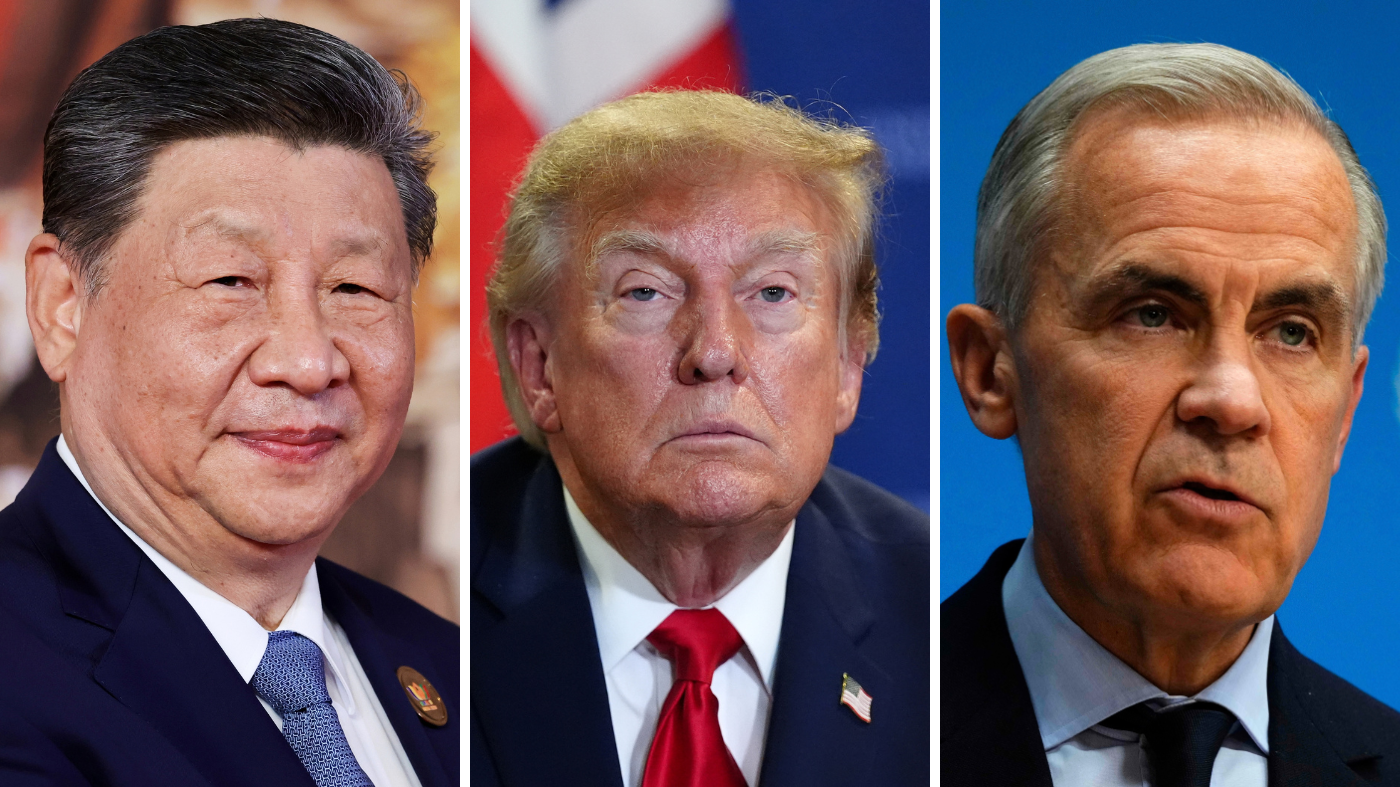
President Trump heads into his summit with Chinese President Xi Jinping this week on the heels of waging a bruising trade war with Canada that has badly damaged relations with that country.
It’s a stark contrast from how he’s handled trade talks with China, a rival nation that many in Congress see as an enemy of the United States, but that is the world’s second-largest economy .
While Canada has long been a U.S. ally, Trump has a frosty relationship with Canadian Prime Minister Mark Carney. With China, Trump has long touted his relationship with Xi, which he has described as strong.
The different approaches make sense in the context of Trump. He sees China as offering more to the U.S., and he wants Beijing’s cooperation on a host of other issues, from Iran to the Russia-Ukraine war .
But it is also an example of Trump’s great-powers approach to economic and foreign policy.
“The administration’s approach to China and Canada has diverged sharply, and leverage helps explain why,” Aarathi Krishnan, the founder of Raksha Intelligence Futures, told The Hill on Wednesday.
“China holds cards Washington cannot easily replace, particularly in rare earth processing, agricultural demand and global manufacturing,” Krishnan added. “That constrains how far the White House can push and has produced a more calibrated, transactional approach to Beijing.”
Multiple Republican lawmakers, including Sens. Susan Collins (R-Maine), have raised concerns about the president’s trade war with Canada.
Sen. Roger Wicker (R-Miss.) did not mention the U.S.-Canada tariff dispute on Tuesday during remarks on the Senate floor. Instead, the Senate Armed Services Committee chair blasted Xi ahead of his visit to Washington.
“Quite frankly, had the White House asked me for advice, I would have suggested the president not invite Xi Jinping to Washington for such a lavish welcome here in the United States of America,” Wicker remarked .
The summit comes less than two months before a Nov. 10 deadline for the U.S. and China to extend a trade truce the sides reached last year.
White House spokeswoman Anna Kelly defended Xi’s visit in a statement to The Hill.
“President Xi hosted President Trump in China for a historic summit this summer, and President Trump is reciprocating his hospitality by welcoming the Chinese delegation for a reciprocal visit this week. The President will forge relationships with anyone in order to advance our national interests and make good deals for the American people,” Kelly said.
Ahead of Xi’s arrival in the states, U.S. Trade Representative Jamieson Greer and Treasury Secretary Scott Bessent met with Chinese Vice Premier He Lifeng on Sunday in New York City. A day after that gathering, Greer acknowledged that while the two sides made “headway,” officials needed more time to hash out an extension of the truce.
“My expectation is we’ll continue talking, and I think both sides want it,” Greer told host Annmarie Hordern on “Bloomberg Surveillance.”
When Hordern later asked the trade representative about a three- to six-month extension, he said that was “probably the right” range.
Bessent also offered a peek behind the curtain at his and Greer’s meeting with He, saying Monday the impending deadline was a “focal point” of discussions.
“In Beijing, this notion of a, what we call a 30 by 30 trade deal for noncritical goods was floated,” Bessent told host Joe Kernen on CNBC’s “Squawk Box,” referencing Trump and Xi’s last summit in May.
Under such a deal, the U.S. and China would reduce tariffs on $30 billion worth of noncritical goods each country imports from the other, Bessent noted.
That would mean U.S. businesses would export more agricultural goods, energy-related products and medical devices to China, while Beijing would purchase more “everyday items” from America, the Treasury secretary remarked.
Bessent also met with He on Wednesday in Washington, D.C., and wrote on the social platform X their discussions centered on “securing meaningful commitments that protect American workers, farmers, and businesses.”
How the president and his officials have approached trade talks with China differs greatly from their attitude toward Carney and Canada amid a North American trade war .
After Carney called out trade discussions last month, Trump’s 50 percent tariffs on $27.6 billion worth of Canadian goods went into effect — applying to roughly 7 percent of the $382 billion U.S. businesses imported from Canada last year.
Carney responded in kind, matching American tariffs “dollar for dollar” earlier this month. Trump then doubled down, signing executive orders to ban the sale of Canadian dairy products, motor vehicles and many alcoholic beverages starting Sept. 29.
Trump has spent his second term mocking Canada and expressing interest in annexing the country. The president also called America’s northern neighbor a “terrible trade partner” last week.
The Canadian prime minister, meanwhile, has used the trade war to shift his focus to strengthening relationships with other Western nations.
European Commission President Ursula von der Leyen has proposed that Canada join the European Union as an associate member, while Carney argued earlier this month the era of Canadian “dependence” on America was over .
“For the past year and a half, we’ve been steering our economy towards trusted partners,” Carney said in a video message his office released on the day the retaliatory tariffs went into effect.
The Trump-Carney tensions contrast with how the president has characterized his relationship with Xi dating back to his first term.
While he has slapped tariffs on Chinese imports as far back as 2018, Trump has sought to forge closer ties with Xi on the likes of critical minerals and the Iran war — despite Beijing’s longtime economic and military alliance with the Islamic Republic.
Bessent highlighted Trump and Xi’s “very good relationship” on Monday, saying on CNBC the two leaders “have great respect for each other.”
Wicker said Tuesday that Trump will “rightfully” discuss trade and artificial intelligence with Xi, noting the possibility for the two leaders to make “progress” on those issues.
But the Mississippi Republican urged the president to “keep in mind that his guest is a brutal, unelected and oppressive dictator,” during the summit, which kicked off Wednesday with Trump greeting Xi at Joint Base Andrews.
Trump’s decision to meet Xi at the base also underscores his differing approaches to world leaders.
Julian Gewirtz, who worked in the State Department during former President Biden’s administration, said Trump’s embrace of Xi is part of a “pattern,” in which the president “views Xi Jinping, [Russian President] Vladimir Putin, these autocratic leaders of large states as his peers, as leaders who merit this degree” of respect.
“Whereas, of course, the leaders of traditional U.S. allies do not get this kind of treatment,” Gewirtz said on Wednesday’s episode of “The President’s Inbox” podcast, adding he does not think “we’re ever going to live to see the day when President Trump greets Mark Carney on a tarmac.”
The second of four meetings in 2026 between the leaders of the United States and China is unlikely to produce any major breakthroughs.
Despite Trump’s courting of Xi, analysts are not certain the two sides will extend the trade truce. Krishnan put the odds of a predeadline extension around 70 percent, arguing neither side “has much to gain from returning” to prior tariff rates.
“An extension would preserve a period of relative stability rather than resolve the underlying contest,” she wrote.
Topics in this story
Gathered from external sources. Rights to this text belong to whoever originally published it.