India’s barrier-free tolling explained: No more stopping as FASTag & number plate recognition will help collect toll automatically
A few years ago, India introduced FASTag to make toll collection across its highways and expressways digital and cashless.
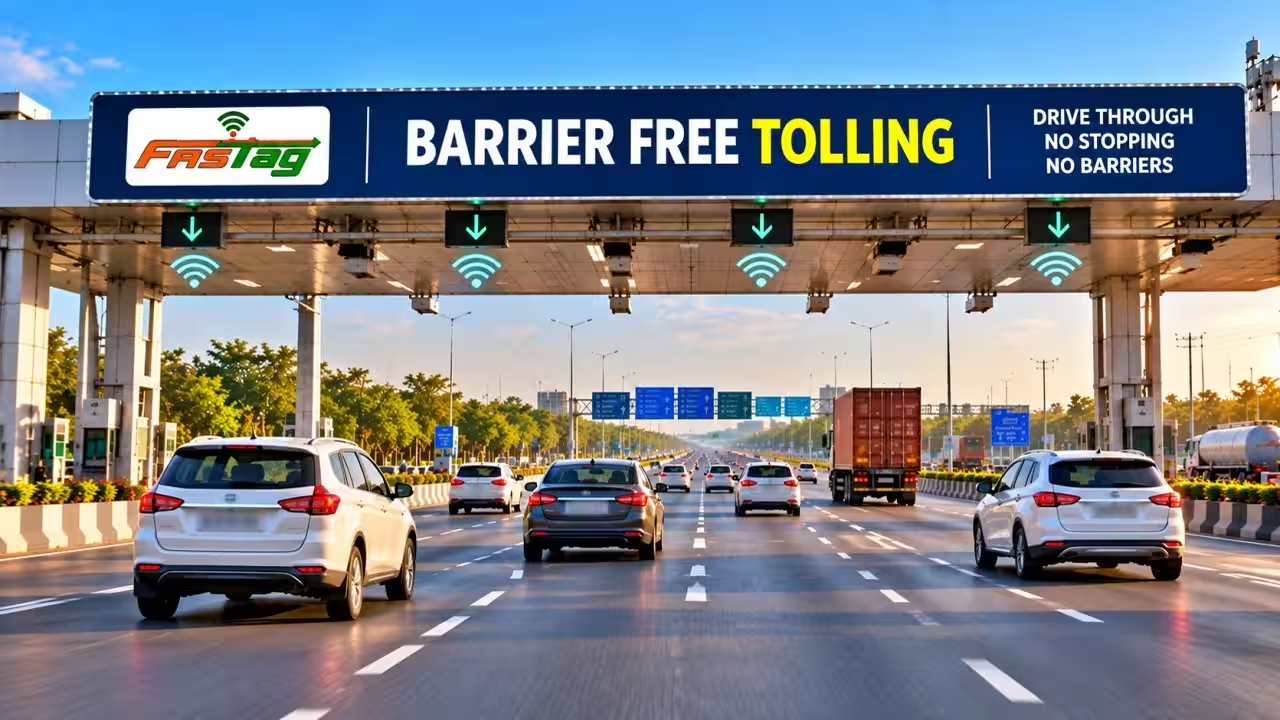
A few years ago, India introduced FASTag to make toll collection across its highways and expressways digital and cashless. Now, it is looking to make the process barrier-free or toll plaza free. Imagine zipping through highways and not stopping at toll points, but instead a system that will automatically cut toll from your FASTag.The government is rolling out the Multi-Lane Free Flow (MLFF) technology on national highways.Barrier-free tolling is seen as the next step after FASTag. While FASTag made toll payments digital, vehicles still need to slow down and pass through toll lanes and barriers.With barrier-free tolling, vehicles can move through at normal highway speeds while cameras and FASTag systems identify the vehicle and collect the toll automatically.Road Transport and Highways minister Nitin Gadkari recently said that the aim is to make toll booths on national highways barrier-free by March 2027. Gadkari has said that over 70% of toll booths will have the MLFF system by December end.According to this TOI report, the Economic Survey 2025-26 had projected a rollout timeline of March 2029 for the MLFF tolling across all National Highways that are four-lane or more, and all high-speed corridors.From FASTag to barrier-free tollingFASTag has become the backbone of electronic toll collection. According to the Ministry of Road Transport and Highways, more than 98% of user-fee collection now takes place through FASTag.The system has also evolved beyond simply automating payment at conventional toll plazas. The government introduced a FASTag-based Annual Pass for non-commercial cars, jeeps and vans from August 15, 2025.For 2026-27, the pass costs Rs 3,075 and allows travel through National Highway and National Expressway fee plazas for one year or up to 200 crossings, whichever comes first.FASTag is now also the payment component of India's shift towards barrier-free tolling.What is a barrier-free tolling system and where has it been implemented?How the system works is simple: With a combination of Automatic Number Plate Recognition (ANPR), AI analytics, and FASTag-based electronic toll collection, it replaces the conventional physical barriers that currently act as a speed bump on your ride.This allows toll to be charged without vehicles stopping, slowing down or remaining in a designated lane. The system identifies the vehicle that has crossed a chosen point and the toll is automatically deducted from the FASTag and the user gets a message.The technology, however, does not mean drivers can simply pass without having a functioning payment mechanism. Highway users need to maintain sufficient balance in their FASTag accounts.If a FASTag has insufficient balance or is invalid or non-functional, an electronic notice, or e-Notice, is issued for non-payment. The normal user fee has to be paid within 72 hours.If it is not paid within that period, the charge rises to twice the normal user fee for the vehicle category.E-Notices can be accessed and paid through the designated National Highway fee portal, while grievances can also be raised within the prescribed period.If there is a case of non-payment, it can result in FASTag blacklisting and restrictions on certain vehicle-related services through VAHAN.The first major rollout of the new barrier-free tolling system came in May this year at the Chorayasi Toll Plaza on the Surat-Bharuch section of NH-48 in Gujarat.Since then, several sections of national highways have seen the rollout of the new MLFF system.What are the benefits?The current system takes at least 20 seconds to process each toll transaction, while MLFF will let vehicles cross tolling points at 80-85 kmph, eliminating waiting and the need for extra lanes.According to the government, the new system will help reduce travel time and congestion, improve fuel efficiency, lower vehicular emissions and reduce human intervention in toll operations.The system is designed to allow vehicles to move through the tolling point without stopping, thereby reducing waiting and improving traffic flow.According to Gadkari, the full implementation of FASTag will lead to up to Rs 25,000 crore per year to the government."When the system will go fully live, then our department alone would deliver a benefit of Rs 20,000-25,000 crore per year to the Government of India because of the use of FASTags," Gadkari recently said.The government estimates that wider adoption of MLFF could reduce annual toll collection operating costs from nearly 15% to around 3-4%, potentially saving about Rs 5,000-6,000 crore a year. It also estimates annual fuel savings of nearly 250 crore litres and a reduction of around 81,000 tonnes of carbon emissions.Jagannarayan Padmanabhan, Senior Director and Global Head-Consulting, Crisil Intelligence explains that while the basic payment system remains similar, the way toll plazas operate changes significantly. The focus moves from managing booths and queues to managing technology, vehicle identification and digital enforcement.“The biggest benefit of barrier-less plazas will be smoother traffic movement. Vehicles will no longer need to slow down, stop or queue at toll plazas. This can reduce travel time, fuel consumption and congestion, especially on busy highway stretches,” Jagannarayan Padmanabhan tells TOI.Not only that, there can also be savings in the cost of collecting tolls.FASTags have reduced cash handling, but toll plazas still require booths, barriers, manpower, electricity and maintenance.According to Padmanabhan, barrier-free tolling can reduce many of these costs by shifting toll collection to cameras, sensors and centralised digital systems.However, Padmanabhan cautions that the extent of savings realized by concessionaires and operators will ultimately depend on factors such as traffic volumes, technology deployment and maintenance costs, as well as the effectiveness of toll violation enforcement and recovery mechanisms.The CRISIL expert notes that aggregate ETC data from six operational MLFF toll plazas through August 2026 also highlights several noteworthy trends.Of the total ETC collections at MLFF plazas, approximately 6% was recovered through e-notices. During May and June, e-notices accounted for around 12.5% of total transactions and 8.5% of collection value. In comparison, the corresponding figures for July and August moderated to 8.7% of transactions and 5.5% of collections, respectively. “While the operative period remains relatively short, the observed trend suggests an improved efficacy,” he says, adding that the long-term outlook for MLFF tolling remains positive, supported by the government's accelerated rollout plans and the potential for improved network-wide efficiency.“Nevertheless, sustained success will depend on effective management of operational risks, minimization of revenue leakage, and robust enforcement of toll violation penalties to ensure revenue protection and user compliance,” he adds.Raghav Madan, Partner at Deloitte India points out that this will be a significant upgrade over the existing FASTag system.“NHAI has a proven history of implementing new technologies such as FASTag and with the trials of MLFF over the last year, the industry is quite confident this system can be implemented successfully. Rather than solely looking at the financial and economic impact, I see this initiative as another step by NHAI in improving user experience across National Highways, signalling a shift in the organization from “Highway Builder” to “Highway Manager”,” he tells TOI.For you, the biggest visible change will be straightforward: the toll plaza will remain, but the need to stop will disappear. The payment of toll will continue through FASTag, while ANPR will help identify the vehicle as it moves through the tolling point.(With inputs from Dipak K Dash, TNN)You use AI every day. Now get your AI Quotient. Take the AIQ test.
Topics in this story
Gathered from external sources. Rights to this text belong to whoever originally published it.